
Reviewed · PARIS
Les Coulisses DE UNESCO
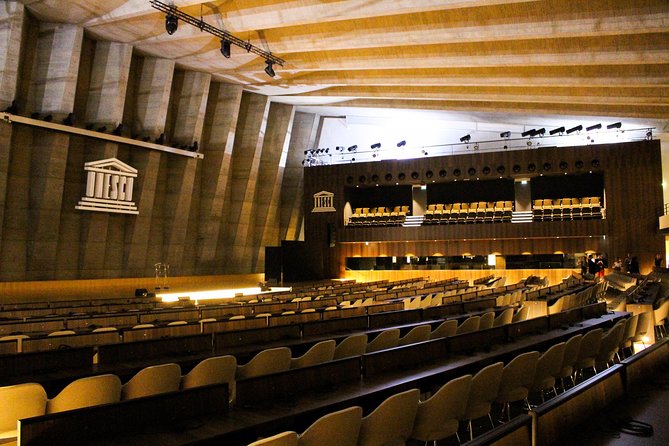
UNESCO House is not a standard museum visit. You enter the Paris headquarters of the United Nations Educational, Scientific and Cultural Organization and see the working spaces behind its public mission. The modern concrete corridors, footbridges, and enormous conference rooms give the visit its unusual character.
I like two things here. First, the tour links art to UNESCO’s work instead of treating each painting or sculpture as an isolated object. Second, you get access to spaces that most Paris sightseeing skips, including the square with its symbolic Globe and rooms built for international events. The main consideration is length: at about 90 minutes, this is a focused visit, not a full-day look at every part of the complex.
Key points at UNESCO House
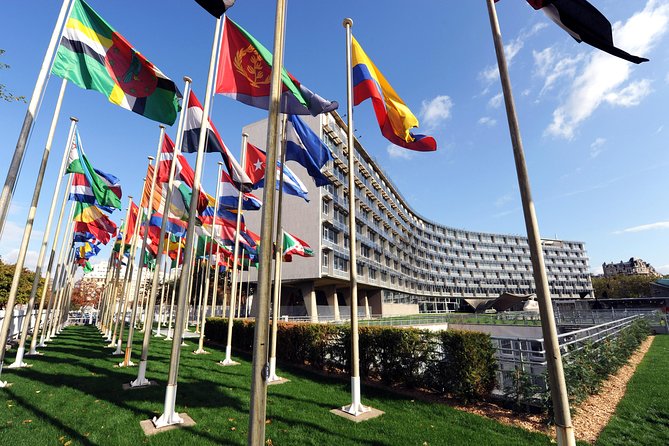
- Tour UNESCO’s working headquarters: See conference rooms, corridors, footbridges, and shared spaces inside the international organization’s Paris base.
- Look for major modern artists: Works by Alexander Calder, Pablo Picasso, and Alberto Giacometti appear along the route.
- Understand UNESCO’s mission: Your guide explains the agency’s projects, purpose, and effect while you move through the building.
- See the symbolic Globe: The Globe on the square is one of the tour’s memorable visual stops.
- Expect a small group: The maximum is 20 people, which should make it easier to hear the guide and ask questions.
- Plan around a 90-minute visit: Transport is not included, but the site is near public transportation.
Why UNESCO House makes an unusual Paris stop
Paris has no shortage of famous museums, churches, and grand monuments. UNESCO House offers something different: a look at an international institution through its building, public spaces, and art collection.
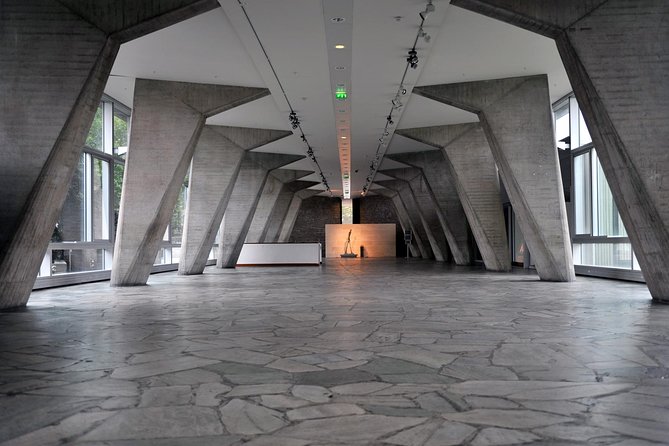
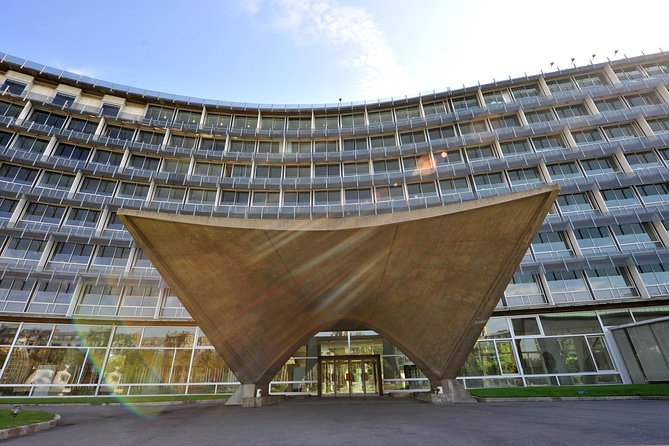
The headquarters was designed to communicate modern ideas. Its concrete passages, open footbridges, broad rooms, and strong geometric forms are part of the experience, not just the setting. You are not simply walking from one artwork to another. You are seeing how architecture can reflect an organization built around education, science, culture, and cooperation between countries.
That gives the visit a useful sense of place. UNESCO can sound abstract when you hear about it in the news or read its name beside a World Heritage site. Inside its headquarters, the organization becomes easier to picture. The building hosts international events and meetings, and your guide explains how those spaces relate to UNESCO’s work.
I would choose this tour if you have already seen several traditional Paris museums and want an experience with a more institutional, modern feel. It also suits anyone interested in architecture, international affairs, or public art.
Other Paris outings people book alongside this one:
- Paris: Louvre Museum Timed-Entrance Ticket
★ 4.6 · 71,977 reviews - Disneyland® Paris 1-Day Ticket
★ 4.6 · 49,412 reviews - Paris: Versailles Palace and Gardens Full Access Ticket
★ 4.6 · 41,579 reviews
Entering the UNESCO building in the heart of Paris
The experience begins at the UNESCO building in the 75007 area of Paris. The exact meeting point is listed as Île-de-France, 75007 Paris, France, and the tour returns to that same point at the end.
The visit is guided rather than self-directed. Your guide leads you through the headquarters and explains what you are seeing along the way. That matters here because the building may be more interesting once you know why its rooms, corridors, and open areas were designed as they were.
The tour is offered in English and lasts about one hour and 30 minutes. A group limit of 20 people keeps it from feeling like a large procession. You still should not expect a private tour, but this is a manageable size for a building where the guide’s explanations are central to the experience.
The headquarters is near public transportation, although transport itself is not included in the price. You will need to make your own way there and allow enough time to arrive before the start.
The architecture: concrete, bridges, and open space
The building’s architecture is one of the strongest reasons to book. The route includes concrete corridors and footbridges that give the headquarters a distinctly modern appearance. These are not polished, old-Paris interiors. The mood is more functional, bold, and international.
That contrast can be refreshing. Paris sightseeing often means carved stone, historic facades, and formal rooms. At UNESCO, you get a different visual language: structural concrete, large meeting spaces, and paths that connect the building’s main areas.
The guide helps you read these details. Without explanation, a concrete passage might seem like a way to get from one room to another. With context, it becomes part of the building’s identity and its connection to postwar modern architecture.
There is also a garden area along the visit. The grounds add a break from the indoor corridors and make the headquarters feel less like a sealed office complex. The garden is described as magnificent, but the supplied details do not specify how much time you spend there, so I would treat it as an important stop rather than the main focus of the tour.
The conference rooms built for world events
The large conference rooms are another highlight. UNESCO’s headquarters hosts events of international importance, and the tour brings you into spaces designed for that scale of gathering.
This is where the organization’s mission becomes most visible. A conference room is not just a handsome interior. It is a place where representatives meet, discuss cultural and educational concerns, and work across national borders. Your guide connects the physical room with UNESCO’s projects and role as a specialized United Nations agency.
One of the meeting rooms has been singled out as particularly impressive. The available information does not give the room’s official name or explain its seating arrangement, so I would not promise a specific chamber when booking. Still, the scale and purpose of these rooms give the visit a feeling that a normal museum cannot provide.
If you enjoy seeing places that still serve an active public function, this part should appeal to you. The headquarters is not presented only as a historic monument. It remains tied to international work.
Same city, a completely different afternoon:
- Paris: Evening River Cruise with Music
★ 4.4 · 22,721 reviews - Paris: Eiffel Tower Entry Ticket with Optional Summit Access
★ 4.4 · 20,035 reviews - Paris: Eiffel Tower Summit or Second Floor Access
★ 4.3 · 17,248 reviews - Paris: Louvre Guided Tour with Reserved Access & Boat Cruise
★ 4.3 · 16,353 reviews
The Globe and the headquarters square
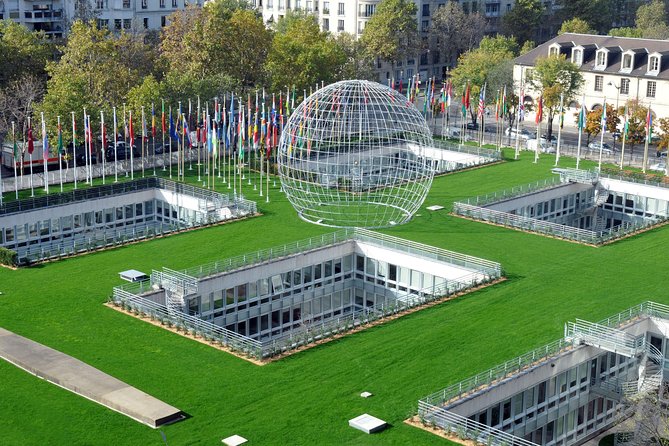
The route also reaches the square where you can see UNESCO’s symbolic Globe. It is a simple but effective visual marker for the organization’s worldwide reach.
The Globe gives the tour a clear center. After hearing about UNESCO’s work across borders, you encounter a physical symbol of that global outlook. It also helps break up the more technical architectural portions of the visit.
I like this kind of stop because it gives you a detail to remember after the tour. The building’s concrete passages and broad conference rooms may blend together if you are not interested in modern architecture. The Globe offers an easier image to carry with you.
Do not expect a city panorama or a classic Paris viewpoint. The appeal is symbolic, not scenic. This is about UNESCO’s international role rather than a sweeping view over the capital.
Calder, Picasso, and Giacometti outside a museum
Art appears throughout the headquarters, and the tour includes works connected with artists such as Alexander Calder, Pablo Picasso, and Alberto Giacometti. The collection is discussed as part of the building and UNESCO’s mission, rather than displayed in the quiet, controlled format of a major museum.
That setting changes how you see the art. A Picasso or Giacometti sculpture in a museum usually arrives with a long wall label and a carefully arranged gallery. At UNESCO, the work shares space with corridors, meeting rooms, and an institution devoted to cultural cooperation.
The guide comments on the pieces and places them in the larger story of the headquarters. This is especially helpful if you recognize the artists but do not know much about a particular work. You get enough context to understand why modern art belongs in this setting.
The supplied description refers to a collection of works by major artists of the 19th century, while the named artists are associated with modern and contemporary art. I would focus less on the exact label and more on the practical point: you will see important modern art integrated into an active international building, not a conventional museum display.
This portion will be especially rewarding if you prefer art with a story about place and purpose. If you want a large collection or a long period of quiet viewing, choose one of Paris’s major museums instead.
What the guide adds to the visit
The guide is essential here. UNESCO House is not laid out like a standard attraction with a simple sequence of numbered rooms. You are depending on the guide to explain the organization, identify the important architectural features, and point out the artworks.
The tour covers UNESCO’s missions, projects, and impact. That broad explanation gives the building meaning. You learn not only what you are looking at, but why the institution exists and how its activities connect to education, science, culture, and international cooperation.
The guide also keeps the visit moving. Ninety minutes is enough time for a clear overview, but not enough for lengthy discussion at every artwork or conference room. If you have a specific interest, such as modern architecture or UNESCO’s cultural programs, prepare a question before you arrive.
The tour is offered in English. A French-language version has also been used successfully, but you should confirm the language option available for your chosen departure before booking. The English tour is the relevant choice shown in the supplied booking details.
Is $24.43 a fair price?
At $24.43 per person, this is not the cheapest way to spend 90 minutes in Paris. It is also not priced like a full museum day or a long guided excursion. The value depends on whether you want access and explanation, not simply a view from outside.
The admission ticket is included, as is the guided tour. Transport is not included, so your cost will be slightly higher if you need a taxi or public transit to reach the meeting point. Since the site is near public transportation, getting there should fit into a normal Paris sightseeing plan.
I see the price as reasonable for three reasons. You enter a headquarters that is not part of the usual tourist circuit, you get guided context for a major institution, and you see art by famous names in an unexpected setting. The small maximum group of 20 also adds value compared with a crowded walk-by visit.
The price is less convincing if you are mainly looking for famous paintings or classic Paris architecture. The art collection is a feature of the route, not the whole point. You are paying for the combination of building, institution, art, and guide.
Who should book this UNESCO visit?
I would recommend it to:
- People interested in international organizations and world affairs
- Fans of modern architecture and postwar concrete design
- Art lovers who enjoy seeing works by Calder, Picasso, and Giacometti outside a museum
- Repeat visitors who want a different side of Paris
- Visitors who prefer a short, structured cultural activity
- Anyone who values a small group and a live explanation
I would think twice if you want a relaxed, self-paced visit. The tour follows a guided route and ends after about 90 minutes. It may also disappoint you if you expect access to every office or a detailed look at UNESCO’s full history. The supplied information promises key spaces, conference rooms, corridors, the square, garden, and artworks, but not unrestricted access across the headquarters.
The visit should work well as one part of a day in the 7th arrondissement. Since it returns to its starting point, you can continue with other plans afterward. No transport is built into the activity, so leave room for your own journey to and from the building.
Booking details and practical limits
Confirmation arrives at the time of booking. The activity is offered with a mobile ticket, which means you can keep the booking on your phone rather than needing a printed document.
Most people can participate, according to the supplied details. The tour is near public transportation, but no more precise accessibility information is given. If you need specific access arrangements, confirm them before paying because the route includes footbridges, corridors, conference rooms, and outdoor areas.
This experience is often booked around 28 days ahead. That does not guarantee that every date sells out, but it is a good reason to avoid leaving your plans until the last minute, especially if your Paris schedule is fixed.
Free cancellation is available if you cancel at least 24 hours before the start time. Cancellations or changes made less than 24 hours in advance are not accepted for a refund. The cut-off follows local Paris time.
Should you book Les Coulisses de UNESCO?
Book it if you want a concise look at Paris through international culture, modern design, and public art. The combination of UNESCO’s symbolic Globe, working conference spaces, and major modern artists gives you a side of the city that ordinary sightseeing rarely shows.
Skip it if your priority is a large art collection, a historic palace, or a flexible self-guided visit. At $24.43, the tour earns its price through access and interpretation. For the right audience, it is a thoughtful 90-minute change of pace. For someone chasing only the headline sights, it may feel too specialized.
FAQ
Where does the UNESCO tour take place?
The tour takes place at the UNESCO building in Paris, in the Île-de-France 75007 area.
How long does the tour last?
The visit lasts approximately one hour and 30 minutes.
Is admission included?
Yes. The guided tour and admission ticket are included.
Is transportation included?
No. Transport is not included, although the meeting point is near public transportation.
What language is the tour offered in?
The supplied booking information lists English as the available language.
How large is the group?
The activity has a maximum of 20 people.
What can I see inside UNESCO House?
The route includes conference rooms, the square with the symbolic Globe, footbridges, concrete corridors, a garden area, and artworks by artists including Calder, Picasso, and Giacometti.
Where does the tour end?
The activity ends back at the meeting point.
Can I cancel for a full refund?
Yes, if you cancel at least 24 hours before the experience start time. Cancellations or changes made less than 24 hours before the start time are not refunded or accepted.
Just added around Paris
- Private 1 – hour Tour: Eiffel Tower,Champs-Elysées Arc DE Triomphe★ 5.0 · 7 reviews
- Private Tour to Mont St-Michel and Honfleur from Paris★ 4.5 · 5 reviews
- Paris with a Tuk Tuk – Private 2-Hour TukTuk Tour★ 4.5 · 34 reviews
- Private Tour of Saint Germain des Pres★ 5.0 · 44 reviews
- Tripa Paris Pubcrawl / Bar Tours★ 5.0 · 16 reviews
- Paris city tour with private guide★ 5.0 · 9 reviews
- Paris Private Tour with Tuktukyourcity★ 4.5 · 38 reviews
- Private Mont Saint-Michel Trip by Mercedes from Paris with Lunch★ 4.0 · 10 reviews