
Reviewed · SEINE RIVER CRUISES
Paris: Cruise on The Canal Saint Martin and The Seine River
The unusual part comes first: you travel from leafy Canal Saint-Martin through locks and a long tunnel beneath the Bastille area before reaching the open Seine. I like that this gives you two very different views of Paris in one ride. I also like the finish at Quai de l’Horloge, close to Pont Neuf, where you can keep exploring on foot.
The main drawback is the mixed format. The canal section can feel slow if you only want famous monuments, and the tunnel takes up a large part of the roughly two-hour trip. Commentary may also be hard to hear when the boat is full, especially on the upper deck.
Key points to know before booking
- Locks and an underground tunnel: You’ll watch the boat rise and fall through canal locks, then sail beneath the Bastille area in a vaulted passage.
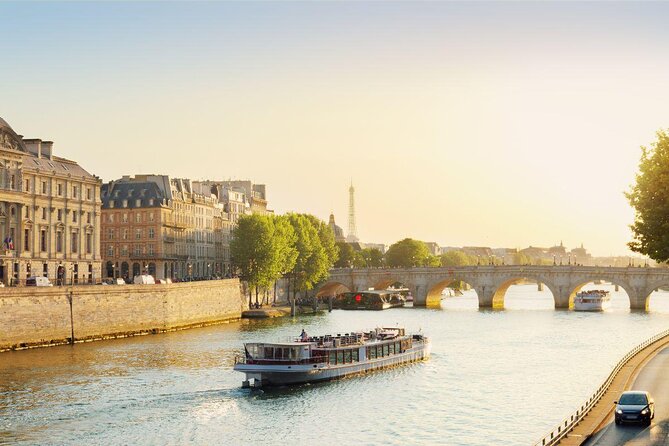
- Classic Seine sights: The open-water section passes Notre-Dame, the Louvre, Musée d’Orsay, Pont Alexandre III, Les Invalides, and the Eiffel Tower.
- A useful one-way route: Begin at 73 Quai de Valmy and finish at 19 Quai de l’Horloge near Pont Neuf.
- Commentary is part of the experience: Guides provide live historical information, with French and English used during the cruise.
- Large boat setting: The maximum is listed as 100 people, so this is not a small, quiet boat ride.
- Good value for a two-hour outing: At $42.05 per person, you pay for both an unusual canal journey and a standard Paris river cruise.
Why this Paris cruise feels different from a standard Seine ride
Most Paris boat trips begin and end on the Seine. This one takes a longer route, starting in the 10th arrondissement on Canal Saint-Martin before joining the river near Port de l’Arsenal.
That first section gives you a look at a part of Paris many people miss. The canal is lined with trees, iron footbridges, cafés, terraces, and old industrial buildings now used by modern businesses. You pass the famous Hôtel du Nord and see the canal as both a piece of working infrastructure and a favorite local hangout.
The canal was built to bring fresh water into Paris. Today, it also carries pleasure boats and provides a calm corridor through the city. I like this blend of engineering, neighborhood life, and history. You are not simply ticking off monuments. You are seeing how Paris grew around its waterways.
The route then changes character. After the locks and tunnel, the boat reaches the Seine, where the views become instantly familiar. The contrast is the point: first, a slow and slightly mysterious passage through the city, then the grand architectural parade along the river.
More Seine river cruises:
- Paris: Evening River Cruise with Music
★ 4.4 · 22,721 reviews - Paris: Louvre Guided Tour with Reserved Access & Boat Cruise
★ 4.3 · 16,353 reviews - Paris: Big Bus Hop-On Hop-Off Tour with Optional Cruise
★ 4.4 · 13,279 reviews
Starting at Canal Saint-Martin near Quai de Valmy
The meeting point is at 73 Quai de Valmy, near the canal in Paris’s 10th arrondissement. The boat is reportedly docked across from the meeting point, but allow extra time to find the exact boarding spot. Two low-rated experiences involved confusion over the address and a missed departure, so you should not cut this one close.
Arriving around 30 minutes early is sensible if you want an outside seat. The upper deck is the popular choice, but it can fill quickly. The lower cabin gives you shelter from sun, heat, and rain, though the best photo angles are usually outside.
This is a one-way cruise. You start near Canal Saint-Martin and finish on Île de la Cité, so plan your day around the end point rather than expecting to return to Quai de Valmy.
Canal locks, footbridges, and Hôtel du Nord
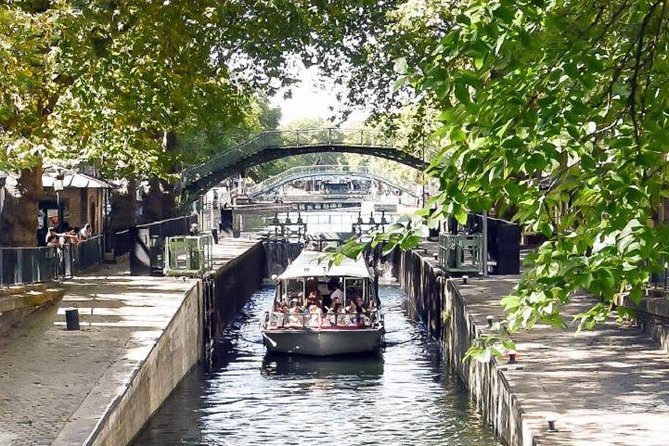
The boat eases along the canal beneath leafy trees and past busy waterside cafés. The setting feels less grand than the Seine, but it gives you a better sense of ordinary Parisian life. People walk along the quays, pause on the bridges, and gather at outdoor terraces.
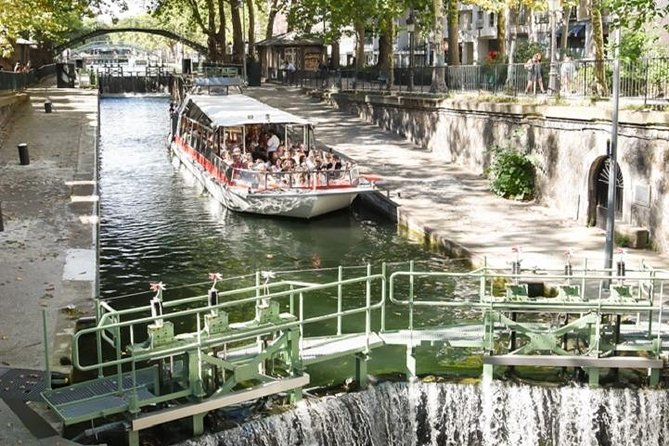
The first major event is the series of locks. As the boat enters each lock, gates close and the water level changes around you. The boat may rise or drop several metres before the next gate opens. One account specifically described a drop of about six metres, which gives you a useful idea of the scale.
This is also where the boat’s design and crowding matter. If you are on the upper deck, people tend to gather at the front, and it may be difficult to see the lock chamber clearly. Stay alert for an open spot along the side rather than assuming the very front is best.
The locks are the highlight for anyone interested in engineering or the working side of a city. Children often find the changing water level fascinating, although adults should keep an eye on young children near railings and the front of the boat.
The swing bridge and the canal’s working side
The boat continues toward a swing bridge, where road traffic stops briefly so the vessel can pass. It is a small but memorable piece of city theater. You see the canal functioning as a real transport route, not just as a scenic strip lined with cafés.
The guide explains how the canal operates and how its purpose has shifted over time. Industrial buildings, old port structures, modern boutiques, and waterside leisure areas appear close together. If you want only sweeping views, this section may seem modest. If you enjoy seeing how a city works, it adds useful context.
Commentary is offered in more than one language, and the bilingual format can affect the pace. Some passengers found the explanations clear and entertaining, while others found them difficult to hear or too long for the boat’s movement. If you want to follow every detail, sit near the speaker system and avoid the noisiest group areas.
Same city, a completely different afternoon:
- Paris: Louvre Museum Timed-Entrance Ticket
★ 4.6 · 71,977 reviews - Disneyland® Paris 1-Day Ticket
★ 4.6 · 49,412 reviews - Paris: Versailles Palace and Gardens Full Access Ticket
★ 4.6 · 41,579 reviews - Paris: Eiffel Tower Entry Ticket with Optional Summit Access
★ 4.4 · 20,035 reviews
The long tunnel beneath Bastille
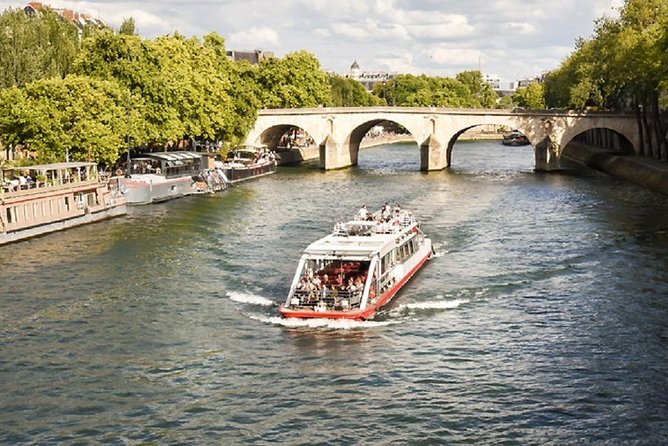
The canal then enters a long underground tunnel beneath the Bastille area. Daylight drops away, and shafts in the roof create occasional breaks in the darkness. The city noise fades, leaving the boat moving through a quiet, vaulted passage below historic streets.
This is the most divisive part of the cruise. I think it is the feature that makes the outing different from a regular Seine ride. You can see the canal’s engineering from the inside and experience a part of Paris that is impossible to understand from street level.
Still, the tunnel lasts long enough that you should know what you are choosing. If you want two straight hours of monuments and open sky, this route will feel inefficient. Some people find the underground passage fascinating, while others find it dull and would rather book a one-hour Seine cruise.
The practical tip is simple: choose this boat for variety, not speed. The tunnel is not filler if you enjoy infrastructure and unusual city views, but it is a poor fit if your only goal is photographing landmarks.
Port de l’Arsenal and the change to the Seine
The boat emerges at Port de l’Arsenal, a marina linking Canal Saint-Martin with the Seine. Houseboats and pleasure craft sit in the basin, and the former commercial port has become a calmer harbor and garden area.
This transition helps explain the route. The canal does not simply end beside the river. It connects into a wider network of waterways and city spaces, moving from an enclosed urban channel into a broad historic river.
From here, the scenery opens up. The boat passes Île Saint-Louis, with its elegant 17th-century façades, and approaches Île de la Cité, the historic center of Paris. The scale changes quickly. You move from narrow water and close walls to wide views framed by bridges and long riverbanks.
Notre-Dame, the Louvre, and the best photo stretch
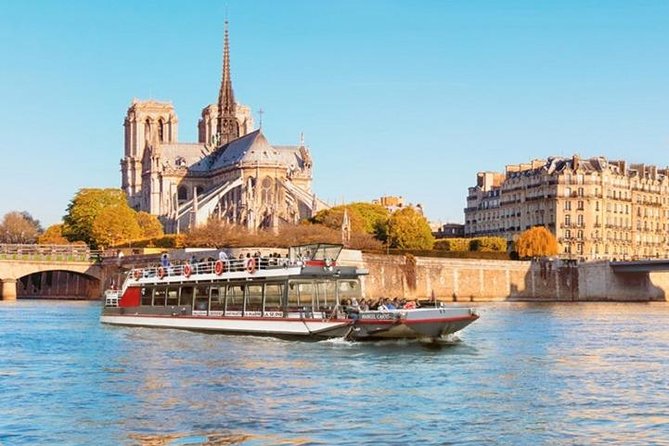
The Seine section supplies the classic Paris views. You pass Notre-Dame, the Conciergerie, the Louvre, the Tuileries gardens, and Musée d’Orsay. The boat offers a useful angle because you can see the full length of riverfront buildings rather than just one façade at a time.
Notre-Dame is especially striking from the water, as are the older buildings on Île de la Cité. The Conciergerie adds a darker note, with its medieval character and connection to the history of the French Revolution.
As the boat moves west, the Louvre’s immense river façade comes into view opposite the domed Institut de France. The Pont des Arts sits between them. From the water, you may be able to frame all three in one photograph, a particularly good moment for anyone who likes architectural views.
The open deck is the best place for photos, but it is exposed. In August, the top deck can become very hot, and there may be no comfortable dry place to sit. Bring water, protect yourself from the sun, and use the lower cabin if comfort matters more than an unobstructed view.
Pont Alexandre III, Les Invalides, and the Eiffel Tower
The boat passes beneath Pont Alexandre III, one of Paris’s most decorative bridges. Golden statues, ornate details, and Art Nouveau lamps make it one of the strongest views along the route.
Nearby, you can see the glass roof of the Grand Palais and the golden dome of Les Invalides across the river. These sights are easy to miss when walking because the city’s streets break them into separate views. From the boat, the river gives you time to see how the monuments relate to one another.
The Eiffel Tower arrives later, rising above the Champ de Mars and Trocadéro. This is the moment most people are waiting for, especially on an evening departure. If the timing is right, the tower will be lit and may sparkle during the cruise.
Do not book this particular ride only for the Eiffel Tower, since the exact light and sparkle timing depends on the departure. But the approach from the Seine gives you a strong, unobstructed view, and the long route means you have time to prepare your camera rather than spotting the tower for a few seconds from a street corner.
The route may also offer a view of the Statue of Liberty with the Eiffel Tower behind it, a less expected photo opportunity mentioned by one passenger. It is a reminder that Paris’s river views include more than the standard postcard scenes.
Commentary, seating, snacks, and group size
Live narration is an important part of the cruise. Guides explain the canal’s construction, the lock system, the tunnel, and the landmarks along the Seine. Guides named in positive accounts include Lea and Ben, while Pasquale was praised for handling the boat. Availability of a particular guide is not guaranteed.
The commentary is presented in French and English. That makes the outing accessible to a wider audience, but switching languages can make announcements longer and harder to follow. A sound system and background conversation can also affect how much you hear.
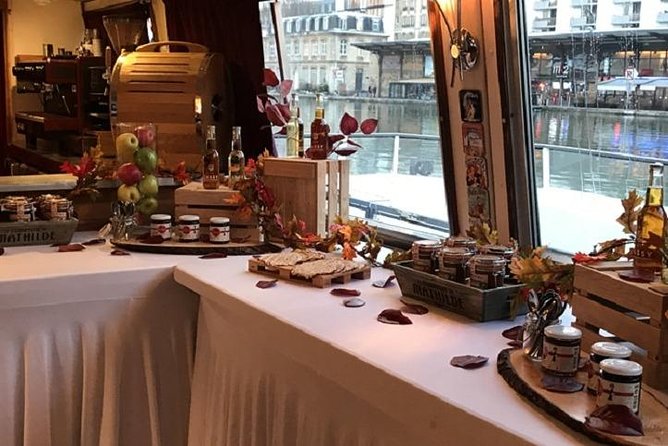
A concession stand sells drinks including soda, wine, beer, and juice. Some accounts also mention snacks such as crêpes. These extras are useful, but I would treat them as a convenience rather than a reason to book.
The boat can hold up to 100 people. That is a fairly large group, not a small personal tour. The benefit is a lively social setting and a lower price than a private boat. The tradeoff is noise, crowded upper-deck seating, and less direct access to the guide.
Is $42.05 good value for two hours?
At $42.05 per person, the price is reasonable if you want two experiences in one: the canal, locks, and tunnel, followed by the central Seine route between Notre-Dame and the Eiffel Tower.
A standard Seine cruise may be a better value for you if you care mainly about open-air monument views. Those boats often spend the full ride on the river, so you avoid the tunnel and get more continuous time beside the major sights.
This cruise earns its price through variety. You see a less familiar side of Paris, watch the boat manage real locks, travel underground, and still pass the city’s major landmarks. The value is strongest for a first visit when you want an easy overview without spending hours walking between distant sights.
At roughly two hours, it also gives you a useful break from museums and pavement. The end point near Pont Neuf makes it easy to continue with Sainte-Chapelle, the Latin Quarter, the Right Bank, or a riverside drink.
Who should book this cruise?
I would choose this experience if you like city infrastructure, unusual routes, historical commentary, and a mix of local neighborhoods with famous sights. Families may enjoy the locks, and photographers will appreciate the Seine views and the chance to see the Eiffel Tower from the river.
It also suits you if walking long distances is tiring. You can see Notre-Dame, the Louvre, Musée d’Orsay, Pont Alexandre III, Les Invalides, and the Eiffel Tower from one moving seat.
I would choose another boat if you dislike enclosed spaces, become uncomfortable in heat, or want a quiet, small-group experience. The tunnel is long, the boat may be crowded, and the sound system is not always easy to hear. The drop-off at Quai de l’Horloge may also involve steps up to street level, which can be awkward with a walker.
Arrive early, aim for about 30 minutes before departure, and expect the boat to be full. If bad weather cancels the trip, you can receive another date or a full refund. Free cancellation is available up to 24 hours before departure, but late cancellations and changes are not refunded.
Should you book it?
Book it if the idea of passing through canal locks and a historic underground tunnel sounds as appealing as seeing the Eiffel Tower. The Seine portion is familiar, but the Canal Saint-Martin route gives the whole outing a stronger sense of place and purpose.
Skip it if you want uninterrupted open-air views or a quiet boat with polished, easy-to-hear narration. For the right person, this is a good-value Paris sampler with real variety. For the wrong person, the tunnel will feel like time taken away from the monuments.
FAQ
Where does the cruise start?
The cruise starts at 73 Quai de Valmy, 75010 Paris, France, beside Canal Saint-Martin.
Where does the cruise end?
It ends at 19 Quai de l’Horloge on Île de la Cité, opposite the address and near Pont Neuf.
How long does the cruise last?
The cruise lasts approximately two hours.
Which Paris sights can I see from the boat?
You can see Notre-Dame, the Conciergerie, the Louvre, the Tuileries gardens, Musée d’Orsay, Pont Alexandre III, Les Invalides, the Eiffel Tower, and other river landmarks.
Does the cruise pass through a tunnel?
Yes. The boat travels through a long underground tunnel beneath the Bastille area after passing through the Canal Saint-Martin locks.
Is commentary available in English?
Yes. English is offered, and the live commentary is presented in French and English.
How far in advance can I cancel?
You can cancel up to 24 hours before the experience start time for a full refund. Cancellations or changes made less than 24 hours before departure are not refunded.
Just added around Paris
- Private Paris Marche d’Aligre Walking Tour with Tastings★ 5.0 · 8 reviews
- Private Louvre Museum Tour for Kids & Families with Alberto or his team in Paris★ 5.0 · 41 reviews
- Private Highlights of Paris Tuk-Tuk Experience★ 5.0 · 26 reviews
- Paris Latin Quarter Walking Tour: History & Culture – Small Group★ 5.0 · 14 reviews
- Private Highlights of Paris Bike Tour★ 4.5 · 15 reviews
- Paris Musee d’Orsay PRIVATE TOUR with a Local Private Guide★ 5.0 · 41 reviews
- Private Half Day Historic Tour★ 5.0 · 58 reviews
- Pere Lachaise Cemetery Paris – Exclusive Guided Walking Tour★ 5.0 · 72 reviews
Seine River Cruises, compared.
Louvre Guided Tour with Reserved Access & Boat Cruise
Read our review →
Big Bus Hop-On Hop-Off Tour with Optional Cruise
Read our review →
Tootbus Hop-on Hop-off with optional river cruise
Read our review →
Seine Cruise & Crepe Tasting near the Eiffel Tower
Read our review →
Louvre Museum Entry Ticket With Host and River Cruise
Read our review →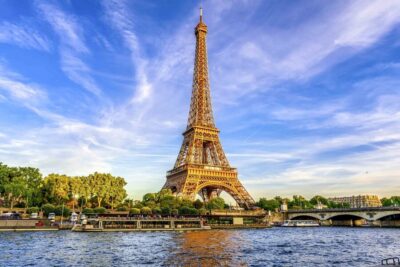
Eiffel Tower Access by Elevator & Seine River Cruise
Read our review →Browse the lists this tour appears in