
Reviewed · SEINE RIVER CRUISES
Paris World Fairs Walking Tour Top Sights Along the Seine River
Paris’s World Fairs changed the city in ways you can still see today. This two-hour walk follows that story from the Champs-Élysées to the Eiffel Tower, linking grand palaces, ornate bridges, modern art buildings, and riverside viewpoints. The fairgrounds are gone, but the ideas they introduced remain all around you.
I like the strong theme and the way it connects familiar sights to inventions, politics, and art. I also like the small group limit of 15, which gives you a better chance to hear the guide and ask questions. The main drawback is the brisk format: you spend only a few minutes at many stops, and admission to museums or monuments is not included.
Key points
- World’s Fair history with a clear route: Follow Paris’s international exhibitions from 1855 through 1937.
- A practical two-hour walk: Start near Champs-Élysées and finish at the Eiffel Tower.
- Guide Olivia is a strong fit for history lovers: Her approach combines facts with anecdotes and a lively sense of humor.
- Excellent photo stops: Pont Alexandre III, the Seine, Trocadéro, and the Eiffel Tower supply plenty of memorable views.
- Small group of 15 people maximum: Easier to hear the guide than on a large city tour.
- No museum admissions or food included: You pay for the guided walk and should plan any interior visits separately.
Why Paris’s World Fairs make a smart walking theme
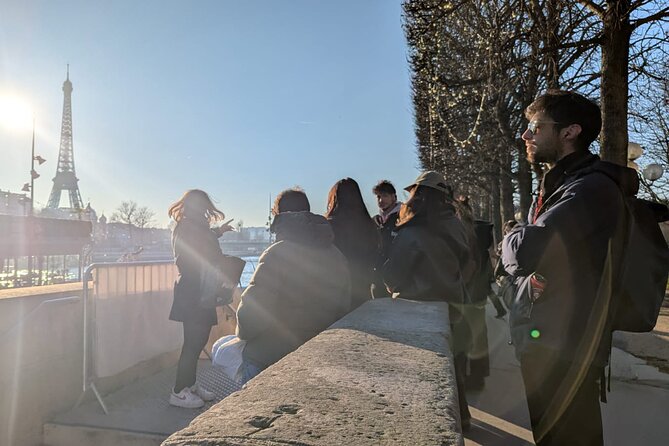
Paris can feel like a greatest-hits collection of monuments. You see the Eiffel Tower, Grand Palais, and Alexandre III Bridge, but it is easy to miss the reason they were built. This tour gives those sights a common thread: the international exhibitions that brought new machines, buildings, art, and political messages to Paris.
The World’s Fairs were not simply trade shows. They were giant public displays of national ambition. Countries presented new technology and artistic work, while Paris reshaped its streets and riverbanks to welcome huge crowds. The Seine connected many of these sites, so walking beside it gives the story a natural direction.
I find this theme especially useful if you have already seen the basic Paris sights. Instead of repeating the usual facts about Napoleon or the French Revolution, the tour asks you to look at the city through the age of industry, engineering, international competition, and public spectacle.
It also works well for a first visit. The route covers several major landmarks without requiring separate trips across the city. You will not enter every building, but you will learn how the buildings fit together.
More city highlights tours in Paris:
- Bateaux Parisiens Seine River Gourmet Dinner & Sightseeing Cruise
★ 4.5 · 6,930 reviews - Paris Seine River Hop-On Hop-Off Sightseeing Cruise by Batobus
★ 4.0 · 3,411 reviews - Paris Top Sights Half Day Walking Tour with a Fun Guide
★ 5.0 · 2,893 reviews
Starting at Champs-Élysées and the 1900 exhibition
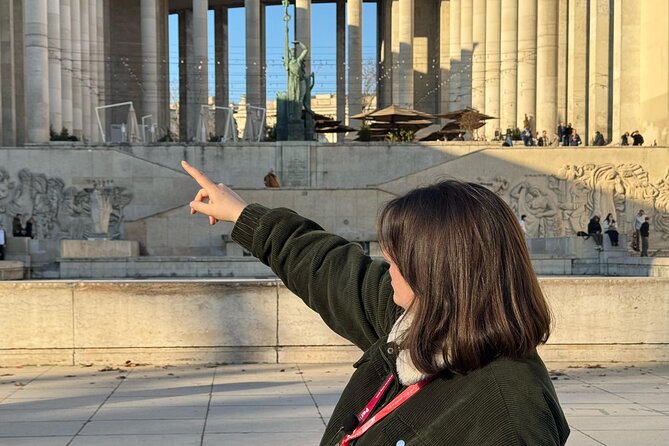
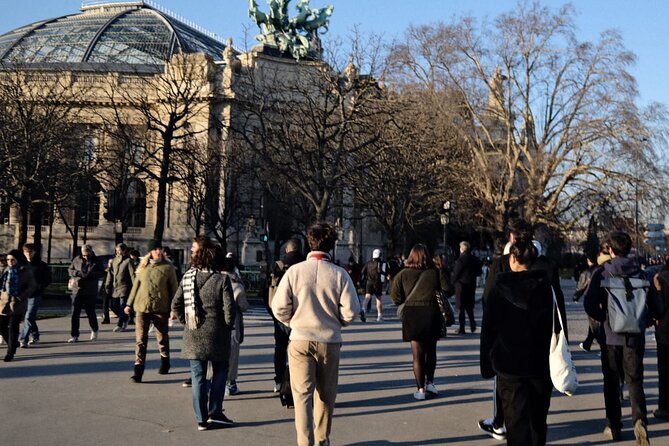
The walk begins at the Statue of General Charles de Gaulle near the Champs-Élysées, close to the Champs-Élysées-Clemenceau metro station. The station opened for the 1900 Paris Exposition Universelle, which makes the meeting area part of the story before you even reach the first major monument.
That detail is easy to miss if you are simply changing metro lines. Here, public transport becomes evidence of how Paris prepared for a major international event. The station was placed near the Grand Palais and Petit Palais, making it a practical gateway to the exhibition grounds.
The first stop is brief, about five minutes. Think of it as an introduction rather than a full tour of the neighborhood. If you want to explore the Champs-Élysées shops, gardens, or nearby monuments, give yourself extra time before the meeting point.
Grand Palais and Petit Palais: two surviving exhibition icons
The Grand Palais was built for the 1900 exposition and is instantly recognizable by its enormous glass-domed roof. Its design mixes classical decoration with industrial construction, a fitting combination for a building meant to celebrate both art and modern engineering.
The guide’s explanation helps you see the building as more than a handsome backdrop. Its glass and iron structure expressed confidence in new construction methods, while its formal design kept one foot in Paris’s classical tradition. Today, it hosts major exhibitions, fashion events, and cultural programs.
You spend about five minutes here, so do not expect an interior visit. Admission is not included, and the tour does not pause for a full museum experience. Still, the exterior makes a strong opening sight, especially if you enjoy architecture.
The Petit Palais sits nearby and was also created for the 1900 exposition. It now houses the Musée des Beaux-Arts de la Ville de Paris, with art ranging from antiquity to the early twentieth century. Its frescoes, grand entry areas, and quiet courtyard give it a different mood from the larger Grand Palais.
The Petit Palais is free to visit, but the walking tour only makes a short stop. I would treat this as a useful orientation. If the art collection interests you, return later with time to look around at your own pace.
Pont Alexandre III and the Seine’s exhibition route
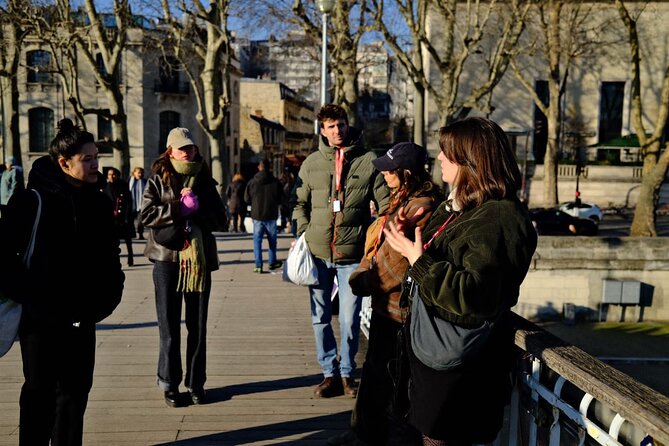
The Pont Alexandre III is one of the most decorative bridges in Paris. Gilded sculptures, elaborate ironwork, and Art Nouveau lamps give it the theatrical look you might expect from a city hosting a world exposition.
The bridge was built for the 1900 event and also represented the political relationship between France and Russia. That adds a diplomatic layer to the decoration. The bridge was not merely a crossing; it helped create a ceremonial route between important exhibition areas.
This is one of the best places for photographs on the walk. You can frame the Seine, the bridge’s gold details, and the grand buildings on either bank. The stop lasts about five minutes, so have your camera ready before the guide begins speaking.
The Seine itself is the main connecting thread. During the World’s Fairs, its banks served as a setting for ambitious buildings, displays, and demonstrations. The river also helped visitors move between areas, including by sightseeing boats.
More walking tours in Paris:
- Montmartre Hidden Gems and Scenic Highlights Walking Tour
★ 5.0 · 2,684 reviews - Montmartre Hill French Gourmet Food and Wine Tasting Walking Tour
★ 5.0 · 2,588 reviews - Paris Île de la Cité and Notre-Dame Walking Tour With Crypt
★ 5.0 · 2,272 reviews - Paris: Montmartre Cheese, Wine & Pastry Guided Walking Tour
★ 4.8 · 2,255 reviews
Bateaux Mouches, Pont de l’Alma, and the Statue of Liberty flame
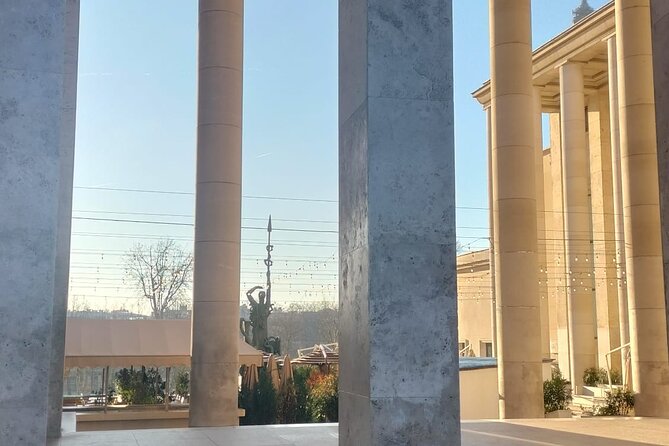
The tour explains the early role of Bateaux Mouches, the famous Paris sightseeing boats. They began as visitor transport during the 1867 Exposition Universelle and later became part of the city’s sightseeing tradition.
That is a useful bit of context because it shows how tourism and large public events grew together. The boats were not added to Paris simply for postcard views. They helped people reach and see the exhibition areas, and their modern descendants still offer a river-level view of the city.
At Pont de l’Alma, you encounter another chapter in the story. The bridge was built for the 1855 Exposition Universelle, though it has since been rebuilt. The remaining Zouave statue once served as a rough flood gauge, giving the bridge a practical role as well as a symbolic one.
Nearby, the Flamme de la Liberté is a full-size replica of the Statue of Liberty’s flame. Its story reaches back to the 1878 exposition, when the Statue of Liberty was presented in Paris before being sent to New York. The flame was donated in 1989 by the International Herald Tribune and represents the friendship between France and the United States.
The monument later became an unofficial memorial to Princess Diana. That gives the stop a modern emotional association, but the guide also places it in the longer story of French-American exchange and international exhibitions.
Debilly Footbridge and the modern art of 1937
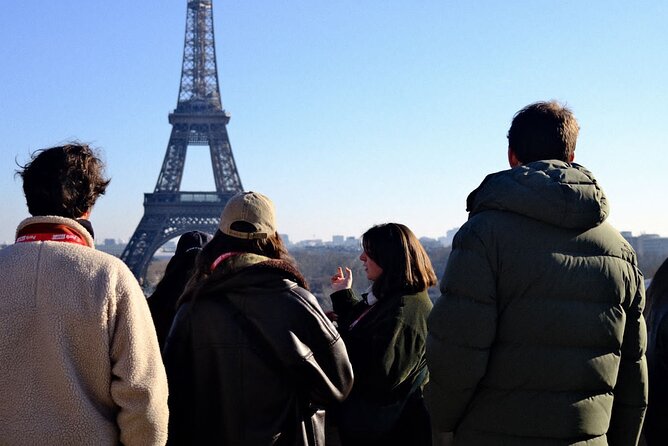
The Passerelle Debilly is a 120-meter footbridge built for the 1900 Exposition Universelle. It links the Quai Branly with Avenue de New York and offers a quieter crossing than the larger road bridges.
Walking across it changes the pace of the tour. After the formal decoration of Pont Alexandre III, the footbridge feels lighter and more functional. You get a closer relationship with the river and another angle toward the Eiffel Tower.
The Palais de Tokyo shifts the story forward to the 1937 Exposition Universelle. The building began as a palace for modern art museums and is now home to one of Europe’s largest contemporary art centers.
This contrast is useful. Paris’s fairs were not frozen in one style. The 1900 event leaned into grand decoration and engineering, while the 1937 exhibition presented a more modern artistic and political mood. You see that shift in the buildings themselves.
Again, the tour focuses on the exterior and the surrounding story. If you want contemporary art, you will need a separate visit. The walk gives you the context, not a gallery tour.
Palais de Chaillot and the Trocadéro view
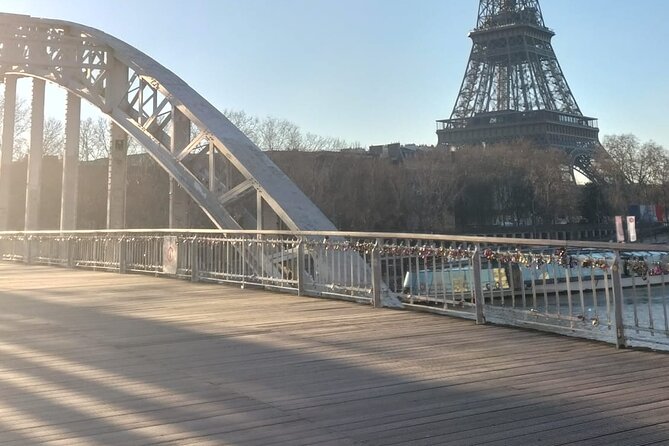
The Palais de Chaillot was built for the 1937 International Exposition by Léon Azéma, Jacques Carlu, and Louis-Hippolyte Boileau. Along with the Palais de Tokyo and Palais d’Iéna, it was designed to survive after the event.
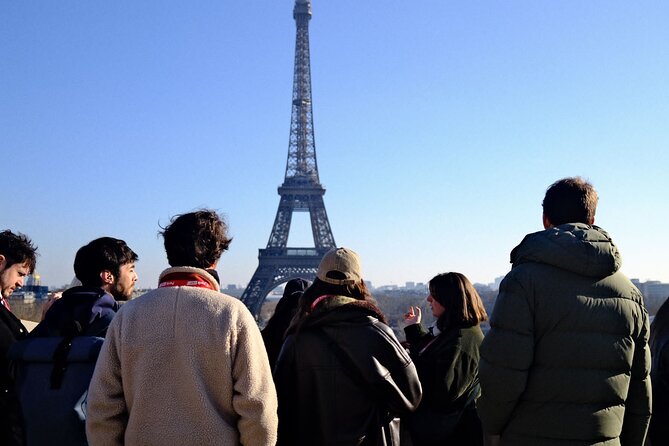
The building’s position across the river from the Eiffel Tower makes it one of the strongest viewpoints on the route. From this area, you can look through the Trocadéro Gardens toward the tower and understand how Paris arranged its exhibition spaces around grand visual axes.
The Trocadéro Fountain was also created for the 1937 exposition, replacing an earlier fountain from the 1878 event. Its water jets, columns, and cannon-like forms make a broad, theatrical display.
This is likely the most rewarding section for photographs. You have the fountain, the gardens, the Palais de Chaillot, and the Eiffel Tower in one setting. The tour spends about ten minutes here, longer than at most earlier stops, but you may still wish for extra time if you want careful photos.
Pont d’Iéna and the Eiffel Tower finale
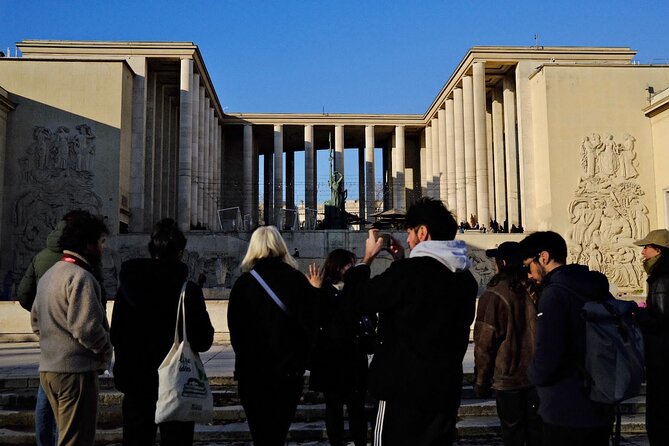
Pont d’Iéna connects the Eiffel Tower with Trocadéro. Napoleon commissioned the original bridge, and it later became an important entry point for visitors to the 1867, 1878, 1889, and 1900 World’s Fairs.
Its role gives the bridge more meaning than a simple route across the river. Millions of people used these exhibition areas to see new buildings, machines, and artistic work. Today, the bridge still carries you into the city’s most recognizable monument zone.
The walk ends at the Eiffel Tower, built for the 1889 Exposition Universelle. Gustave Eiffel’s tower was intended as a display of engineering skill and modern progress. It faced criticism at first, yet soon became Paris’s defining symbol.
The tour does not include entry to the tower. The final stop lasts about ten minutes, so plan a separate visit if you want to go up. Ending here is practical: you finish near one of Paris’s major transport and sightseeing areas, with the option to continue on your own.
What the $43.26 price gets you
At $43.26 per person, this is not the cheapest way to stroll beside the Seine. You are paying for a focused English-language explanation, a certified local guide, and a group capped at 15 people.
The value depends on how you like to sightsee. If you only want photographs, you can walk much of this route without paying. If you want to understand why these monuments appeared where they did, the guide adds the main benefit.
I also think the price is easier to justify if this is your first day in Paris. The route helps you connect several major areas and gives you ideas for places to revisit. It is less valuable if you want long interior visits, extensive museum time, or a slow architectural sketching walk.
Food, drinks, and transport to and from the meeting point are not included. The tour is offered in English, and confirmation arrives when you book. Free cancellation is available up to 24 hours before the start time, which gives you some flexibility.
Who will enjoy this walk most
I would choose this tour for anyone who likes city history but does not want a lecture. The theme is focused, the route is scenic, and the facts are tied to things you can see in front of you.
It is also a good match for repeat visitors. One local resident found that the walk changed how they viewed their own neighborhood, which points to the tour’s main strength: it makes familiar Paris feel newly connected.
Guide Olivia receives especially strong praise for being informative, funny, passionate, and clear. Her style appears to suit people who want lively storytelling without being buried under too many facts. A past participant who had already visited Paris found the thematic approach particularly useful.
You should have moderate physical fitness for a two-hour city walk. The tour is outdoors, and the enjoyment of the Seine views depends partly on the weather. Wear comfortable shoes and keep your camera ready, especially around Pont Alexandre III and Trocadéro.
Should you book the Paris World Fairs walk?
Book it if you want a compact, well-connected introduction to the monuments along the Seine and enjoy learning the story behind the architecture. The small group, scenic route, and World’s Fair theme make it more distinctive than a standard highlights walk.
Skip it if your priority is entering the Grand Palais, Petit Palais, Palais de Tokyo, or Eiffel Tower. Those interiors are not part of the experience, and the short stops are designed for explanation and orientation rather than detailed visits.
For $43.26, I see the best value in the guide’s interpretation, especially with Olivia leading the walk. You get a fresh way to read Paris, a string of excellent photo stops, and a useful route that finishes at the Eiffel Tower.
FAQ
How long does the Paris World Fairs Walking Tour last?
The tour lasts approximately two hours.
Where does the tour begin?
It begins at the Statue of General Charles de Gaulle at Place Clemenceau, 75008 Paris, near the Champs-Élysées-Clemenceau metro station.
Where does the tour end?
The tour ends at the Eiffel Tower at 5 Avenue Anatole France, 75007 Paris.
What language is the tour offered in?
The tour is offered in English.
How large is the group?
The group is limited to a maximum of 15 people.
Is entry to the Eiffel Tower included?
No. The tour stops at the Eiffel Tower, but admission is not included.
Are food and drinks included?
No. Food and drinks are not included.
Can I cancel for a full refund?
Yes. You can cancel up to 24 hours before the experience start time for a full refund. Cancellations or changes made less than 24 hours before the start time are not accepted for a refund.
More Seine river cruises
- Paris: Evening River Cruise with Music
★ 4.4 · 22,721 reviews - Paris: Louvre Guided Tour with Reserved Access & Boat Cruise
★ 4.3 · 16,353 reviews - Paris: Big Bus Hop-On Hop-Off Tour with Optional Cruise
★ 4.4 · 13,279 reviews - Paris: Tootbus Hop-on Hop-off with optional river cruise
★ 4.3 · 11,924 reviews
Just added around Paris
- Private Paris Marche d’Aligre Walking Tour with Tastings★ 5.0 · 8 reviews
- Private Louvre Museum Tour for Kids & Families with Alberto or his team in Paris★ 5.0 · 41 reviews
- Private Highlights of Paris Tuk-Tuk Experience★ 5.0 · 26 reviews
- Paris Latin Quarter Walking Tour: History & Culture – Small Group★ 5.0 · 14 reviews
- Private Highlights of Paris Bike Tour★ 4.5 · 15 reviews
- Paris Musee d’Orsay PRIVATE TOUR with a Local Private Guide★ 5.0 · 41 reviews
- Private Half Day Historic Tour★ 5.0 · 58 reviews
- Pere Lachaise Cemetery Paris – Exclusive Guided Walking Tour★ 5.0 · 72 reviews
Seine River Cruises, compared.
Louvre Guided Tour with Reserved Access & Boat Cruise
Read our review →
Big Bus Hop-On Hop-Off Tour with Optional Cruise
Read our review →
Tootbus Hop-on Hop-off with optional river cruise
Read our review →
Seine Cruise & Crepe Tasting near the Eiffel Tower
Read our review →
Louvre Museum Entry Ticket With Host and River Cruise
Read our review →
Eiffel Tower Access by Elevator & Seine River Cruise
Read our review →Browse the lists this tour appears in