
Reviewed · PARIS
A Day of Exploring Black Paris
Paris has many famous stories, but this tour follows a less familiar thread: the people, places, music, writing, food, and political ideas shaped by the African diaspora. A Day of Exploring Black Paris begins at Les Deux Magots and moves through Saint-Germain, Pigalle, and La Goutte d’Or, connecting literary landmarks with present-day African businesses and neighborhoods.
I like two things right away. First, guide Knight brings the subject to life through people such as Josephine Baker, Richard Wright, James Baldwin, Langston Hughes, Malcolm X, and Anna Julia Cooper. Second, the tour links history with ordinary Paris life: breakfast in a classic café, a Metro ride, a bookstore, local shops, and lunch at a West African restaurant.
The main drawback is simple: this is a serious walking day, with several Metro and bus rides that may include stairs. Six hours can pass quickly, but you should bring comfortable shoes and be ready to keep moving.
Key points to know before booking
- Breakfast at Les Deux Magots: Start with a croissant, bread, Poitou-Charentes butter, and a hot drink while learning about Black writers connected with the café.
- A small group capped at 10 people: You get real time to ask Knight questions and discuss the stories rather than standing at the back of a large crowd.
- Black Paris across several eras: The route connects the Harlem Renaissance, French Caribbean culture, Pan-African publishing, African migration, and present-day Paris.
- Public transport is part of the experience: An all-day Metro pass is included, but you will walk between stops and manage stairs along the way.
- Lunch is optional and extra: The day ends at BMK Paris-Bamako, but your meal is not included in the $216.48 price.
- Respect for local neighborhoods matters: In La Goutte d’Or and Château Rouge, Knight asks you to treat the area as a lived-in community, not a photo set.
Why this tour gives Paris a different center of gravity
The tour is not a general sightseeing circuit with a few references to African and African American figures. Black Paris is the main subject from the first coffee to the final meal. That focus changes how familiar streets make sense.
You hear about American writers who came to Paris after the Second World War, Caribbean figures who built businesses and cultural spaces, African thinkers connected through publishing and political movements, and performers who changed Paris nightlife. The story also reaches into present-day neighborhoods where African-owned shops, cafés, restaurants, clothing businesses, and markets shape daily life.
That mix is the tour’s greatest strength. You are not only looking at plaques or listening to a lecture. You are moving through the city and seeing how history continues in real places.
The group size helps. With no more than 10 people, Knight can check in with you, answer questions, and adjust the pace when needed. The small setting also makes conversation easier, especially for solo visitors or people who want to share their own family and cultural connections.
Other Paris outings people book alongside this one:
- Paris: Louvre Museum Timed-Entrance Ticket
★ 4.6 · 71,977 reviews - Disneyland® Paris 1-Day Ticket
★ 4.6 · 49,412 reviews - Paris: Versailles Palace and Gardens Full Access Ticket
★ 4.6 · 41,579 reviews
Les Deux Magots starts the day with writers and coffee
Meet at 10 a.m. outside Les Deux Magots at 6 Place Saint-Germain des Prés. The café is a useful opening point because it places you inside the literary and intellectual world of Saint-Germain-des-Prés before the tour moves to other parts of Paris.
Your included breakfast is straightforward: a croissant, bread with Poitou-Charentes butter, and your choice of hot drink. It is not a full brunch, but it gives you something to eat before several hours of walking and public transport.
While you settle in, Knight explains the café’s connection to Black writers who lived and worked in Paris. The discussion can include figures such as James Baldwin and Richard Wright, alongside the wider American and Caribbean presence in the city.
I like beginning here because it avoids treating Black Paris as a separate subject disconnected from famous Paris. Les Deux Magots is part of the standard Saint-Germain story, yet its links to Black writers add another layer to a place many visitors already recognize.
If you have already eaten at your hotel, the breakfast remains a pleasant social start. If you have not, keep in mind that the included food is light.
Présence Africaine and the ideas that traveled across borders
The next stop is Présence Africaine, a bookstore and publishing house founded in 1949. This is one of the most important intellectual stops of the day.
Here, you learn how the space connected writers and thinkers from Africa, the Caribbean, France, and the United States. It played a role in Pan-African thought, decolonization, and the Négritude movement, making it more than a shop selling books.
The 30-minute visit is short, but the point is not to browse every shelf. It gives you a clear explanation of how publishing helped people separated by geography exchange ideas and build movements.
For readers, writers, students, and anyone interested in political history, this may be the most rewarding part of the morning. It shows that Paris was not simply a destination for Black artists. It was also a meeting place where intellectual networks took shape.
La Rhumerie brings the French Caribbean into view
At La Rhumerie, a rum house founded in 1932, Knight turns to the Caribbean connection. The establishment has roots in the French Caribbean, and the story includes Joseph Louville, a Martinican who founded it. The business remains linked to his family.
The stop lasts about 45 minutes. You learn how trade, migration, food, drink, and family enterprise tied Paris to the Caribbean. The setting also makes the history easier to grasp. A restaurant or rum house can reveal social and economic connections that are easy to miss in a museum display.
One detailed account of the day described plantains here, but you should not treat a particular food tasting as guaranteed. The included meal is breakfast, and food beyond that depends on what you choose to purchase.
I appreciate this stop because it widens the story. Black Paris is not only African American writers in the Left Bank or African communities in the north. Caribbean people have also shaped the city’s businesses and culture.
Same city, a completely different afternoon:
- Paris: Evening River Cruise with Music
★ 4.4 · 22,721 reviews - Paris: Eiffel Tower Entry Ticket with Optional Summit Access
★ 4.4 · 20,035 reviews - Paris: Eiffel Tower Summit or Second Floor Access
★ 4.3 · 17,248 reviews - Paris: Louvre Guided Tour with Reserved Access & Boat Cruise
★ 4.3 · 16,353 reviews
Pigalle, jazz, cabaret, and Black Montmartre
Pigalle brings the tour into the world of music and nightlife. In the early 20th century, this area was shaped by Black performers, clubs, and cultural exchange.
Knight discusses Josephine Baker, jazz, and the energy that connected Pigalle with Harlem and the wider Black world. You may also hear about the Harlem Renaissance figures who passed through Paris and the way performance created opportunities for cultural exchange.
The stop is not just about nightlife nostalgia. It asks how migration and music changed the identity of a neighborhood. It also shows how Black performers could be celebrated on stage while still facing prejudice and unequal treatment away from it.
This section should suit you if music, theater, and performance matter as much to you as architecture. It also helps explain why Paris became so important to artists and writers from the United States and the Caribbean.
The practical limitation is that Pigalle is a neighborhood walk, not a formal museum visit. You will hear stories while moving through the streets, so pay attention to Knight rather than expecting a long stop at one preserved venue.
Places linked to Richard Wright, James Baldwin, and Anna Julia Cooper
The route can include extra points of context around the Sorbonne and the Left Bank. One especially striking story concerns Anna Julia Cooper, who earned a doctorate at the Sorbonne in 1925.
Born into slavery in North Carolina in 1858, Cooper later became an educator, scholar, and activist. Her dissertation examined France’s attitude toward slavery. Knight also explains how she hosted gatherings that brought African, Caribbean, and African American thinkers together.
Another memorable point is the plaque marking Richard Wright’s former apartment at 14 Rue Monsieur le Prince. A small plaque will not take long to see, but the address matters because it makes literary history physical and local.
These details give the day emotional weight. You begin with famous names, then encounter the rooms, streets, and institutions where people actually lived, studied, wrote, and met.
The route may also touch on the relationship between Baldwin and Wright, including their friendship and later disagreement. That kind of detail keeps the subject human. This is not a list of perfect heroes. It is a story of ambition, argument, community, and change.
La Goutte d’Or and the everyday life of African Paris
The tour then travels north to La Goutte d’Or, including the Château Rouge area. This is where the experience shifts from historical landmarks to present-day community life.
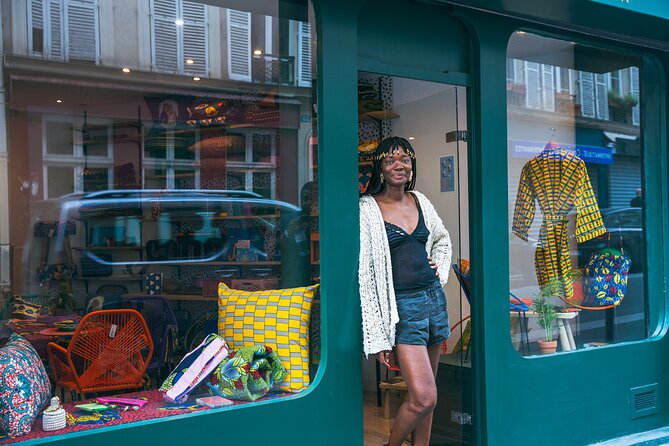
The neighborhood has been shaped by African communities, commerce, migration, and family life. Walking through its streets and market areas, you see the shops and businesses that make it an important gathering and trading center within Paris.
This is also where Knight’s guidance about manners matters most. He asks you not to photograph people without consent and reminds you that the area is a neighborhood first. That advice is practical and respectful. You are there to understand a place, not to turn residents into scenery.
You may encounter African textiles, clothing, jewelry, food, and design businesses along the way. A stop such as Peulh Vagabond can introduce you to contemporary African fashion, while African Textiles can offer a lesson in the complicated world of Dutch wax prints and imitation fabrics.
Keur Coffee Shop provides another modern connection between Dakar and Paris through coffee, design, and hospitality. These businesses show that Black Paris is not frozen in the past. It is also being made today by shop owners, designers, cooks, and artists.
The area can be crowded, and street walking here requires awareness. Keep your belongings secure as you would anywhere in a busy city, stay with the group, and listen when Knight asks you to put your phone away.
Ending at BMK Paris-Bamako over West African food
The day ends at BMK Paris-Bamako at 14 Rue de la Fidélité. This final stop gives everyone a chance to sit down, talk, and think over the day.
Lunch is not included in the tour price, so budget separately for your meal and any drink. The restaurant offers West African food connected with Mali and Senegal. Hibiscus mint drink has been a particular favorite, but your meal choices and costs are not specified.
Ending with food makes sense. After a day of stories about migration, family, trade, and cultural exchange, a shared table brings the subject into the present. It also gives you a chance to ask Knight follow-up questions in a less hurried setting.
Do not expect this to be a formal food tour with a fixed tasting menu. It is a history and culture tour that ends at a restaurant. You choose what to order, and the restaurant bill is your responsibility.
Walking, Metro rides, and the real pace of the day
The experience lasts about six hours, but the clock does not tell the whole story. You will walk between locations, use the Metro and bus, and handle stairs at some stations. An all-day Metro pass is included, which is useful because the route crosses several parts of Paris.
The physical level is listed as moderate, but the direct advice is stronger: wear shoes you can comfortably walk in for hours. Bring water, keep your day bag light, and avoid scheduling a demanding evening activity immediately afterward if you know long walks tire you.
Knight has adjusted the route for people who needed extra help, but you should not assume that the standard day is easy. The group may be able to adapt, yet the itinerary still requires movement.
Public transport is not merely a way to fill gaps between sights. It helps you see how the different parts of Black Paris connect across the city. The polished Left Bank, historic entertainment districts, and African commercial neighborhoods are not one compact quarter.
Is $216.48 a fair price?
At $216.48 per person, this is not a cheap walking tour. The price includes breakfast, an all-day Metro pass, and six hours with a guide in a group of no more than 10 people. Lunch is extra.
The value depends on what you want from Paris. If you only want major monuments and quick photo stops, this will feel expensive. If you want a focused cultural route, a guide who can connect literature, politics, music, migration, and food, and a small group with room for questions, the cost is easier to justify.
You are also paying for structure. It would take time and research to connect Présence Africaine, La Rhumerie, Pigalle, Richard Wright’s apartment, Anna Julia Cooper, Château Rouge, and BMK Paris-Bamako on your own.
The included breakfast and Metro pass help, but they do not transform the price into a bargain. I would book it for the subject and the guide, not for the food inclusions.
Who will get the most from this experience?
This tour suits first-time visitors who want a strong cultural introduction, but it can be just as useful if you have already been to Paris several times. The route gives familiar parts of the city a different meaning.
It is especially good for:
- People interested in African, Caribbean, African American, and French cultural connections
- Solo visitors who want a small group and an easy way to meet others
- Readers, artists, students, and music lovers
- Anyone looking for Black-owned or African-connected businesses in Paris
- Visitors who enjoy walking and public transportation more than sitting on a sightseeing bus
You do not need to be of African or Caribbean descent to appreciate the tour. The stories are part of Paris and of the wider history connecting France, Africa, the Caribbean, and the United States.
I would hesitate if you have mobility concerns that make stairs and several hours of walking difficult. I would also skip it if your priority is seeing the Eiffel Tower, Louvre, or other major monuments. This day has a specific purpose and follows it closely.
Practical details before you go
The meeting point is Les Deux Magots at 6 Place Saint-Germain des Prés, with a 10 a.m. start. The tour ends at BMK Paris-Bamako, 14 Rue de la Fidélité, rather than returning you to the starting point.
Confirmation is provided when you book, and the experience is offered in English. Service animals are allowed, and the route begins near public transportation.
The tour requires good weather. If poor weather causes a cancellation, you can receive another date or a full refund. You can also cancel for a full refund up to 24 hours before the start time. Changes or cancellations made within 24 hours are not accepted for a refund.
Bring comfortable shoes and a respectful attitude. In Château Rouge especially, ask before taking pictures of people, and remember that local residents are going about their daily lives.
Should you book A Day of Exploring Black Paris?
Book it if you want Paris presented through Black writers, performers, entrepreneurs, scholars, and communities rather than only through monuments. Knight’s storytelling, the small group, and the combination of historic cafés, bookstores, public transport, neighborhoods, and food make this a focused and personal day.
The strongest reason to go is the range. You move from Baldwin and Wright to Caribbean rum, from Josephine Baker and Pigalle to Présence Africaine, Anna Julia Cooper, African fashion, and West African cooking.
Skip it if you want a low-effort sightseeing day or if six hours of walking and stairs will be uncomfortable. For everyone else, especially visitors who want a more thoughtful understanding of Paris, this is a worthwhile use of one day.
FAQ
Where does the tour begin?
It begins at Les Deux Magots, 6 Place Saint-Germain des Prés, 75006 Paris.
What time does the tour start?
The start time is 10 a.m.
Where does the tour end?
The tour ends at BMK Paris-Bamako, 14 Rue de la Fidélité, 75010 Paris.
Is breakfast included?
Yes. Breakfast includes a croissant, bread with Poitou-Charentes butter, and a choice of hot drink.
Is lunch included?
No. Lunch at BMK Paris-Bamako is not included in the tour price.
Is public transportation included?
Yes. An all-day Metro pass is included. You will also walk between stops and may encounter stairs during public transportation connections.
How many people can join the tour?
The experience has a maximum of 10 people.
Can I cancel for a refund?
Yes. You can cancel at least 24 hours before the start time for a full refund. Cancellations or changes made less than 24 hours before the start time are not refunded.
Just added around Paris
- Private 1 – hour Tour: Eiffel Tower,Champs-Elysées Arc DE Triomphe★ 5.0 · 7 reviews
- Private Tour to Mont St-Michel and Honfleur from Paris★ 4.5 · 5 reviews
- Paris with a Tuk Tuk – Private 2-Hour TukTuk Tour★ 4.5 · 34 reviews
- Private Tour of Saint Germain des Pres★ 5.0 · 44 reviews
- Tripa Paris Pubcrawl / Bar Tours★ 5.0 · 16 reviews
- Paris city tour with private guide★ 5.0 · 9 reviews
- Paris Private Tour with Tuktukyourcity★ 4.5 · 38 reviews
- Private Mont Saint-Michel Trip by Mercedes from Paris with Lunch★ 4.0 · 10 reviews