
Reviewed · LOUVRE MUSEUM TOURS
Exclusive Semi-Private Louvre Tour with Mona Lisa, Max 6 People
The smartest thing about this Louvre tour is its tight focus. In two and a half hours, your guide leads you through the museum’s major rooms and masterpieces instead of leaving you to wander a huge palace with a map and fading patience. Guides such as Anais, Claire, Avi, Sarah, and Raphael have been praised for clear storytelling, humor, and strong art knowledge.
I like the small-group format, which makes it easier to ask questions and keep up in crowded galleries. I also like that your museum ticket lets you stay after the guided portion, so you can return to a favorite room or see more on your own. The main caution is that the listing promises a group of no more than six, while the additional booking information mentions up to 15. Confirm the actual group limit and headset setup before paying.
Key points at a glance
- Mona Lisa plus the big essentials: See Leonardo’s famous portrait along with Venus de Milo, Winged Victory, the Great Sphinx of Tanis, and major French and Italian paintings.
- A useful two-and-a-half-hour plan: You cover the Louvre’s key works without pretending that this enormous museum can be fully seen in one visit.
- Small group, when the promise holds: A maximum of six makes questions and navigation much easier than on a large bus tour.
- Headsets may matter: Several guides use earpieces, a real help in packed galleries, but one disappointing experience involved a soft-spoken guide without a microphone.
- Stay after the tour: The included adult ticket allows you to continue visiting until closing, giving the tour more value than a simple guided loop.
- English-language guiding: The advertised tour is in English, though one guide was able to provide a Spanish tour.
Meeting Louis XIV beneath the Louvre Pyramid
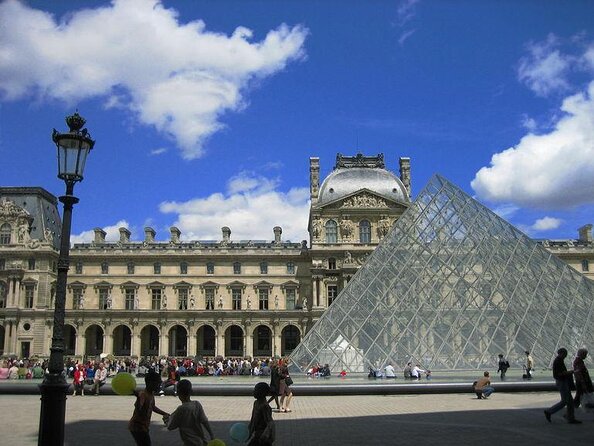
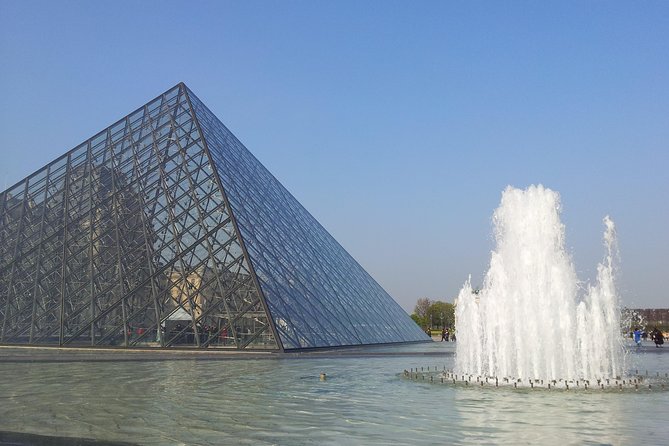
Your visit begins at the statue of Louis XIV in the Cour Napoléon, in front of the glass pyramid. This is a sensible meeting point, but the open square can be busy, so arrive early enough to identify your guide without rushing.
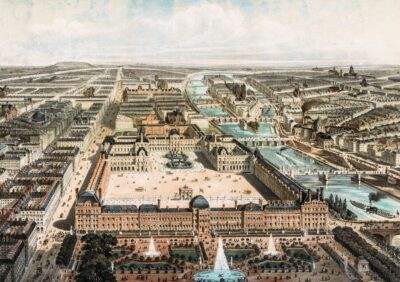
The first part takes about 20 minutes and explains what the Louvre was before it became the museum you see today. That short introduction matters. You are not entering a plain gallery building. You are entering a former royal palace, and the grand scale of the courtyards and halls makes more sense once you know a little about its earlier purpose.
Your adult admission ticket is included, listed at €22. The tour is sold at about $204.38 per person, so the value depends mainly on how much help you want with navigation and interpretation. You are paying a considerable premium over basic admission, but you are also buying a planned route, a local guide, and a way to use limited time well.
The meeting point is close to public transportation. The end point is the Louvre itself, so you do not lose time crossing Paris between sections of the experience.
More Louvre Museum Tours:
- Paris: Louvre Museum Timed-Entrance Ticket
★ 4.6 · 71,977 reviews - Paris: Louvre Guided Tour with Reserved Access & Boat Cruise
★ 4.3 · 16,353 reviews - Louvre Museum Masterpieces Guided Tour with Access
★ 4.5 · 12,023 reviews
The Louvre in 150 minutes
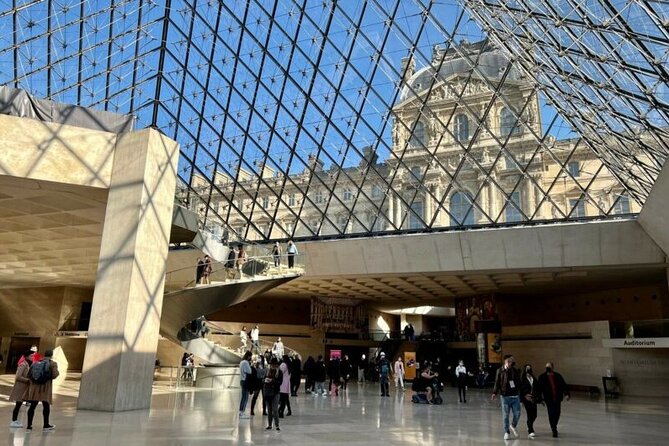
The guided museum visit takes about two hours and ten minutes. That is long enough to see a strong selection of famous works, but not long enough to cover all three wings or anything close to the museum’s full collection.
That limitation is not a flaw. The Louvre contains more than 35,000 works on display, and trying to see everything in one day is a poor plan. A good first visit gives you a framework: a few great works, a sense of the building, and enough confidence to return to sections that interest you.
The route covers two of the museum’s three wings and moves across several periods. You can expect Ancient Egypt, Ancient Greece, the Renaissance, Neoclassicism, and Romanticism. The best guides explain not only what you are looking at, but why the work matters and how it fits its time.
A guide such as Berta, described as a recent art history graduate, was especially good at explaining why an artist made certain visual choices. That sort of explanation is more useful than a string of dates. It turns a painting from something you merely recognize into something you can actually read.
The Great Sphinx of Tanis and Ancient Egypt
The Ancient Egypt portion includes the granite Great Sphinx of Tanis. It is described as the largest and best-preserved example in a Western museum, making it one of the more impressive objects on the route.
This is a good early stop because it shifts your attention away from the modern fame of the Louvre. The museum is not only a place for Leonardo and French royal paintings. Its ancient collections reach far beyond the European art most first-time visitors expect.
Do not expect a long, specialist treatment of Egypt in a short highlights tour. The guide has to keep moving. Still, a clear explanation of the sculpture’s age, scale, and survival gives you a useful foothold in a collection that can otherwise feel scattered.
Venus de Milo and Winged Victory
The tour also brings you to two of the Louvre’s most recognizable sculptures: the Venus de Milo and the Winged Victory of Samothrace.
The Venus de Milo is famous partly because of its missing arms, while Winged Victory is headless and dramatically positioned at the top of a staircase. These works are not simply famous photo stops. Their pose, scale, and placement help show how Greek sculpture can communicate movement and balance even when parts are missing.
The route’s strength is its range. You move from ancient sculpture to Renaissance painting and then to the dramatic French works that many visitors expect from the Louvre. A guide who keeps the pace steady can make those changes feel like a connected story rather than a series of unrelated rooms.
That said, the route may not linger equally everywhere. If sculpture is your main interest, you may want to use the time after the tour to return to the works that received the shortest explanation.
More private tours in Paris:
- Paris: Private Photoshoot at the Eiffel Tower
★ 4.7 · 2,636 reviews - Top Private Cruises in Paris with French Champagne and surprises
★ 5.0 · 1,553 reviews - Private Paris Airport Arrival Transfer – CDG & ORLY Airports
★ 4.5 · 1,119 reviews - Paris Private Arrival Transfer from Charles de Gaulle (CDG) or Orly (ORY)
★ 4.0 · 1,084 reviews
The Mona Lisa without losing the rest of the museum
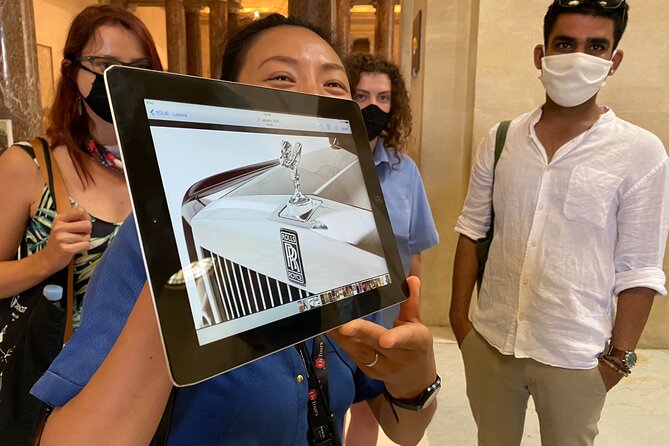
Of course, the Mona Lisa is the main event for many people. The tour includes Leonardo da Vinci’s portrait, and the guide explains its place among the Louvre’s thousands of paintings.
You should expect crowds around it. The point of the guided visit is not a quiet, private look at the painting. It is to get there with a guide who can add context and help you understand what you are seeing before you move on.
One useful feature is the chance to continue in the museum after the guided tour. Once you have seen the Mona Lisa and the main route, you can decide how much more energy you have. You might return to Leonardo, spend extra time with sculpture, or explore a room the guide only passed through.
That extra time changes the value equation. A two-and-a-half-hour tour can feel short for a museum this large, but the included admission means your visit does not have to end when the guide says goodbye.
Veronese, David, and Géricault
The painting selection includes Paolo Veronese’s Wedding Feast at Cana, Jacques-Louis David’s Coronation of Napoleon, and Théodore Géricault’s Raft of the Medusa.
These are useful choices because they show how different artists handled scale, ceremony, power, suffering, and drama. The Wedding Feast at Cana is enormous and full of detail. The Coronation of Napoleon presents political authority with deliberate grandeur. The Raft of the Medusa brings a darker emotional charge, with desperate figures arranged for maximum impact.
A strong guide can make these large canvases manageable. Instead of telling you only the title and date, the guide may point out how your eye is directed, what the figures are doing, and how the work reflects its period. Guides Sarah, Avi, Sebastian, and Anna were praised for bringing paintings to life through history, technique, and humor.
This is where the tour can help people who do not normally enjoy museums. You do not need a background in French history or art theory. You need a guide willing to explain without talking down to you. Claire was praised for an approachable manner, an even pace, and explanations that worked for people with different levels of knowledge.
Why the group size matters

The advertised maximum is six people, and that is the ideal size for this kind of museum visit. In a small group, you can ask a question without stopping a large crowd, and the guide can respond to individual interests.
Small groups also make movement easier. The Louvre’s rooms can be crowded, and large tour parties often clog doorways or scatter between paintings. With six people, you have a better chance of staying together and seeing the guide’s gestures and pointing.
There is one point to check before booking. The additional information says the activity can have a maximum of 15 participants, which conflicts with the guaranteed maximum of six in the tour description. Ask the operator to confirm the actual group size for your date.
Headsets are another practical detail. Claire and several other guides used earpieces, which helped people hear over the noise. One guide received strong criticism for speaking softly without a microphone, leaving two people struggling to follow in a packed gallery. Ask specifically if an audio system will be provided. It can make the difference between following the explanation and leaning forward through every stop.
Is $204.38 a fair price?
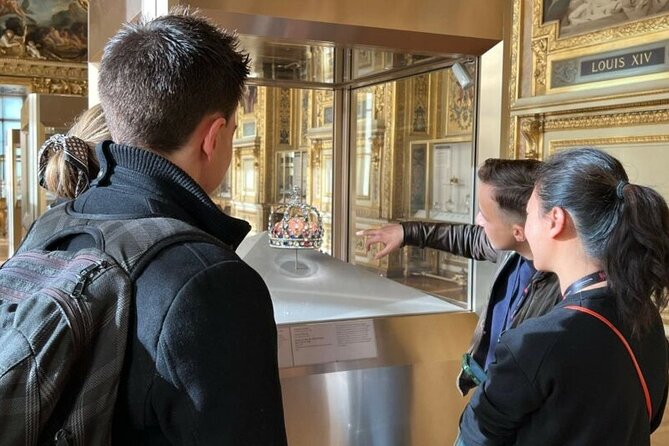
At roughly $204.38 per person, this is not a budget Louvre visit. If you only want museum entry, the tour costs far more than a ticket alone.
I think the price can make sense for a first visit when you have limited time, especially if the Louvre feels intimidating. A good guide saves you from spending the first hour finding the right wing, losing your route, and wondering if you missed the important rooms. The value is highest for couples, families, and small groups who want an efficient introduction with room for questions.
The price is harder to justify if you already know the Louvre well or prefer to set your own pace. You may find a self-guided visit more satisfying, particularly if you want lesser-known works rather than the standard highlights.
Group discounts may be available, and the ticket is included for adults. Visitors under 18 and residents of the European Economic Area under 26 can receive free admission with valid identification and proof of residency, though the tour price and booking rules should be checked before assuming the full cost is removed.
Who will get the most from this tour?
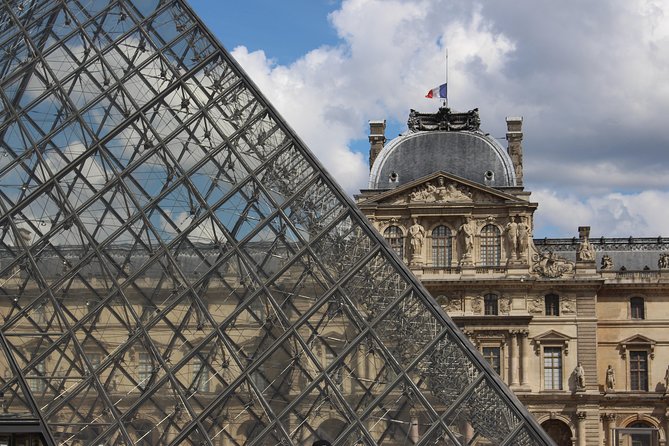
I would choose this experience for a first-time Louvre visitor, someone with only one Paris afternoon, or anyone who wants context without taking a full-day museum class. It is also a good fit if one person in your group loves art and another needs a clear route and lively explanations.
The tour suits you less if you want to explore every wing, spend 20 minutes with one painting, or avoid the Mona Lisa crowds. The route is built around famous works and broad periods, not a quiet, specialized study.
It can also work well for families, provided everyone can manage two and a half hours of walking and standing. The right guide can keep the history moving, but this is still a major museum visit, not a short photo stop.
Timing, cancellation, and practical planning
The tour is offered in English and confirmation is provided at booking. It is free to cancel up to 24 hours before the local start time. Changes or cancellations made less than 24 hours ahead are not accepted for a refund.
The tour is booked, on average, 42 days ahead, which suggests you should not leave a popular time until the last minute. Arrive early at the Louis XIV statue. A late arrival can create serious trouble because the group is moving on a fixed schedule and museum tickets are timed.
Most people can participate, and public transportation is nearby. Gratuities are optional and not included.
Should you book the Louvre semi-private tour?
Book it if you want a clear first look at the Louvre, value a guide who can explain art in plain language, and do not want to spend your limited Paris time finding your way through the palace. The best version of this tour combines a small group, a good headset, and a guide such as Anais, Claire, Avi, Sarah, or Raphael who keeps the pace lively and welcomes questions.
Before booking, confirm two things: the actual group size and whether headsets are guaranteed. If those details are in order, the tour offers a practical route through the Mona Lisa, Venus de Milo, Winged Victory, major French paintings, and the Louvre’s ancient collections, with time left afterward to explore by yourself. If you prefer slow, independent museum time, save the money and buy admission on your own.
FAQ
How long does the Louvre tour last?
The experience lasts approximately two hours and 30 minutes. About 20 minutes are spent at the pyramid and meeting area, followed by roughly two hours and 10 minutes inside the museum.
What works of art are included?
The route includes the Mona Lisa, Venus de Milo, Winged Victory of Samothrace, the Great Sphinx of Tanis, Veronese’s Wedding Feast of Cana, David’s Coronation of Napoleon, and Géricault’s Raft of the Medusa.
Is the museum ticket included?
Yes. An adult museum admission ticket, listed at €22, is included.
Can I stay in the Louvre after the guided tour?
Yes. Your ticket allows you to remain in the museum after the guided portion until closing.
What is the advertised group size?
The tour description guarantees a maximum of six people. However, the additional booking information lists a maximum of 15, so confirm the group size for your date before booking.
Is the tour offered in English?
Yes. English is the advertised language. One guide was also able to provide a Spanish tour, but additional languages are not guaranteed.
Where does the tour begin?
It begins at the Louis XIV statue in the Cour Napoléon, beneath the Louvre Pyramid at 75001 Paris.
Are headsets provided?
Some guides use earpieces, which help in crowded galleries, but headset use is not clearly guaranteed for every departure. Confirm this before booking.
Can I cancel for a full refund?
Yes, if you cancel at least 24 hours before the experience start time. Cancellations or changes made less than 24 hours before the start are not accepted for a refund.
Just added around Paris
- Private Paris Marche d’Aligre Walking Tour with Tastings★ 5.0 · 8 reviews
- Private Louvre Museum Tour for Kids & Families with Alberto or his team in Paris★ 5.0 · 41 reviews
- Private Highlights of Paris Tuk-Tuk Experience★ 5.0 · 26 reviews
- Paris Latin Quarter Walking Tour: History & Culture – Small Group★ 5.0 · 14 reviews
- Private Highlights of Paris Bike Tour★ 4.5 · 15 reviews
- Paris Musee d’Orsay PRIVATE TOUR with a Local Private Guide★ 5.0 · 41 reviews
- Private Half Day Historic Tour★ 5.0 · 58 reviews
- Pere Lachaise Cemetery Paris – Exclusive Guided Walking Tour★ 5.0 · 72 reviews
Louvre Museum Tours, compared.

Louvre Guided Tour with Reserved Access & Boat Cruise
Read our review →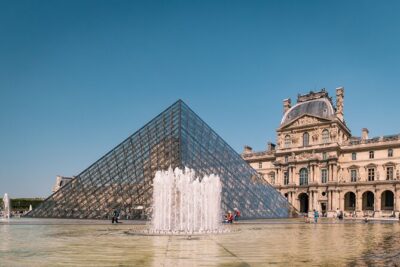
Louvre Museum Masterpieces Guided Tour with Access
Read our review →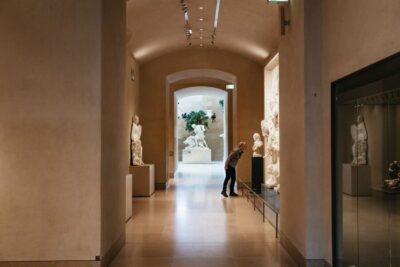
Louvre Museum Entry Ticket With Host and River Cruise
Read our review →
Priority Access Louvre with Host -Direct to Mona Lisa
Read our review →
Mona Lisa & Louvre Masterpieces Tour with Reserved Access
Read our review →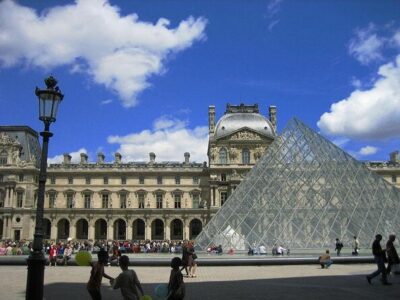
Louvre Museum – Exclusive Guided Tour (Entry Included)
Read our review →
Louvre Reserved Ticket and River Cruise Combo
Read our review →Browse the lists this tour appears in