
Reviewed · LATIN QUARTER AND SAINT-GERMAIN TOURS
Paris: Private walking tour – Latin Quarter and Center!
The most interesting part of this private Paris walk is its wide lens. You move from Roman ruins and medieval streets to the Sorbonne, Gothic churches, Notre-Dame, and the Seine, while Blaze explains how daily life, politics, language, and architecture changed the city. This is not just a parade of famous buildings.
I like the small-group format, which lets you ask questions without holding up a large crowd. I also like the route’s mix of major sights and quieter pedestrian paths, along with Blaze’s background as a La Sorbonne graduate and former scholar at the School of Advanced Studies in Social Sciences.
The main consideration is the pace and terrain. You will walk for about two and a half hours, often on historic streets and paths, so this is not suitable for people with mobility impairments. The route also covers many places, which means some stops receive an introduction rather than a long visit.
Key points at a glance
- A private route for up to six people: You get personal attention and plenty of room for questions.
- Blaze brings an academic and local point of view: His background covers history, art, politics, society, and the French language.
- The walk links Roman, medieval, classical, and Haussmannian Paris: You see how the city changed instead of viewing each landmark in isolation.
- The route starts near Notre-Dame and Bridge Saint-Michel: It is a handy introduction to the Île de la Cité and Latin Quarter.
- You visit both headline sights and lesser-known corners: Arènes de Lutèce, Saint-Séverin, Place de la Contrescarpe, and the Sorbonne share the route with Notre-Dame and Pont Neuf.
- The price works best for a full group: At $82 for up to six people, the per-person cost falls sharply when shared.
A history walk that connects the Roman city to modern Paris
Many Paris walks focus on one theme. This one tries to explain the city as a series of layers. You begin near Notre-Dame, then move through Roman Paris, medieval religious life, university culture, royal power, and later changes to the city.
That broad approach is useful because Paris can otherwise feel like a collection of unrelated monuments. At the Arènes de Lutèce, you get a sense of the Roman settlement. At the Sorbonne, the focus shifts to education and intellectual life. Along the Seine and at Pont Neuf, the city’s political and commercial importance comes into view.
Blaze’s background gives the walk an academic base, but the experience is intended to stay casual and interactive. You can ask about architecture, French expressions, art, political science, or the social tensions behind major changes. The three five-star comments supplied for the activity consistently point to the same strengths: a friendly manner, strong command of history and culture, clear answers to questions, and a pace that does not feel rushed.
I would choose this tour if you want context rather than a checklist. It is especially useful early in a Paris visit, when you want to learn how the city fits together.
More Latin Quarter and Saint-Germain Tours:
- Paris Bike Tour Hidden Secrets in the Latin Quarter & Le Marais neighborhoods
★ 5.0 · 766 reviews - Paris St Germain Food Tour with Cheeses, Foie Gras, Wines & More
★ 5.0 · 401 reviews - Paris Latin Quarter Pub Crawl Bars and Clubs
★ 4.5 · 394 reviews
Starting near Bridge Saint-Michel and Notre-Dame
The meeting point is close to Bridge Saint-Michel, in the area of Notre-Dame. This puts you right beside the Île de la Cité and within easy reach of the Latin Quarter.
Pay close attention to the exact meeting instructions when you book. The description refers to the area near Bridge Saint-Michel and also identifies Notre-Dame as the starting location. Paris has several nearby bridges, squares, and entrances, so arriving early and checking the confirmed pin is sensible.
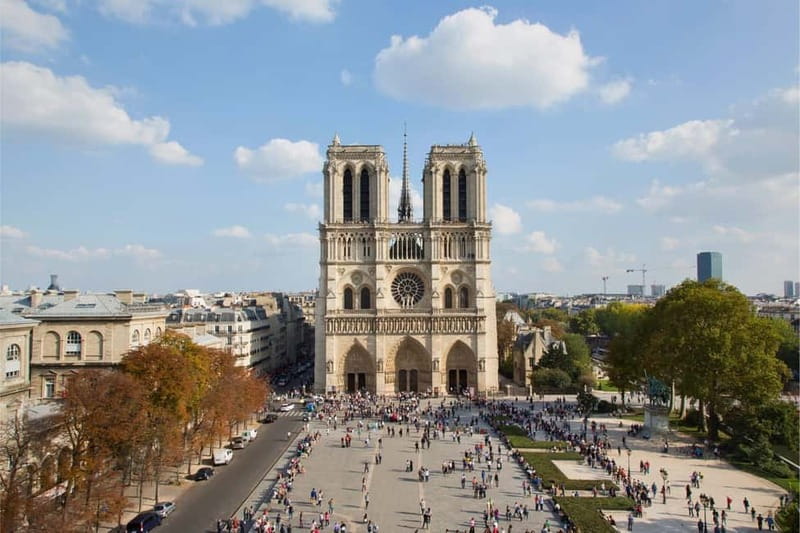
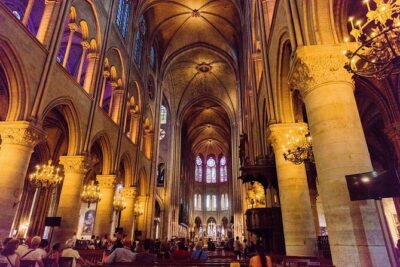
Notre-Dame is a strong opening point because it brings together religion, architecture, politics, tourism, and the long story of Paris. Blaze can use the cathedral and its surroundings to explain how the city grew around the Seine. You should expect commentary and orientation here rather than a private interior visit. The walk is designed around the wider area and its connected landmarks.
Arènes de Lutèce and the first layers of Paris
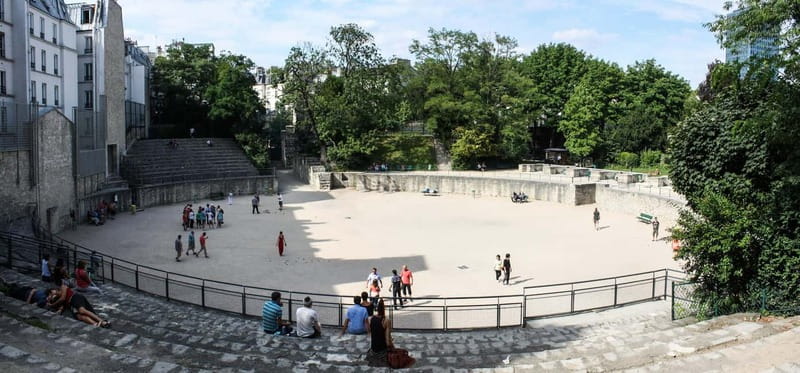
The route then reaches the Arènes de Lutèce, one of the clearest reminders that Paris began as a Roman city. This former amphitheater gives the walk an immediate sense of time. Before the grand boulevards, royal palaces, and Gothic towers, there was Lutetia.
This stop is valuable because it helps you picture early urban life. Blaze’s stated focus on medieval society and the city’s early development fits well here, even though the site itself is Roman. You can ask how Paris changed after the Roman period and how older traces survived beneath later neighborhoods.
The walk continues toward Place de la Contrescarpe, where the mood changes. The square and nearby streets offer a more everyday view of the Latin Quarter. You are not simply looking at a monument; you are seeing how old Paris remains part of a lived-in neighborhood.
The route includes pedestrian pathways, which can make the walk easier and more pleasant than following major traffic routes. Still, this is an old district with uneven surfaces and a moderate amount of walking. Wear shoes that can handle stone streets.
Place de la Contrescarpe and the feel of the Latin Quarter
Place de la Contrescarpe is a useful pause between formal landmarks. Here, Blaze can talk about local life, language, food culture, and the changing character of the Latin Quarter. The activity description places real weight on daily life and social tensions, so this is the kind of stop where questions can take the discussion beyond dates and names.
I like this part of the route because it gives you a break from the standard Notre-Dame and Eiffel Tower version of Paris. You get a neighborhood setting and a chance to notice how the Latin Quarter works as a place where residents, students, visitors, and businesses meet.
The square is not a major museum stop, so set your expectations accordingly. Its value comes from conversation and setting rather than a long list of objects to see. If you want more time for cafés, shopping, or independent wandering, mention that before the tour so Blaze can take your preferences into account.
More walking tours in Paris:
- Paris Top Sights Half Day Walking Tour with a Fun Guide
★ 5.0 · 2,893 reviews - Montmartre Hidden Gems and Scenic Highlights Walking Tour
★ 5.0 · 2,684 reviews - Montmartre Hill French Gourmet Food and Wine Tasting Walking Tour
★ 5.0 · 2,588 reviews - Paris Île de la Cité and Notre-Dame Walking Tour With Crypt
★ 5.0 · 2,272 reviews
Saint-Étienne-du-Mont and the Sorbonne
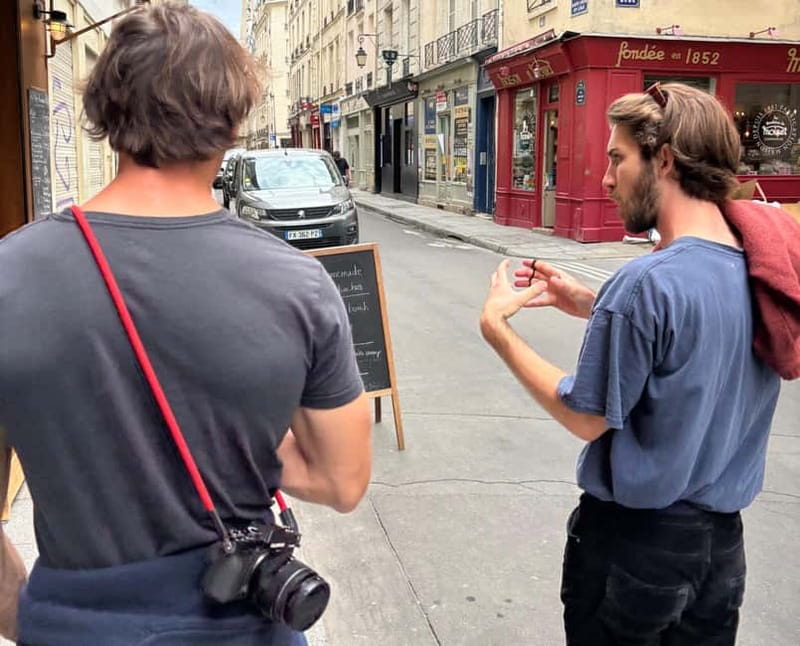
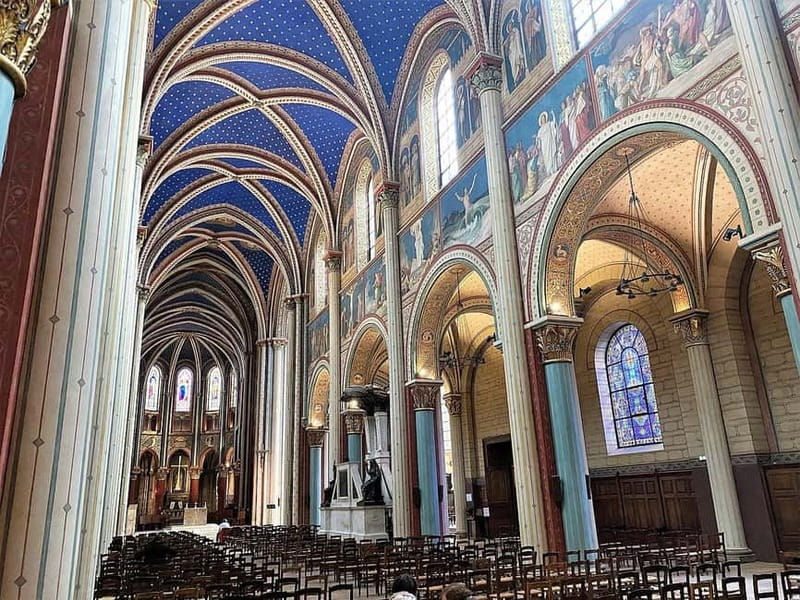
Saint-Étienne-du-Mont adds another architectural layer. The church is a good place to work on identifying Gothic and Classical features, two of the architectural styles Blaze specifically teaches on the walk.
That makes this experience useful for anyone who often looks at Paris buildings but is unsure what to notice. You can ask about shapes, decoration, structure, and how later designers borrowed from or changed older styles. The aim is not to turn you into an architect in one afternoon. It is to give you a few simple tools for reading the city.
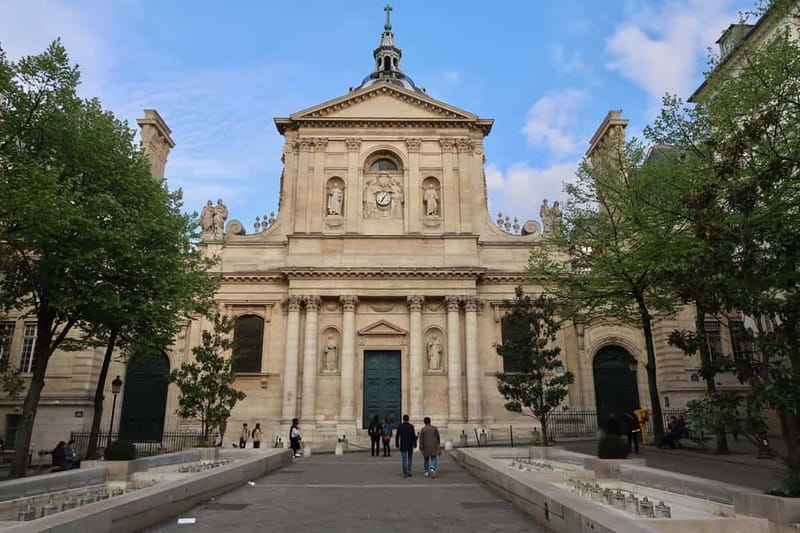
The nearby Sorbonne brings the focus back to education and intellectual life. Blaze is a La Sorbonne graduate, so this stop has a personal connection as well as historical importance. The university area helps explain why the Latin Quarter became associated with students, scholarship, debate, and political ideas.
This is also a good moment to ask about the French language or the role of universities in French society. Blaze’s interests include the relationship between power, freedom, and society, and the Sorbonne provides a natural setting for those subjects.
The Thermes de Cluny and medieval Paris
The Thermes de Cluny gives you a look at another surviving piece of ancient Paris. These Roman baths are important because they show that the city’s past is not limited to churches and royal monuments. Ancient infrastructure remained part of the urban fabric as later generations built around it.
From here, the story turns toward medieval life. Blaze aims to explain how ordinary people lived, along with the amusing details and social pressures that standard history lessons often leave out. That kind of storytelling can make the period easier to understand, especially if you prefer human stories to a long sequence of rulers.
The stop is also useful for comparing architectural periods. You may hear about Roman construction, Gothic forms, Classical ideas, and later Haussmannian changes within a fairly compact area. The result is a practical lesson in how Paris was repeatedly rebuilt without erasing every earlier layer.
The route covers a lot in two and a half hours. I would not expect a detailed museum-style treatment of every site. Think of the Thermes de Cluny as one piece in a connected explanation of the city.
Saint-Germain-des-Prés and the Seine
Saint-Germain-des-Prés brings the walk into another famous Paris neighborhood. The stop is listed as a visit rather than simply a passing view, so it offers a chance to pause and take in the area.
Blaze’s discussion can move from art and culture to social change. Since the tour covers the evolution of art and political science, you can ask questions that go beyond the church or street in front of you. The experience is strongest when you treat the route as a conversation rather than waiting for a fixed speech at every stop.
The Seine then provides one of the walk’s best connecting points. Paris grew around the river, and its bridges and islands help explain the city’s geography. Along the river, Blaze can point out how power, trade, religion, and public life gathered around this central corridor.
At Île de la Cité, the story returns to the city’s oldest core. This is where the route feels most cohesive. Roman Paris, medieval Paris, royal Paris, and modern Paris all meet within a short distance.
Notre-Dame, Pont Neuf, and Saint-Séverin
The walk returns to Notre-Dame, now with more context behind what you are seeing. A second encounter can be useful because you may notice details that were easy to miss at the beginning.
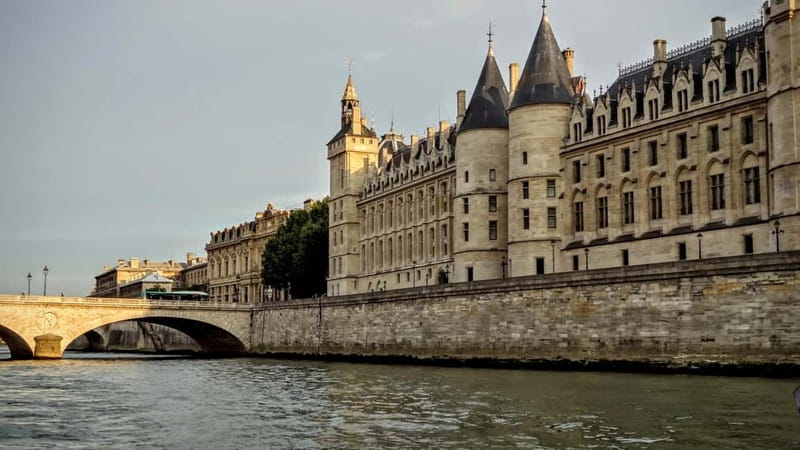
Pont Neuf adds a different view of the city. Despite its name, it is Paris’s oldest standing bridge, and its position links the Île de la Cité with both banks of the Seine. The stop helps explain why bridges mattered so much to the growth and control of Paris.
Saint-Séverin closes the route with another Gothic church and a quieter atmosphere than the most famous cathedral. This is a good place to apply what you have learned about Gothic architecture. It also reinforces the tour’s central idea: Paris is not one period or one style, but many eras placed side by side.
The stated drop-off points are Arènes de Lutèce and Maubert-Mutualité. The activity also says the walk ends back at the meeting point, so check the final instructions for the exact end location. Either way, you finish in the Latin Quarter, where you can continue exploring on your own.
What Blaze adds to the experience
Blaze is presented as a Paris native, La Sorbonne graduate, former scholar, and dancer. The combination suggests a guide who can move between serious ideas and a relaxed street-level conversation.
The strongest praise in the supplied comments concerns his manner and range. He is described as friendly, easy to spend time with, and able to discuss history, art, culture, and politics. The comments also point to a comfortable pace and a willingness to answer questions with enthusiasm.
That matters on a private tour. A large group often forces you to follow the guide’s priorities. Here, you can tell Blaze in advance if you care most about architecture, medieval life, French words, political history, art, or practical orientation around Paris.
The guide also says he keeps learning and updating his knowledge. I would use that flexibility. Before the walk, send a short note with two or three interests. You are more likely to get a satisfying experience if the guide knows what you want to understand.
Price, timing, and who gets the best value
The price is $82 per group of up to six people. For six, that works out to about $13.67 per person. For two people, it is $41 each, and for one person, the full group price applies.
That is a fair value for a private 2.5-hour walk, especially if you want to ask many questions or adjust the discussion to suit your group. The value is less obvious if you prefer a fast, highly scripted sightseeing tour or plan to spend most of the time taking photographs rather than listening.
The tour is offered in English and French. It runs in all weather, so bring water, wear comfortable shoes, and dress for the forecast. A camera is welcome, but follow the rules at religious and historic sites, including restrictions on flash photography.
The walk is not suitable for people with mobility impairments. Even without major mobility concerns, you should expect a moderate amount of walking on historic streets and paths. Children and adults who enjoy conversation, history, and questions will likely get the most from it.
Free cancellation is available up to 24 hours before the activity for a full refund, and you can reserve now and pay later. Those options are useful if your Paris schedule is still shifting.
Should you book this Latin Quarter walk?
Book it if you want a personal introduction to Paris that mixes major landmarks with Roman remains, churches, university life, architecture, and social history. It is a particularly good choice for a first or second day in the city, when a local guide can help you understand where you are and how the central districts connect.
I would also choose it for a group of friends or family members who want to talk rather than simply follow a flag. With six people sharing the $82 price, the value is strong.
Skip it if you need a fully accessible route, a museum-heavy experience, or a tightly focused visit to one monument. This walk covers a lot of ground and depends on conversation, walking, and curiosity.
FAQ
How long does the Paris walking tour last?
The tour lasts 2.5 hours. Starting times depend on availability when you book.
Where does the tour begin?
The meeting point is close to Bridge Saint-Michel, near Notre-Dame. The activity also identifies Notre-Dame as the starting location, so check the confirmed meeting details before setting out.
What languages does Blaze speak?
The tour is available in English and French.
How many people can join the private tour?
The private group can include up to six people.
Is admission included?
Admission to all visited sites is included in the activity price.
Is the tour suitable for people with mobility impairments?
No. The experience involves a moderate amount of walking and is listed as unsuitable for people with mobility impairments. Comfortable shoes and weather-appropriate clothing are recommended.
Just added around Paris
- Private Paris Marche d’Aligre Walking Tour with Tastings★ 5.0 · 8 reviews
- Private Louvre Museum Tour for Kids & Families with Alberto or his team in Paris★ 5.0 · 41 reviews
- Private Highlights of Paris Tuk-Tuk Experience★ 5.0 · 26 reviews
- Paris Latin Quarter Walking Tour: History & Culture – Small Group★ 5.0 · 14 reviews
- Paris Musee d’Orsay PRIVATE TOUR with a Local Private Guide★ 5.0 · 41 reviews
- Private Highlights of Paris Bike Tour★ 4.5 · 15 reviews
- Private Half Day Historic Tour★ 5.0 · 58 reviews
- Pere Lachaise Cemetery Paris – Exclusive Guided Walking Tour★ 5.0 · 72 reviews
Latin Quarter and Saint-Germain Tours, compared.
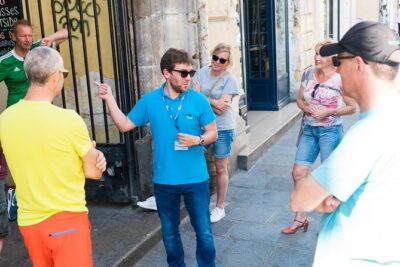
Paris Bike Tour Hidden Secrets in the Latin Quarter & Le Marais neighborhoods
Read our review →
Paris St Germain Food Tour with Cheeses, Foie Gras, Wines & More
Read our review →
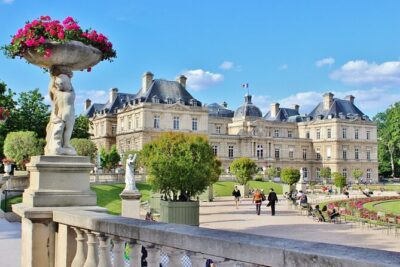
Latin Quarter Paris Guided Walking Tour Semi-Private 12ppl Max
Read our review →
Paris Latin Quarter Food Tour – Full French Meal by Do Eat Better
Read our review →
Saint-Germain The Original Chocolate Tasting Tour with Pastries and Macaron
Read our review →
Paris Latin Quarter Walking Tour plus Seine River Cruise Option
Read our review →Browse the lists this tour appears in