
Reviewed · NORMANDY D-DAY DAY TRIPS
Canadians in Normandy D-Day beaches Juno Beach and Pegasus Bridge (3/7 pax)
The most striking part of this Normandy day is its tight focus. You are not trying to cover every D-Day beach. Instead, you follow the Canadian story from the first assault areas at Juno Beach to the cemetery where many of the fallen were laid to rest. The stop at Pegasus Bridge adds the British airborne side of the invasion, giving you a broader picture of the first hours.
I like the small group, capped at seven people in the booking details, and I like that the guide can give the day a personal feel. Guides named Adrian and Régis received especially warm praise for their military knowledge, thoughtful storytelling, and patience with questions. The catch is the schedule: this is a very long day, and the price of $288.99 per person is high for a road trip from Paris.
Key points at a glance
- Pegasus Bridge sets the opening scene: See the canal crossing seized by British glider troops in the first minutes of D-Day.
- Juno Beach receives the main attention: The Juno Beach Centre explains Canada’s war effort with films, documents, maps, and personal stories.
- Canada House links history to a real home: This familiar D-Day image shows where the Queen’s Own Rifles fought during the landing.
- Bény-sur-Mer is a quiet, moving stop: More than 2,000 Canadian headstones are arranged among pines and maples.
- The day is built for history-minded visitors: You get a specialist subject, a small vehicle, and a guide rather than a large coach tour.
- Plan for a demanding schedule: Leave Paris at 6:30 a.m., bring lunch money, and expect to return after 7:30 p.m.
Why this Canadian D-Day tour is different
Many Normandy excursions from Paris try to squeeze in several beaches, a museum, a cemetery, and perhaps a town or two. This experience makes a clearer choice. It concentrates on Canada’s contribution to the Normandy campaign, with Juno Beach as the center of the day.
That focus matters because Canada’s role can get less attention on a general D-Day outing. At Juno, Canadian troops faced strong resistance and moved farther inland than any other Allied force on D-Day. The tour gives you places where that story becomes easier to grasp: a bridge taken before dawn, a house on the beach, rows of graves, and a museum devoted to Canadian service.
The group size also changes the rhythm. With no more than seven people in the additional tour information, you are not part of a large crowd waiting for a guide to finish a speech. You can ask questions as the day unfolds, and a guide such as Adrian or Régis can adjust the explanation to your interests. The small vehicle is air-conditioned, which matters on a full day with a great deal of road time.
Still, you should book this for the subject, not for a relaxed day in the countryside. The drive from Paris is long, the start is early, and lunch is not included. At $288.99 per person, the cost reflects private-style transport, guiding, and a small group, but it will feel expensive if you only want a quick look at the beaches.
More Normandy D-Day Day Trips:
- Normandy D-Day Sites & Cemetery Day Trip from Paris with Lunch
★ 5.0 · 6,877 reviews - Normandy D-Day Small-Group Day Trip with Omaha Beach, Cemetery & Cider Tasting
★ 5.0 · 2,786 reviews - Normandy D-Day Beaches and American Cemetery Day Trip from Paris
★ 4.5 · 2,673 reviews
Pegasus Bridge and the first minutes of D-Day
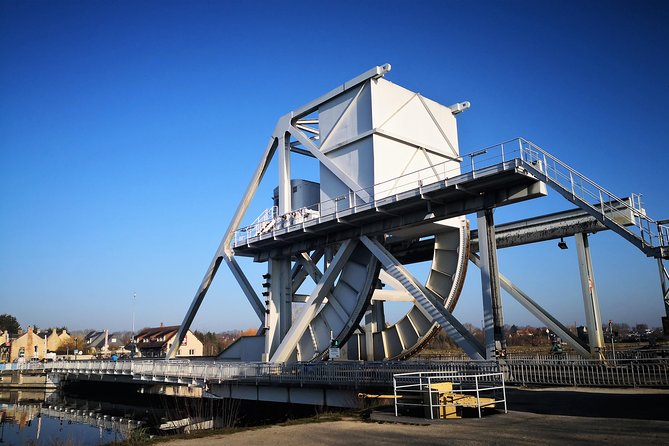
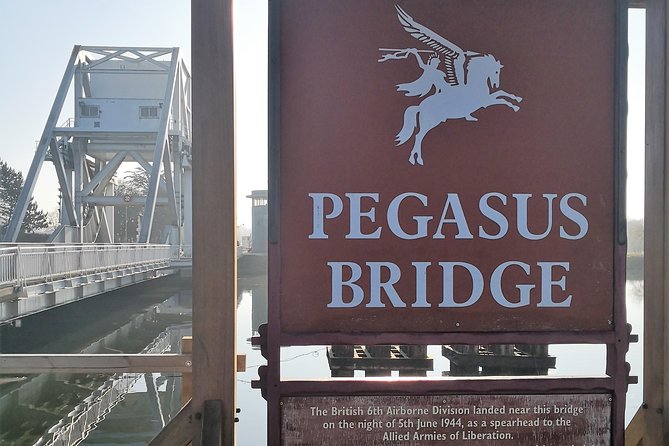
The first listed stop is Pegasus Bridge, reached after the early departure from Paris. The present bridge is a bascule bridge built in 1934 over the Caen Canal, between Caen and Ouistreham. It was also known as Bénouville Bridge, after the nearby village.
Its wartime importance came during Operation Deadstick, part of Operation Tonga. In the opening minutes of June 6, 1944, glider infantry from the 2nd Battalion, Oxfordshire and Buckinghamshire Light Infantry, landed under Major John Howard. Their orders were direct: take the bridge intact, seize the nearby Ranville Bridge, and hold both until support arrived.
You have about 20 minutes here, with no admission charge. That is enough for an explanation and a quick look, but not enough for a long museum visit or a leisurely exploration. I see this as a scene-setting stop. It helps you understand that the invasion began well before the famous beach landings, with airborne troops trying to protect the eastern flank and block German movement toward the beaches.
The short visit is also one reason the guide matters. A bridge can look ordinary without the story attached to it. Your guide supplies the scale, timing, and military purpose that turn a canal crossing into a key D-Day objective.
Bény-sur-Mer Canadian War Cemetery
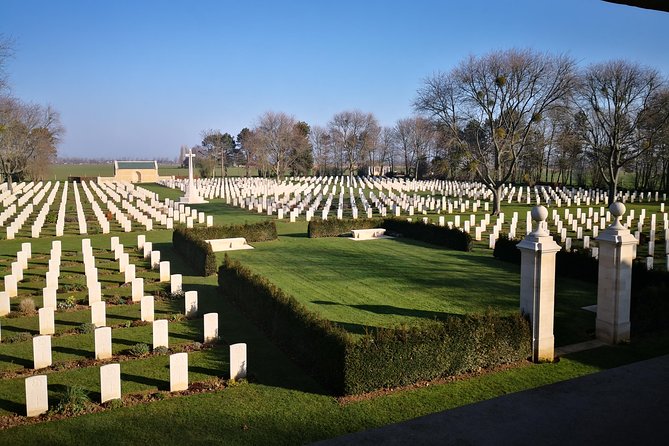
The road then leads to Bény-sur-Mer Canadian War Cemetery, near the village of Reviers rather than directly in Bény-sur-Mer. The grounds are carefully kept, with pines, maples, hedges, and the familiar Cross of Sacrifice used in many Commonwealth military cemeteries.
The cemetery contains 2,049 headstones, mainly for Canadian soldiers killed during the early part of the Battle of Normandy. Many died on Juno Beach or in the hard fighting that followed the landing. Fifteen airmen are also buried here.
You have about 30 minutes, free of admission charges. That is a good length for this kind of stop. You can walk among the graves, read names and ages, and take in the design without being rushed through in a few minutes. I would keep your voice low and leave time simply to stand still. This is not a site that needs a busy explanation at every turn.
The connection with Reviers is worth noting. Although the cemetery carries the name Bény-sur-Mer, the people of Reviers have taken a special interest in caring about it as part of their own community. The surrounding landscaping was planned so that visitors can see across the grounds from the entrance buildings, making the scale of the cemetery clear.
For many people, this will be the most emotional stop before the museum. The beach gives you geography. The cemetery gives you the human cost.
Canada House at Bernières-sur-Mer
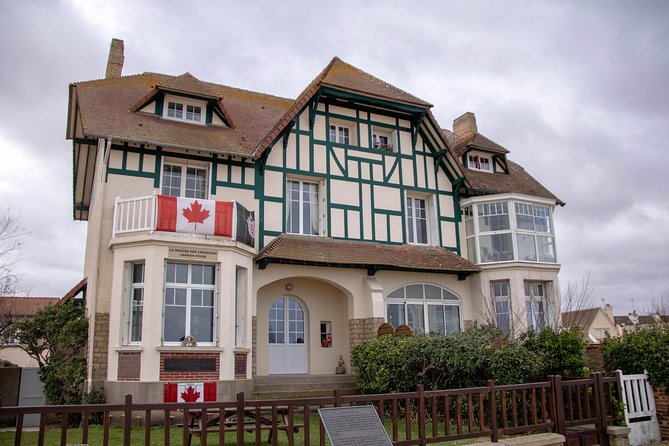
At La Maison des Canadiens, or Canada House, you see one of the most recognizable buildings connected with Canada’s D-Day landing. The large timber-framed house overlooks Juno Beach in Bernières-sur-Mer and appears in many wartime photographs of Canadian troops coming ashore.
The building was among the first houses liberated by Canadian soldiers on June 6, 1944. More than 100 men of the Queen’s Own Rifles were killed or wounded within sight of the house during the first minutes of the landing. That fact makes the building more than a picturesque coastal home. It is a fixed point beside a place of intense fighting.
You have about 20 minutes here, and admission is free. The stop is mainly about seeing the exterior, understanding its position above the beach, and connecting the house to the photographs and military story. Do not expect a long interior tour based on the information provided.
The building survived intact, perhaps because it had been the preferred home of a German officer. The family connected with the house later met Canadian veterans who had liberated it, including descendants of the wartime owners. That link between local families and returning veterans adds a personal note to the visit.
I like this stop because it makes history concrete. You do not need a large exhibit to understand that soldiers were fighting for control of actual streets and homes, not an abstract point on a map.
Same city, a completely different afternoon:
- Paris: Louvre Museum Timed-Entrance Ticket
★ 4.6 · 71,977 reviews - Disneyland® Paris 1-Day Ticket
★ 4.6 · 49,412 reviews - Paris: Versailles Palace and Gardens Full Access Ticket
★ 4.6 · 41,579 reviews - Paris: Evening River Cruise with Music
★ 4.4 · 22,721 reviews
Two hours inside the Juno Beach Centre
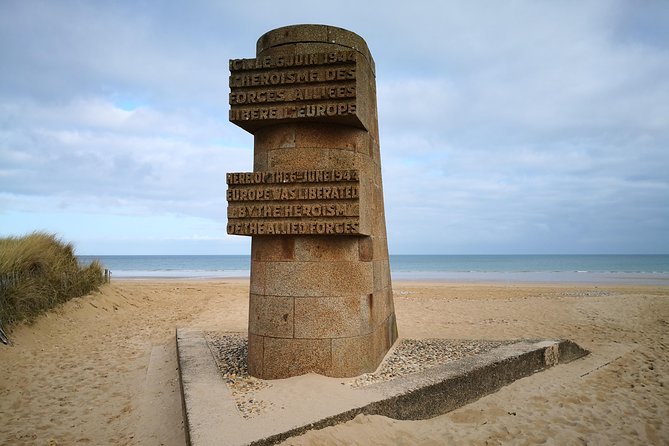
The Juno Beach Centre is the main museum visit, with about two hours set aside and admission included. This is where the tour moves from individual sites to the wider Canadian war effort.
The permanent exhibition begins with a simulated landing craft and a film about June 6, 1944. Photographs, projected images, and the voices of Canadian soldiers and their families introduce the fear, uncertainty, and preparation behind the landing. The presentation is designed to put you near the experience without pretending that a museum can reproduce combat.
The next section explains Canada in the 1930s. You see the country’s geography, population, economy, politics, military position, and social climate before the war. That context is useful because it shows how a country with a relatively small population mobilized more than one million men and women.
The Canada Goes to War section uses period radio voices, including Hitler, Daladier, Chamberlain, and Mackenzie King, to place the declaration of war in its political setting. It also shows how civilians and soldiers contributed on every front. The war was not only fought by infantry in Europe. Engineers, medical personnel, war correspondents, and families at home all formed part of the effort.
The Road to Victory section follows Canadian campaigns in Italy, Normandy, the Scheldt, the Rhineland, and the final victory. It also gives space to subjects that are often left out of a basic beach tour, including First Nations service, the Canadian flag, the 1st Canadian Parachute Battalion, and Canadians working behind enemy lines.
A memorial display carries the names of more than 45,000 Canadians who died during the war. Of those, about 5,500 died during the Battle of Normandy, including 359 on D-Day. That distinction helps you understand both the size of Canada’s total wartime loss and the particular cost of the Normandy campaign.
The final film, They Walk With You, uses wartime newsreel footage, dramatic reconstruction, and the voices of Canadian correspondents Marcel Ouimet and Matthew Halton. It presents the Normandy battle from the viewpoint of an infantry soldier who often knew little of the wider plan and was mainly trying to survive. Viewer discretion is advised.
Two hours is a sensible amount of time here, but you will need to manage it. If you read every panel slowly and watch every film, you may feel pressed. If you focus on the Canadian D-Day story, the museum provides a strong center for the day.
The Cross of Lorraine and Churchill tank
The final listed stop is the Cross of Lorraine, a monument more than 18 meters high facing the sea. It marks General de Gaulle’s return to French soil on June 14, 1944, after crossing the English Channel aboard the French destroyer La Combattante.
This visit broadens the story beyond the Canadian landing. De Gaulle’s return carried political meaning for Free France, while the monument’s position by the coast connects that national story with the Allied return to Normandy.
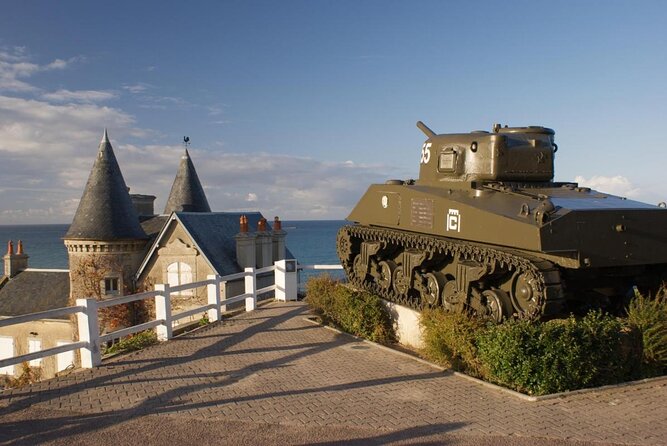
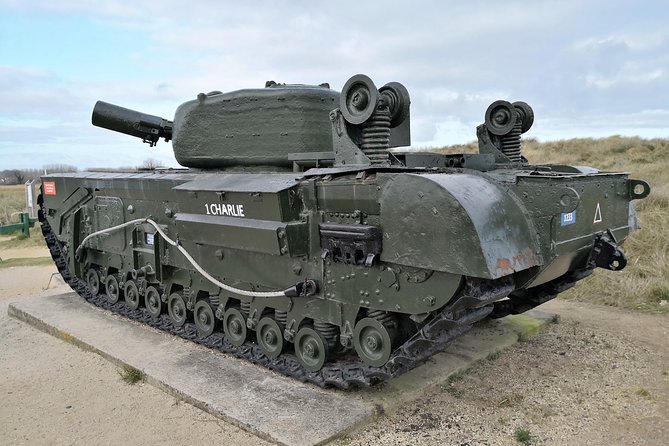
Nearby, a Churchill AVRE tank called One Charlie recalls the engineering and assault work required during the landings. The tank could not bridge a deep culvert about 100 yards south of the site on D-Day. Its crew tried to escape under enemy fire, suffering very heavy casualties.
You have around 30 minutes here, with no admission charge. The tank is especially useful for showing that the invasion depended on more than riflemen and landing craft. Armoured vehicles had to help troops cross obstacles, roads, and fortified areas, often under direct fire.
Price, timing, and what you actually get
The price is $288.99 per person. You receive round-trip transportation from the Théâtre du Lido at 116 bis Avenue des Champs-Élysées, an air-conditioned vehicle, a guide, and entry to the Juno Beach Centre. The other listed stops do not charge admission.
The value depends on your alternative. Reaching Normandy independently from Paris means arranging transport, navigating between sites, and finding a guide who can explain the Canadian campaign. This tour removes those tasks and gives you a specialist route in a small group. If those benefits matter, the price is easier to justify.
The schedule is the trade-off. Departure is at 6:30 a.m., and the full day lasts about 13 to 14 hours. With the return to the same meeting point, you should expect a late evening in Paris. The listed stops alone include roughly four hours of visits, so much of the day is spent on the road.
Bring money for lunch and drinks because neither is included. The provided details do not specify a restaurant or fixed meal break, so you should not assume lunch is arranged. Wear practical shoes, even though this is not presented as a hiking tour.
Confirmation is provided when you book. The tour is offered in English and is near public transportation. Most people can participate, and the activity requires good weather and a minimum number of bookings. You can cancel for a full refund up to 24 hours before the start time. A weather or minimum-group cancellation brings an alternative date or a full refund.
Who should book this Normandy day trip
I would choose this tour if Canada’s military role is your main reason for visiting Normandy. It also suits families with a strong interest in World War II, since the museum includes accessible films, personal accounts, maps, and material for younger visitors.
The small group is helpful if you want to ask questions. The strongest guiding praise centered on Adrian and Régis, whose explanations were described as thoughtful, clear, and sensitive rather than like a classroom lecture. Guide availability may vary, so you should not assume one particular person will lead your departure.
I would hesitate if you want a broad survey of all the D-Day beaches. This route does not promise Omaha, Utah, or the American cemetery. It is a Canadian-focused day with one British airborne stop and several locations tied to Juno and the surrounding battle.
I would also hesitate if you dislike early starts or long drives. Staying in Normandy would give you more time at each site, but this outing is designed for people based in Paris who want to see the key Canadian places in one demanding day.
Should you book it?
Book this tour if you want a focused, guided look at Canada’s part in D-Day and you value a small group over a lower-cost large coach. Pegasus Bridge, Canada House, Bény-sur-Mer, and the Juno Beach Centre work well together, moving from military planning to combat, sacrifice, and remembrance.
Skip it if you need a slower pace, a wide survey of Normandy, or a cheaper excursion. For the right history-minded visitor, though, this is one of the more direct ways to reach Juno Beach from Paris without spending several nights in the region.
FAQ
Where does the tour start?
It starts at Théâtre du Lido, 116 bis Avenue des Champs-Élysées, 75008 Paris.
What time does the tour leave?
The scheduled start time is 6:30 a.m.
How long does the experience last?
The full day lasts approximately 13 to 14 hours and returns to the original meeting point.
Is lunch included?
No. Lunch, food, and drinks are not included unless specifically stated.
What language is the tour offered in?
The tour is offered in English.
What is included in the price?
Transportation in an air-conditioned vehicle, a guide, and admission to the Juno Beach Centre are included.
How many people can join the tour?
The additional tour information gives a maximum of seven people. It is presented as a small-group experience.
Can I cancel for a refund?
Yes. You can cancel at least 24 hours before the start time for a full refund. Cancellations or changes made less than 24 hours before departure are not refunded, and weather or minimum-group cancellations offer an alternative date or a full refund.
Just added around Paris
- Private Paris Marche d’Aligre Walking Tour with Tastings★ 5.0 · 8 reviews
- Private Louvre Museum Tour for Kids & Families with Alberto or his team in Paris★ 5.0 · 41 reviews
- Private Highlights of Paris Tuk-Tuk Experience★ 5.0 · 26 reviews
- Paris Latin Quarter Walking Tour: History & Culture – Small Group★ 5.0 · 14 reviews
- Private Highlights of Paris Bike Tour★ 4.5 · 15 reviews
- Paris Musee d’Orsay PRIVATE TOUR with a Local Private Guide★ 5.0 · 41 reviews
- Private Half Day Historic Tour★ 5.0 · 58 reviews
- Pere Lachaise Cemetery Paris – Exclusive Guided Walking Tour★ 5.0 · 72 reviews
Normandy D-Day Day Trips, compared.

Normandy D-Day Sites & Cemetery Day Trip from Paris with Lunch
Read our review →
Normandy D-Day Small-Group Day Trip with Omaha Beach, Cemetery & Cider Tasting
Read our review →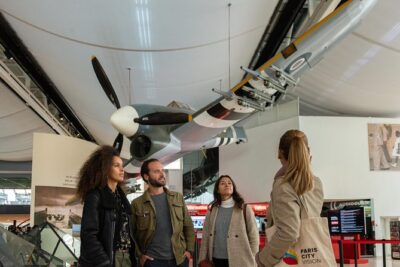
Normandy D-Day Beaches and American Cemetery Day Trip from Paris
Read our review →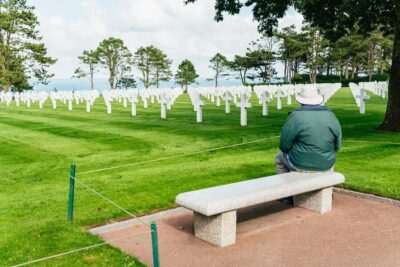
Normandy D-Day Sites Guided Day Trip with Lunch
Read our review →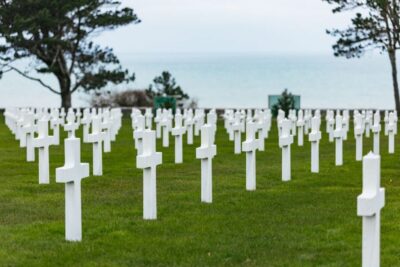
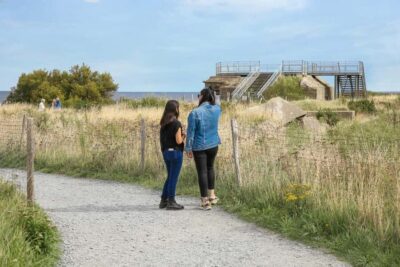
Normandy D-Day Beaches with Juno Beach, bunkers & Canadian Cemetery from Paris
Read our review →
Normandy D-Day Landing Beaches Small-Group Day Trip from Paris
Read our review →Browse the lists this tour appears in