
Reviewed · MONTMARTRE AND SACRé-CœUR TOURS
Clos Montmartre ‘Paris in your Glass’ Wine Tasting
Montmartre’s wine story is far older than its tourist cafés, and this tour connects the two nicely. You walk from the old Saint-Pierre church through quiet village streets to the Clos Montmartre vineyard, then taste three wines with cheese and rustic bread at Place du Tertre.
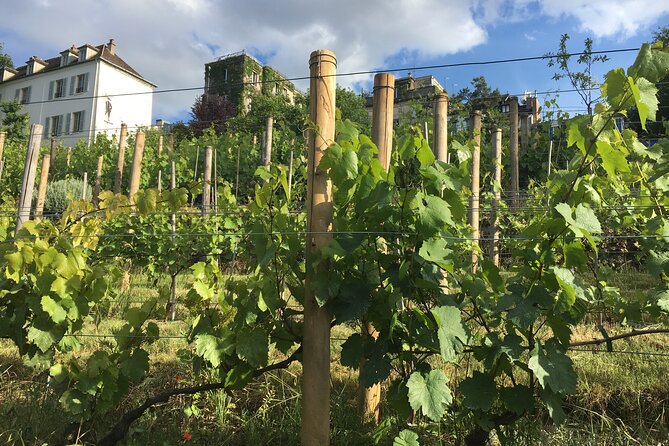
I like the Renoir Garden view of the vineyard, which gives you a clear sense of how a small patch of vines survives in central Paris. I also like the mix of wine and local stories, from Van Gogh’s courtyard to the artists, millers, and writers who shaped this hill. The catch is the uphill walking, and Montmartre’s cobbled streets can be tiring if your legs or balance are not at their best.
Key points
- Rare Paris vineyard wine: Taste the Clos Montmartre vintage, plus one white and one red in a blind tasting.
- A real Montmartre walk: See Saint-Pierre church, La Bonne Franquette, the Moulin de la Galette, the Dalida statue, and other village landmarks.
- Best view: The Renoir Garden at the Musée de Montmartre looks directly over the Clos Montmartre vines.
- Food with the wine: Shared plates include French cheeses and rustic fermented bread.
- Named guide: Geoffrey leads the walk and brings personal experience with Paris wine and Montmartre.
- Plan for hills: The tour begins near Saint-Pierre de Montmartre and ends at Place du Tertre after uphill streets and stairs.
Why this wine walk feels different from a standard Montmartre tour
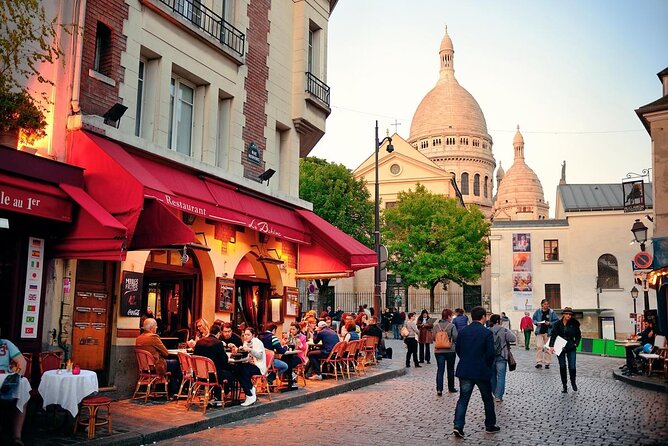
Many Montmartre walks focus on painters, Sacré-Cœur, and the famous views. This one uses wine as the thread. You still see art and village landmarks, but the talk keeps returning to vineyards, grape growing, Paris wine making, and the old Abbey of Montmartre.
That gives the walk a clear purpose. The wine is not simply added at the end as a reward. It helps explain why this hill once had fields, mills, gardens, and vineyards before Paris spread around it.
The experience lasts about two hours and 20 minutes to three hours. It begins at 3:30 pm at Église Saint-Pierre de Montmartre and finishes at 17 Place du Tertre. That timing works well if you want to see Montmartre in the afternoon and settle into the tasting toward the end of the day.
Geoffrey is the named guide. He brings a strong personal interest in wine and shares stories about both the drink and the neighborhood. The walk is offered in English, which makes the historic details easier to follow as you move from stop to stop.
More Montmartre and Sacré-Cœur Tours:
- Montmartre Hidden Gems and Scenic Highlights Walking Tour
★ 5.0 · 2,684 reviews - Montmartre Hill French Gourmet Food and Wine Tasting Walking Tour
★ 5.0 · 2,588 reviews - Paris: Montmartre Cheese, Wine & Pastry Guided Walking Tour
★ 4.8 · 2,255 reviews
Starting beside Église Saint-Pierre de Montmartre
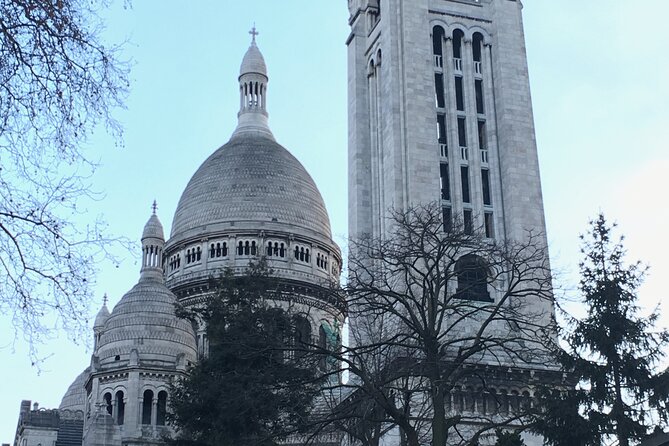
The meeting point is 2 Rue du Mont-Cenis, beside Église Saint-Pierre de Montmartre. This is a useful starting place because the church introduces Montmartre before the crowds and café terraces take over.
Saint-Pierre was built on the site of a Roman temple and is considered the second-oldest church in Paris. Roman columns recovered from the former temple to Mars can be seen inside. The church also belonged to the Abbey of Montmartre, whose grounds were once surrounded by vineyards.
You spend about 10 minutes here. That is enough time for a focused explanation rather than a long church visit. If you arrive early, use the extra time to locate the meeting point and prepare for the climb ahead.
The route requires moderate physical fitness. You will walk uphill and may encounter stairs, so comfortable shoes matter more here than polished evening footwear.
From Van Gogh’s courtyard to Montmartre’s old water tower
The next stops are brief, but they add texture to the walk.
At La Bonne Franquette, you hear about the café as a meeting place for the artists who lived in Montmartre. Its inner courtyard was painted by Van Gogh. The visit lasts only about five minutes, yet it helps link the working neighborhood to the art world that later made Montmartre famous.
The Commanderie du Clos-Montmartre was once a water tower. It now serves as the headquarters of one of the few wine fraternities in Paris. That is a useful reminder that local wine is not just a museum subject. It still has clubs, ceremonies, and people who work to keep the tradition visible.
These short stops do not involve admission fees. Their value comes from the guide’s explanation and the way they connect to the wine theme.
Small stories at Le Passe-Muraille and the Moulin de la Galette
Le Passe-Muraille is a bronze sculpture of a man walking through, or caught in, a wall. It refers to a book by Marcel Aymé, who lived on the square. The stop takes about five minutes.
This is the kind of detail you could easily walk past alone. It also gives the tour a literary side, so the experience is not limited to grapes and tasting notes.
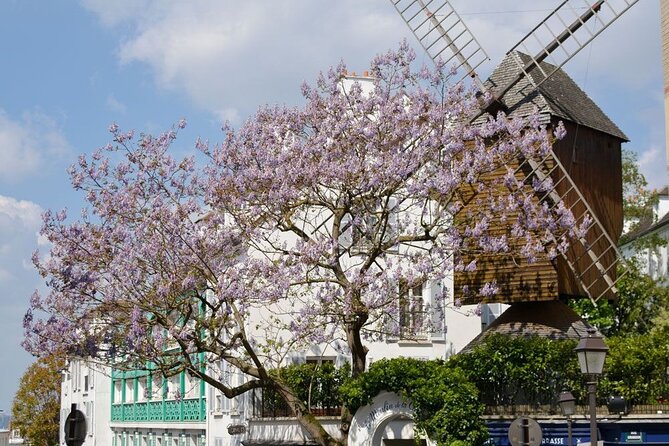
At Le Moulin de la Galette, the guide explains the old windmills of Montmartre. They once milled grain from the surrounding fields. The Moulin de la Galette became linked with a small brown bread called a galette, served by the Debray family of millers with a glass of milk.
You only spend about two minutes here, but the story helps put the vineyard into a wider rural setting. Montmartre was once a village on a hill, not simply a famous district surrounded by Paris.
More wine tastings in Paris:
- Authentic Parisian Gourmet Food Tour with 10 Local Dishes & Wines
★ 5.0 · 4,754 reviews - Loire Valley Castles Day Trip from Paris with Complementary Wine
★ 4.5 · 3,907 reviews - From Paris: Loire Valley Castles Day Trip With Wine Tasting
★ 4.6 · 1,727 reviews - Private Montmartre Food Tour with Wine, Cheese & Pastries
★ 5.0 · 1,027 reviews
Learning how vines grow at Square Suzanne-Buisson
Square Suzanne-Buisson offers one of the clearest teaching moments on the walk. Near the entrance is a grapevine about 30 metres long, and the park contains a statue of Saint-Denis.
Here the talk turns practical. You learn about the life of a vine, cultivation, pruning, and the large number of grape varieties used in wine making. This is a good section if you want more than a sightseeing walk with a drink at the end.
The short stop also prepares you for the vineyard visit. By the time you reach the Clos Montmartre, you have a basic sense of what the vines require and why a vineyard in a city needs care.
The Dalida statue and the view toward Sacré-Cœur
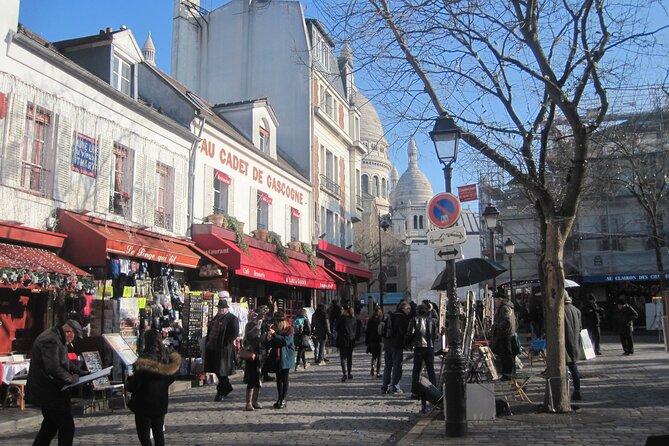
The Place Dalida provides one of the prettiest views on the route. From here, Rue de l’Abreuvoir leads toward the Butte Montmartre and Sacré-Cœur. The square is also beside the Château des Brouillards.
You spend about 15 minutes here, which gives the guide time to discuss the area and lets you take in the view without rushing. Rue de l’Abreuvoir is one of the most photographed streets in Montmartre, so this section can feel more crowded than the earlier lanes.
It is worth paying attention to the less obvious details, too. The Château des Brouillards adds another layer to the neighborhood’s old village character, while the Dalida statue connects the area to a much later period of Parisian popular culture.
The Renoir Garden gives you the best vineyard view
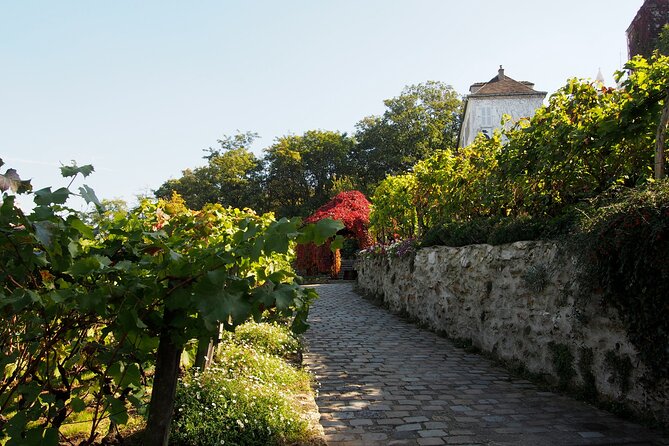
The Musée de Montmartre is the central stop of the experience. Its Renoir Garden offers a clear view over the Clos Montmartre vineyard, making it much easier to understand the scale and setting of the vines.
You spend about 30 minutes at the museum. The garden is especially useful because you can see the vineyard from above before walking closer to it. From that angle, the Clos Montmartre looks less like a conventional rural vineyard and more like a small working patch tucked into the city.
The guide recounts the history of the vineyard and the old Abbey of Montmartre here. This is where the separate stories of church land, village life, artists, and Paris wine come together.
Admission to the Musée de Montmartre is included. The museum itself is not described as a full-length visit, so you should book this experience for the garden viewpoint and the wine story rather than expect hours inside the collection.
Seeing the Clos Montmartre vines up close
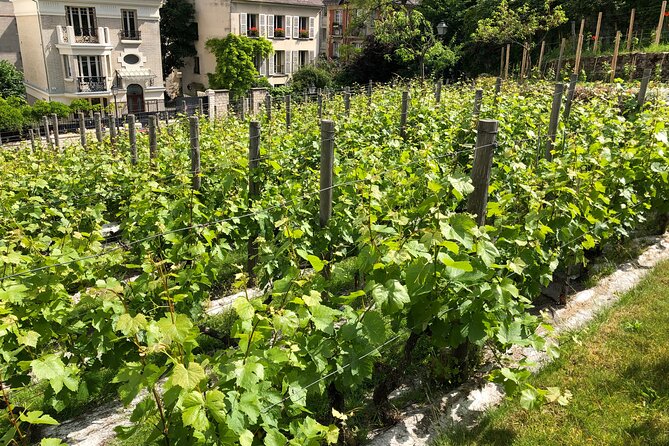
The Clos Montmartre is one of the best-known vineyards inside Paris. It represents an older version of Montmartre, when the hill had more open land and a stronger rural identity.
The vineyard visit follows the view from the museum garden. The walk includes stories about the Abbey of Montmartre as well as artistic, literary, and cultural life in the village. That blend is one of the tour’s strengths. You are not asked to choose between a neighborhood walk and a wine lesson.
The vineyard is not a vast estate, and it should not be treated as one. Its appeal comes from its location and survival. You are looking at a small piece of working vineyard surrounded by one of the world’s most visited cities.
This is also where the experience feels most authentic. The vines are not a decorative backdrop added for visitors. They are the reason for the tour’s subject, and the guide explains how they fit into Montmartre’s past and present.
Three wines, French cheese, and rustic bread at Place du Tertre
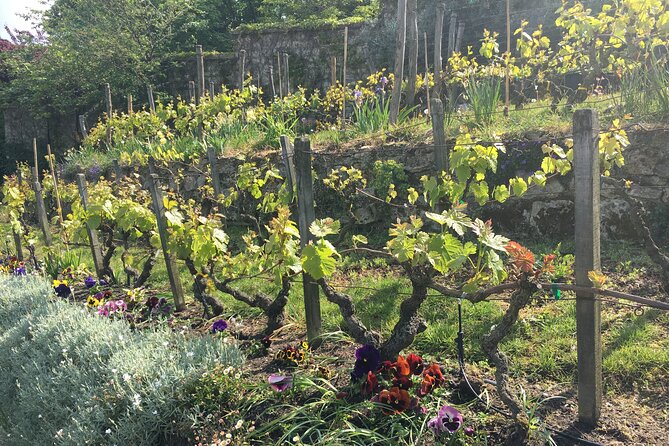
After the vineyard visit, you make the short walk to Place du Tertre, the heart of the Montmartre village. The tasting takes place in one of the square’s well-known wine-bar bistros at 17 Place du Tertre.
The tasting lasts about one hour. You sample three wines:
- The rare Clos Montmartre wine
- One additional white wine
- One additional red wine
The white and red are served as a blind tasting. That makes the closing meal more engaging than a simple pour-and-listen session. You can focus on what you smell and taste before hearing the full explanation.
Shared plates of cheeses and rustic fermented bread accompany the wine. This is not presented as a full dinner, so you may want to eat earlier or plan another meal afterward if you are hungry. Still, the food adds real value because it gives you something substantial to taste between pours.
The Place du Tertre setting is convenient, but it is also the most tourist-oriented part of the route. The square is famous for its artists, restaurants, and busy atmosphere. You gain an easy finish and a classic Montmartre location, but not the quietest setting in Paris.
Is $126.17 a fair price?
At $126.17 per person, this is not a cheap neighborhood stroll. The price makes more sense if you value the combination of a guided walk, museum admission, a rare local wine, two additional tastings, and shared cheese and bread.
You are also paying for interpretation. Without a guide, you could find the church, sculpture, windmill, vineyard, and Dalida statue, but the connection between them would be harder to see. The tour gives those places a single story about Montmartre as a former village with vineyards and working land.
The value is weaker if you mainly want a quick glass of French wine or a general tour of Montmartre. You can find less expensive tastings elsewhere in Paris. This experience suits you best if you want the local vineyard itself and enjoy learning how wine fits into the neighborhood.
The average booking time is 61 days in advance, so advance planning is sensible. The experience has a stated maximum of 110 people, which is a large possible group for narrow Montmartre streets. The actual feel may depend on the number booked on your date, so do not assume an intimate small-group walk.
Who should book this Montmartre experience?
I would choose this tour if you enjoy history, wine, and walking in equal measure. It is especially useful on a first visit to Montmartre because you see several landmarks while getting background that you might miss on your own.
It also suits returning visitors who have already seen Sacré-Cœur and want a different angle on the district. The vineyard, Renoir Garden, Commanderie du Clos, and wine fraternity provide a fresh reason to come back.
You should think twice if steep streets, stairs, or uneven surfaces are difficult for you. The route climbs the hill, and the physical effort is part of the experience rather than a minor detail.
English-speaking wine beginners can enjoy it too. You do not need to be a connoisseur. The blind tasting gives you a simple way to compare the wines, while the guide’s explanations provide useful context without requiring specialist knowledge.
Service animals are allowed, and the meeting point is near public transportation. Free cancellation is available up to 24 hours before the start time. If the minimum number is not reached, the provider offers another date or experience, or a full refund.
My call: book it for the vineyard, not just the wine
I would book this tour if you want to understand why Montmartre feels like a village and how wine helped shape that identity. The Renoir Garden view, the Clos Montmartre visit, and Geoffrey’s personal wine knowledge give the walk a clear focus.
Book it with comfortable shoes, a light meal in mind, and realistic expectations about the hills. You will not visit a grand French château or spend the afternoon in a quiet countryside vineyard. You will see something more unusual: a small Paris vineyard tied to churches, painters, writers, windmills, and an old village on a city hill.
FAQ
Where does the tour begin?
The tour begins at Église Saint-Pierre de Montmartre, 2 Rue du Mont-Cenis, 75018 Paris.
What time does the tour start?
The start time is 3:30 pm.
Where does the tour finish?
The tour ends at 17 Place du Tertre, 75018 Paris.
How long does the experience last?
It lasts approximately two hours and 20 minutes to three hours.
How many wines are included?
You taste three wines: the Clos Montmartre wine, one white wine, and one red wine.
Is food included?
Yes. The tasting includes shared plates of cheeses and rustic fermented bread.
Is museum admission included?
Yes. Admission to the Musée de Montmartre is included.
Is the tour suitable for someone with limited mobility?
The experience requires moderate physical fitness and uphill walking. Montmartre includes hills and stairs, so it may not suit anyone who finds these difficult.
Can I cancel for a refund?
You can cancel at least 24 hours before the start time for a full refund. Cancellations or changes made less than 24 hours before the start time are not accepted for a refund.
More food tours in Paris
- Paris: Seine Cruise & Crepe Tasting near the Eiffel Tower
★ 4.4 · 11,231 reviews - Normandy D-Day Small-Group Day Trip with Omaha Beach, Cemetery & Cider Tasting
★ 5.0 · 2,786 reviews - Paris: Illuminated Evening River Cruise & Waffle Tasting
★ 4.1 · 2,697 reviews - Devour Paris Ultimate Food Tour
★ 5.0 · 2,087 reviews
Just added around Paris
- Private Paris Marche d’Aligre Walking Tour with Tastings★ 5.0 · 8 reviews
- Private Louvre Museum Tour for Kids & Families with Alberto or his team in Paris★ 5.0 · 41 reviews
- Private Highlights of Paris Tuk-Tuk Experience★ 5.0 · 26 reviews
- Paris Latin Quarter Walking Tour: History & Culture – Small Group★ 5.0 · 14 reviews
- Private Highlights of Paris Bike Tour★ 4.5 · 15 reviews
- Paris Musee d’Orsay PRIVATE TOUR with a Local Private Guide★ 5.0 · 41 reviews
- Private Half Day Historic Tour★ 5.0 · 58 reviews
- Pere Lachaise Cemetery Paris – Exclusive Guided Walking Tour★ 5.0 · 72 reviews
Montmartre and Sacré-Cœur Tours, compared.

Montmartre Hidden Gems and Scenic Highlights Walking Tour
Read our review →
Montmartre Hill French Gourmet Food and Wine Tasting Walking Tour
Read our review →
Montmartre Cheese, Wine & Pastry Guided Walking Tour
Read our review →
Montmartre Highlights Walking Tour with a Local Guide
Read our review →
Sacré-Coeur and Montmartre Tour with Expert Guide
Read our review →
Private Montmartre Food Tour with Wine, Cheese & Pastries
Read our review →
Paris Montmartre Food Tour – A Full French Meal by Do Eat Better
Read our review →
Hidden Montmartre: Paris’ Secret Streets Walking Tour
Read our review →Browse the lists this tour appears in