
Reviewed · PARIS WALKING TOURS
Neoclassical Paris Architecture 2-Hour Private Walking Tour
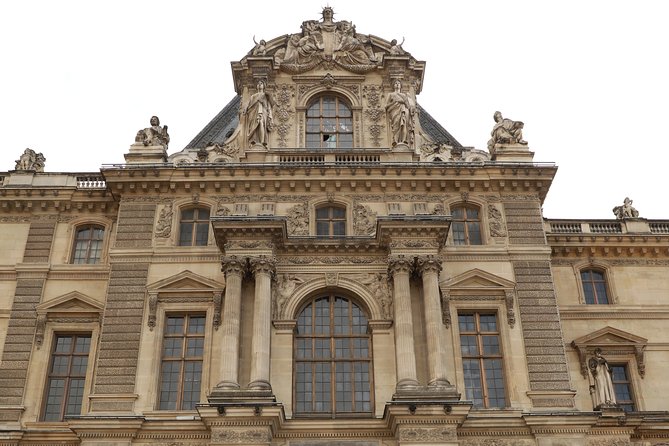
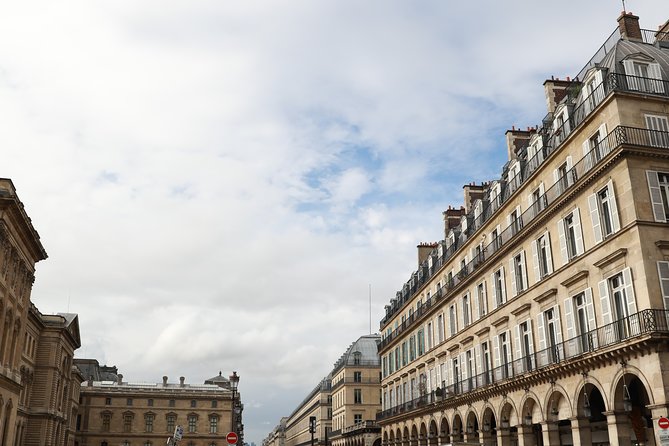
Paris reveals its ideas in stone. On this private Neoclassical walking tour, you follow the shift from royal power and classical order to commerce, public life, and modern Paris. The route links the former stock exchange, a royal square, a covered arcade, the Tuileries, and Palais-Royal, ending near the Louvre.
I like the small-group format, which gives you room to ask why a building looks the way it does instead of simply snapping photos. I also like the art-history focus. Guides such as Boris, Mila, Melissa, Milica, and Dunya have been praised for making architecture easier to understand and connecting it with politics, art, and culture.
The main drawback is its narrow subject. If you want the Eiffel Tower, Notre-Dame, or a broad introduction to Paris, this is not the right walk. Two hours also passes quickly, and some of your time goes to moving between stops rather than standing in front of a single building.
Key points at a glance
- A private route for up to six people: Your group gets the guide’s attention, with no strangers joining you.
- Five carefully linked stops: The walk covers Palais Brongniart, Place des Victoires, Galerie Vivienne, the Tuileries, and Palais-Royal.
- An art historian leads the discussion: Expect architecture explained through art, politics, history, and culture.
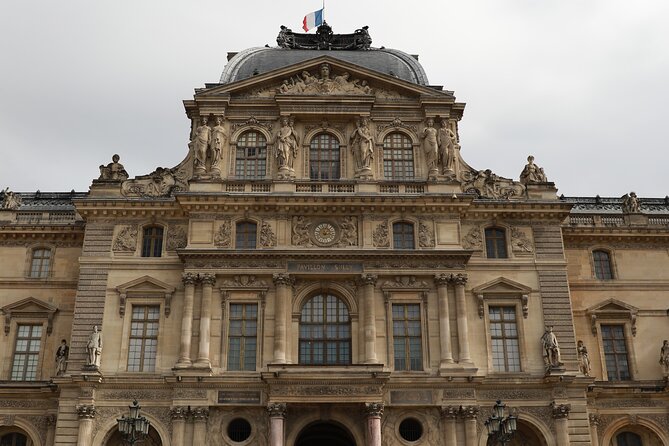
- A useful central Paris finish: You end at the Arc de Triomphe du Carrousel, beside the Louvre complex.
- Strong value for a full group: The price is $360.48 per group, or about $60.08 per person if six people share it.
- A specialized subject: This suits curious visitors who want more than a standard list of famous sights.
Why Neoclassical Paris makes a good walking subject

Neoclassical architecture can sound dry at first. It becomes much more interesting when you see it as a set of choices: symmetry over decoration, ancient Greek and Roman forms over playful excess, and public buildings designed to express order, reason, authority, or civic purpose.
That is the useful promise of this tour. You are not only shown attractive facades. You are given a way to read them. A column, arcade, garden axis, or balanced square becomes part of a larger story about how Paris presented power and modern life.
The route is also smart geographically. It moves through a compact part of central Paris, linking places that many people visit separately. You begin at the former stock exchange and finish close to the Louvre, so the walk can fit neatly into a day spent around the first arrondissement and the Grands Boulevards.
The subject remains specialized, though. I would not choose this as your only Paris tour if you have never visited the city and want the basic landmarks explained. I would choose it after you have seen the major sights, or for a second visit when you want to understand the city’s design and public spaces.
More walking tours in Paris:
- Paris Top Sights Half Day Walking Tour with a Fun Guide
★ 5.0 · 2,893 reviews - Montmartre Hidden Gems and Scenic Highlights Walking Tour
★ 5.0 · 2,684 reviews - Montmartre Hill French Gourmet Food and Wine Tasting Walking Tour
★ 5.0 · 2,588 reviews
Palais Brongniart: finance in a classical frame
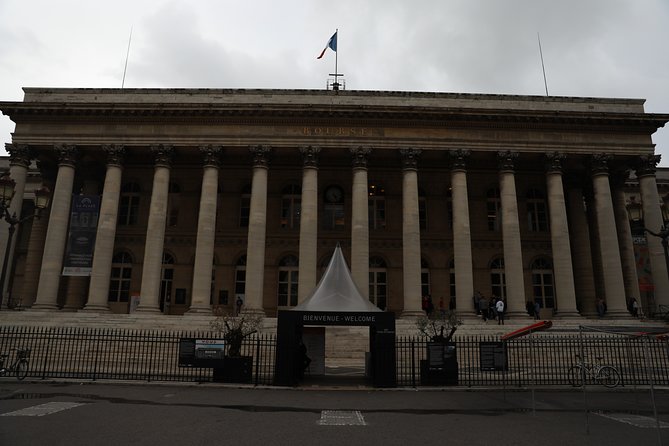
The tour begins at Palais Brongniart, the former stock exchange. You get about 30 minutes here, the longest single stop, and that makes sense. The building is presented as a major example of the style and as a reflection of the values of its era.
This is a good opening because the building gives the guide plenty to work with. Its formal appearance helps introduce the rules of Neoclassicism, while its former function brings those rules into public and economic life. You are not looking at a palace or church alone. You are considering how a society represented trade, confidence, authority, and order.
The free admission listed for the stop means there is no separate ticket to budget for. This is an exterior-focused walking visit based on the information provided, so do not book expecting a long indoor tour of the former exchange.
The 30-minute pause is helpful if you enjoy questions. Several people who took the walk valued the way the guide made complex architectural ideas simple and used questions to get them thinking. That style matters here. A good explanation can turn a formal facade into something you understand rather than merely recognize.
Place des Victoires and the royal-square idea
From Palais Brongniart, the walk continues to Place des Victoires, one of Paris’s four royal squares. You spend about 15 minutes here, enough for a focused explanation rather than a long stop.
The key point is the square’s role as a classical predecessor and model for later Neoclassical thinking. That gives you a helpful bridge between earlier royal planning and the buildings that followed. Instead of treating Neoclassicism as a style that appeared out of nowhere, the guide can show how its visual language developed from existing ideas about symmetry, public space, monarchy, and classical models.
This stop may appeal most if you enjoy urban planning as much as individual buildings. A square is not just a place to stand. Its proportions, surrounding facades, and relationship to a central monument can communicate who holds power and how people are meant to move through the city.
There is a practical point here: 15 minutes is brief. You will receive a compact interpretation, not a full architectural survey of every facade. That is fine for a fast route, but if you want extended time for photographs or detailed drawing, the private format gives you a chance to ask the guide how much flexibility is possible.
Galerie Vivienne: the 19th-century shopping arcade
The next stop is Galerie Vivienne, with about 20 minutes to explore its role in the first half of the 19th century. The tour presents the arcade as an ancestor of the modern shopping mall, a useful connection for anyone who enjoys seeing how old city forms still shape daily life.
This is one of the route’s most approachable stops. You can understand the basic idea quickly: an elegant covered passage brings shops and pedestrians together while offering protection from the weather. Yet the architectural setting also gives the guide room to explain how commerce became part of Parisian public life.
I like this stop because it breaks up the formal language of government buildings and royal spaces. The tour is not only about grand monuments. It also considers the places where people browsed, bought things, and spent time. That makes the subject feel closer to ordinary city life.
The time here remains limited, and shopping is not included as a planned activity. Food and drinks are also not included anywhere on the tour. If you want to browse the arcade at leisure, save that for before or after the two-hour walk rather than expecting the guide to pause for shopping.
More two-hour experiences in Paris:
- The Père Lachaise Cemetery: Guided 2-Hour Small-Group Tour
★ 4.7 · 1,065 reviews - Paris: 2-Hour Perfume Creation Workshop
★ 4.8 · 731 reviews - Paris Louvre: 2-Hour Private Tour for Groups or Families
★ 4.6 · 639 reviews - Paris Montmartre: 2-Hour City Tour in German
★ 4.9 · 299 reviews
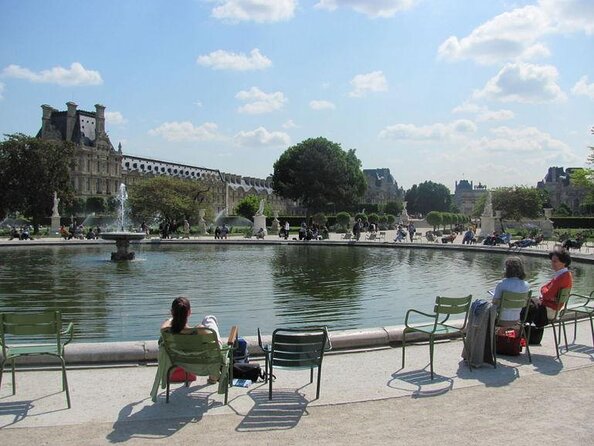
Jardin des Tuileries: a royal garden viewed through ideas
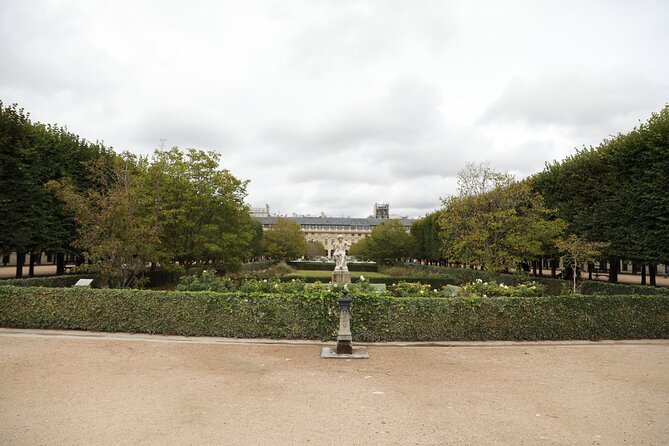
At the Jardin des Tuileries, you spend about 20 minutes looking at the former royal garden through a Neoclassical lens. The guide’s job here is less about naming plants or pointing out every statue and more about explaining the garden’s order, axes, design, and connection to royal power.
Gardens are especially useful in an architecture tour because they show that classical thinking extends beyond buildings. Paths, open spaces, sightlines, and carefully arranged features can create a sense of control and ceremony. You begin to see the city as a planned composition rather than a collection of unrelated sights.
This is also where the route can feel most spacious. After several urban facades and enclosed passages, the Tuileries gives you room to look along long views and consider how the garden relates to the surrounding monuments.
Do not expect a complete visit to the gardens. Twenty minutes is enough for a focused reading of the site, not a stroll through every section. The stop works best if you are willing to listen while walking and keep the larger route in mind.
Palais-Royal: from royal complex to commercial center
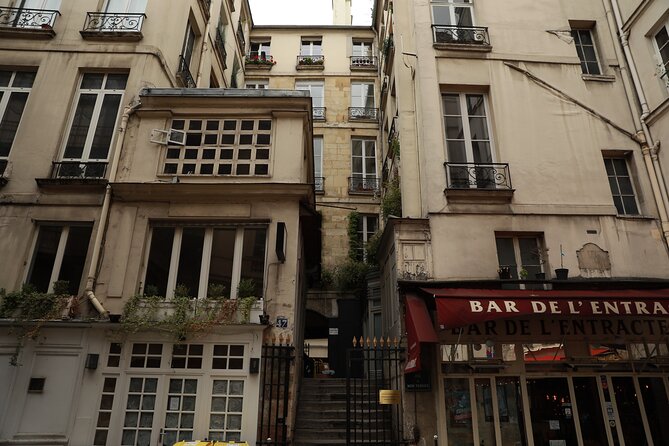
The final listed stop is the Domaine National du Palais-Royal, where you spend about 20 minutes. The complex is examined from the point of view of its transformation into a commercial center, which brings together royal history, architecture, and urban business.
This is a strong ending because it returns to a question raised at Galerie Vivienne: how did formal, elite spaces become connected with public commerce? Palais-Royal lets the guide discuss that change within a setting known for its courtyards, arcades, and relationship to central Paris.
You should expect the guide to focus on interpretation rather than simply giving a list of dates. The most praised part of this tour is the way architecture is joined to historical context and art. That approach is especially useful at Palais-Royal, where the meaning of the site depends on how its function changed over time.
The walk ends at the Arc de Triomphe du Carrousel, at Place du Carrousel near the Louvre. That is a convenient finish for continuing your day, though the tour itself does not include entry to the Louvre or the Arc. Plan any museum visit separately.
What the private format changes
A private tour for up to six people costs $360.48 per group. For six participants, that works out to about $60.08 each. For two people, the per-person cost rises sharply, so the value depends on your group size and how much you care about personal attention.
The biggest advantage is the ability to shape the conversation. If one person in your group wants more about art, another wants political context, and someone else wants help understanding building design, you can ask the guide to adjust the balance. The tour is offered in English, and it may be operated by a multilingual guide.
A private format also helps if your group has different levels of interest. You can ask for a plain explanation of a technical term, or spend longer at a stop that catches your attention. One guide, Boris, was praised for asking questions and making architectural information easy to follow. That suggests the tour can work well for families or mixed-age groups, especially when a child or teenager needs the subject brought down to earth.
The tradeoff is price. You are paying for the guide’s time rather than a low-cost group outing. If you are traveling alone or as a couple on a tight budget, a shared architectural walk may cost less. If you have four to six people who enjoy museums, design, or city history, the calculation looks better.
Timing, meeting point, and walking demands
The tour begins at Bourse in the 75002 area and ends at the Arc de Triomphe du Carrousel in the 75001 area. That east-to-west movement is useful because it carries you toward the Louvre rather than returning you to the starting point.
The listed stop times add up to 105 minutes, leaving roughly 15 minutes within the two-hour schedule for walking between locations and transitions. You should arrive ready to keep moving. The tour asks for a moderate level of physical fitness, and public transportation is nearby.
No food or drinks are included, so carry what you need for two hours. Service animals are allowed. Confirmation normally arrives at booking, but reservations made within seven days of the tour may receive confirmation within 48 hours, subject to availability.
You can cancel for a full refund up to 24 hours before the start time. Changes or cancellations made less than 24 hours ahead are not accepted for a refund. Since this tour is often booked about 41 days in advance, planning early is sensible if your Paris dates are fixed.
The guides and the teaching style
The guide is the heart of this walk. The tour calls for a professional art historian, and the strongest feedback centers on clear explanations, warmth, and the ability to connect architecture with wider culture.
Guides named in the feedback include Mila, Melissa, Dunya, and Boris, with Milica also mentioned in a response. Names and availability can change, so you should not assume a particular person will lead your date. You can reasonably expect an English-speaking guide, though the operator notes that the guide may be multilingual.
The most useful feature is not a stack of facts. It is the effort to make the subject understandable. Melissa was praised for linking architecture with historical context and art. Boris was praised for using questions so that the material felt like a conversation rather than a lecture. Those details matter because Neoclassical architecture can become a blur of dates and style names without a guide who can explain why the choices mattered.
This is also a tour for people who like to participate. Bring questions about symmetry, royal planning, public buildings, art, or the changing use of Parisian spaces. You will get more from the walk if you treat the guide as a specialist you can talk with, not as an audio recording moving you from stop to stop.
Who should book this Paris walk?
I would recommend it to you if you already have a basic feel for Paris and want to understand the city’s design. It suits architecture students, art lovers, history enthusiasts, curious families, and repeat visitors who have already checked off the biggest landmarks.
It also works well for a small group with a shared interest. Six friends or family members can split the price and ask questions without competing with a large crowd. A parent and older child could also enjoy it, especially if the child likes buildings, art, or puzzles about how cities work.
I would be more cautious if you want interiors, museum admission, or a broad tour of Paris. The route is mainly about public spaces and architectural context, and the tour does not include food, drinks, or entry tickets. Two hours gives you a strong introduction to one subject, not a complete survey of the city.
Should you book it?
Book this walk if you want Paris explained through architecture, art, and power, and if a private guide is worth the extra cost to you. The route is compact, the five stops fit together well, and the finish near the Louvre makes it easy to continue sightseeing.
Skip it if you prefer a highlight reel of famous monuments or need a low-cost tour for one or two people. For the right audience, though, this is a thoughtful way to see familiar central Paris with new eyes. You leave with more than a set of photographs: you gain a practical method for reading the city’s squares, gardens, arcades, and public buildings.
FAQ
How long is the Neoclassical Paris walking tour?
The tour lasts approximately two hours.
How many people can join the private tour?
The private tour accommodates up to six people in your group.
What language is the tour offered in?
The tour is offered in English. The guide may be multilingual.
Where does the tour begin?
The meeting point is at Bourse, Paris 75002, France.
Where does the tour end?
The tour ends at the Arc de Triomphe du Carrousel, Place du Carrousel, Paris 75001, near the Louvre.
Which places are included on the route?
The route includes Palais Brongniart, Place des Victoires, Galerie Vivienne, Jardin des Tuileries, and Domaine National du Palais-Royal.
Is admission included?
The professional art historian guide and private tour are included. Food and drinks are not included, and the listed stops have no separate admission ticket.
Can I cancel for a full refund?
Yes. You can cancel at least 24 hours before the start time for a full refund. Cancellations or changes made less than 24 hours before the tour are not accepted for a refund.
Just added around Paris
- Private Paris Marche d’Aligre Walking Tour with Tastings★ 5.0 · 8 reviews
- Private Louvre Museum Tour for Kids & Families with Alberto or his team in Paris★ 5.0 · 41 reviews
- Private Highlights of Paris Tuk-Tuk Experience★ 5.0 · 26 reviews
- Paris Latin Quarter Walking Tour: History & Culture – Small Group★ 5.0 · 14 reviews
- Private Highlights of Paris Bike Tour★ 4.5 · 15 reviews
- Paris Musee d’Orsay PRIVATE TOUR with a Local Private Guide★ 5.0 · 41 reviews
- Private Half Day Historic Tour★ 5.0 · 58 reviews
- Pere Lachaise Cemetery Paris – Exclusive Guided Walking Tour★ 5.0 · 72 reviews
Paris Walking Tours, compared.

Paris Top Sights Half Day Walking Tour with a Fun Guide
Read our review →
Montmartre Hidden Gems and Scenic Highlights Walking Tour
Read our review →
Montmartre Hill French Gourmet Food and Wine Tasting Walking Tour
Read our review →
Paris Île de la Cité and Notre-Dame Walking Tour With Crypt
Read our review →
Montmartre Cheese, Wine & Pastry Guided Walking Tour
Read our review →
Paris in a Day: Louvre or Orsay, Eiffel Tower, City Walk & Cruise
Read our review →
Montmartre Highlights Walking Tour with a Local Guide
Read our review →
Browse the lists this tour appears in