
Reviewed · PARIS WALKING TOURS
Paris by Night Walking Tour: Ghosts, Mysteries and Legends
Paris looks different after sunset, and this walk uses that change of mood well. Starting near Pont Neuf, you follow a guide through the Île de la Cité and central streets tied to executions, royal intrigue, and religious violence. The stories range from the Knights Templar to Marie Antoinette and the French Revolution.
I like the low price and the small group, capped at 20 people. I also like the route’s mix of famous places and less obvious corners, including Square du Vert-Galant and Eglise St-Germain l’Auxerrois. The main catch is simple: this is often a dark-history walk rather than a true ghost tour, and some stretches involve walking without much commentary.
Key points to know before booking
- The route covers about two hours: One detailed account puts the distance at roughly 10,000 steps, so wear comfortable shoes.
- The supernatural side is limited: Expect murders, massacres, torture, and legends more often than confirmed hauntings or jump scares.
- The small group helps: A maximum of 20 people makes it easier to hear guides such as Sophia, Daniel, Thelma, or Sylvia.
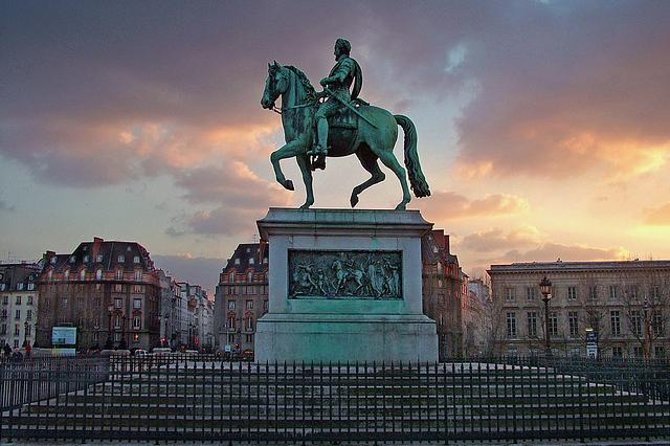
- You finish near Hôtel de Ville: The walk begins at the equestrian statue of Henri IV by Pont Neuf and ends near Hotel La Ville on Rue de Rivoli.
- Several stops carry serious historical weight: You visit the Conciergerie area, Palais de Justice, St-Germain-l’Auxerrois, and the former execution site at Hôtel de Ville.
- The value is strongest for casual history fans: At $18.10 per person, it offers a long evening walk and plenty of background, but specialists may find parts too familiar or simplified.
Paris after dark, with a grim turn
This is not a candlelit séance or a haunted-house attraction. It is a guided walk through the darker chapters of Paris, with ghosts and legends used as a doorway into stories about murder, war, plague, religious conflict, royal power, and public punishment.
That distinction matters. The title promises Ghosts, Mysteries and Legends, but the actual experience leans heavily toward history. You may hear about spirits and lingering legends, yet much of the evening concerns real events: the St. Bartholomew’s Day Massacre, the French Revolution, medieval executions, the Paris Commune, and the city under Nazi occupation.
I see that as both the tour’s strength and its weakness. If you want a well-priced evening introduction to Paris’s violent past, the format works. If you want a frightening ghost story at every stop, you may feel shortchanged.
The walk is offered in English, and the guide stays with your group throughout. Guides named in individual accounts include Sophia, Sofia, Thelma, Daniel, Sylvia, Ami, Kritika, and Emmy. The quality can depend on who leads your departure. Strong guides tie the locations together and tell the stories with humor and feeling. Less engaging guides may simply recite facts while the group walks.
More evening tours in Paris:
- Paris: Big Bus Panoramic Night Tour by Open-Top Bus
★ 4.4 · 4,168 reviews - Paris: Discover Paris by Night in a Vintage Car with a Local
★ 4.6 · 1,058 reviews - Paris Big Bus Open Top Panoramic Night Tour
★ 4.0 · 874 reviews
Meeting Henri IV beside Pont Neuf
The meeting point is the equestrian statue of Henri IV at 15 Place du Pont Neuf. This puts you in a useful part of central Paris, close to the Seine and the western end of Île de la Cité.
Arrive ready to walk. The tour lasts about two hours, and one account estimates roughly 10,000 steps. That is not an extreme distance for Paris, but the route includes standing on pavements and moving between stops, often at an evening pace. Comfortable shoes matter more than dressy footwear.
The opening setting is attractive and slightly deceptive. Pont Neuf, despite its name, is Paris’s oldest standing bridge, and the river views can feel romantic. The guide then turns that pleasant scene toward the city’s darker past. Paris’s polished streets were also places of punishment, political unrest, religious conflict, and public spectacle.
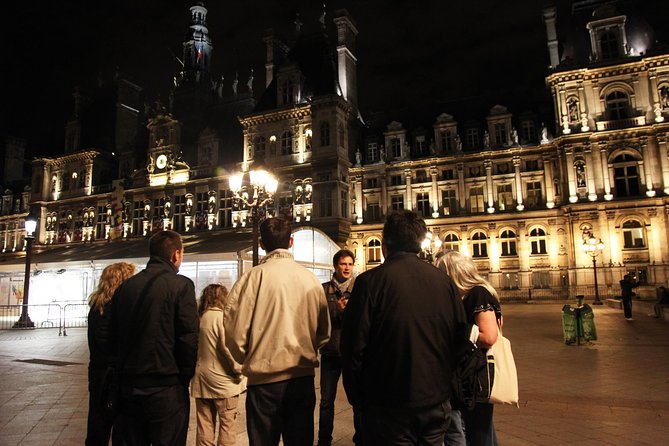
The group size is limited to 20. That is not a private tour, but it is small enough for a good guide to answer questions and keep the group together. A weaker guide may still spend long periods speaking at the group rather than engaging with it.
Square du Vert-Galant and the Knights Templar
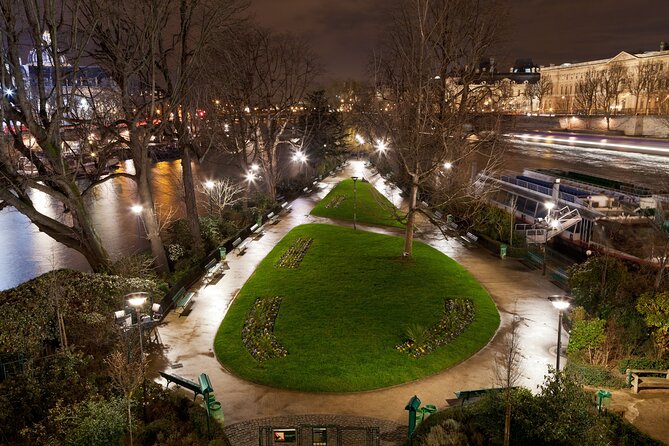
One of the first stops is Square du Vert-Galant, the green tip of Île de la Cité. Today it is a peaceful riverside spot associated with Henri IV and his mistresses. It has also received ecological park status, which makes the setting feel far removed from the tale attached to it.
Here, the guide describes the execution of the last Knights Templar. The contrast is the point: a quiet park and beautiful Seine views become the backdrop for a story about religious power, accusations, and burning at the stake.
You spend only about five minutes at this stop, and admission is free. Do not expect to enter a museum or see a surviving execution platform. The appeal comes from hearing the account in the place connected with it, even though the modern surroundings have changed greatly.
This stop also illustrates an important limitation. Some guides may use nearby features to help tell the story, but you should not assume every stone or pillar is an original medieval object. One detailed account raised concerns about a modern stair pillar being presented as the place where Templars were tied. If historical precision matters greatly to you, treat the storytelling as an introduction, not a scholarly lecture.
St-Germain-l’Auxerrois and the St. Bartholomew’s Day Massacre
The walk continues to Eglise St-Germain l’Auxerrois, a church with origins reaching back to the seventh century. Its location near the Louvre gives it an important place in Paris’s royal and religious story.
The guide discusses the St. Bartholomew’s Day Massacre of 1572, when around 30,000 Huguenots were killed. This is one of the tour’s strongest subjects because it combines religious conflict, court politics, marriage, fear, and mob violence.
A good guide can explain why the massacre still matters without turning the event into a quick horror anecdote. You should hear about the tension between Catholics and Protestants and the role played by powerful figures around the French court. The church provides a serious setting for that discussion.
The stop itself is brief, listed at about five minutes. You are not signing up for an extended church visit or a guided interior tour. The value is in the location and the explanation, not in spending a long time inside.
More walking tours in Paris:
- Paris Top Sights Half Day Walking Tour with a Fun Guide
★ 5.0 · 2,893 reviews - Montmartre Hidden Gems and Scenic Highlights Walking Tour
★ 5.0 · 2,684 reviews - Montmartre Hill French Gourmet Food and Wine Tasting Walking Tour
★ 5.0 · 2,588 reviews - Paris Île de la Cité and Notre-Dame Walking Tour With Crypt
★ 5.0 · 2,272 reviews
Île de la Cité and the Conciergerie connection
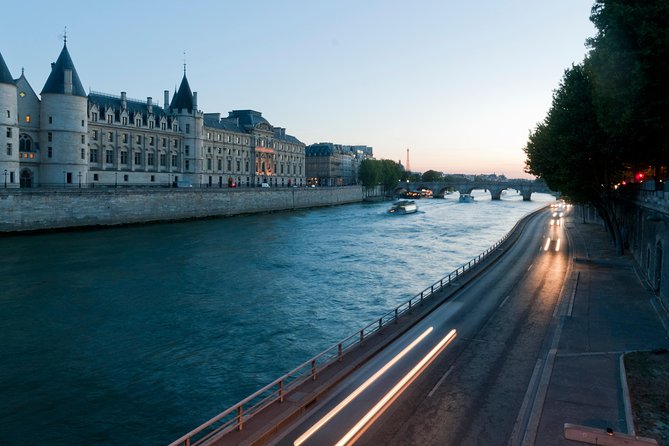
The walk passes through or near Île de la Cité, the island at the center of the Seine. In the fourth century, it was the site of the Roman governor’s fortress. Today it is one of the most visited parts of Paris, but the tour encourages you to see it as a place of authority, imprisonment, judgment, and revolt.
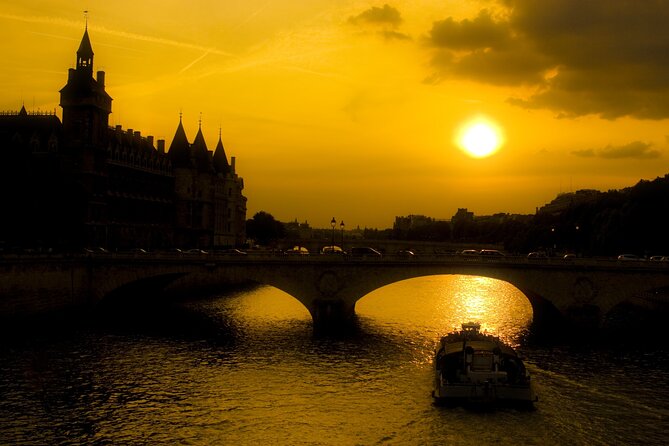
The Conciergerie is a major point of interest. This former royal prison held Marie Antoinette before her execution during the French Revolution. The tour does not include hotel pickup or a separate admission to the monument, so you should think of this as an exterior visit and historical explanation rather than a full prison tour.
The Conciergerie is worth visiting independently if you want more detail and interior access. On this walk, you get the useful context without paying for another ticket or spending hours inside. For a first evening in Paris, that can be a good trade.
Palais de Justice and the machinery of punishment
At the Palais de Justice de Paris, the focus turns to the courts and the French Revolution. The building received the Grand Prix de l’Empereur as the greatest work of art produced in France during that decade, yet it is also tied to people being judged, condemned, and sent to the guillotine.
The guide explains how punishment became public entertainment during the Revolution. Executions drew crowds, and even kings and revolutionaries could become part of the spectacle. The story is grim, but it helps explain how quickly political ideals could turn into violence.
This is likely to be one of the more informative sections of the walk. It gives you a framework for understanding the Revolution beyond familiar images of barricades and the Bastille. You hear about institutions, public judgment, and the way fear moved through Paris.
The tone is not suitable for every child. The tour deals openly with torture, beheadings, murder, and mass killing. Families with older teenagers may find it useful, but young children may be bored or unsettled.
Place de l’Hôtel de Ville and the final executions
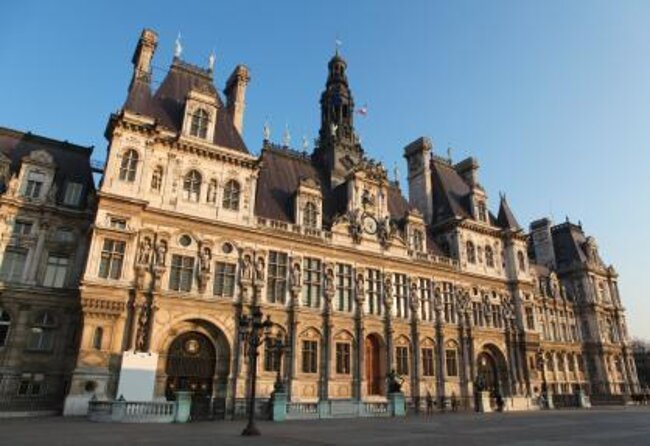
The route ends near Place de l’Hôtel de Ville, formerly a site for municipal celebrations, royal births, and marriages. It was also an execution ground from 1310 to 1830.
The guide discusses figures including François Ravaillac and La Brinvilliers. Ravaillac assassinated Henri IV, while La Brinvilliers became infamous as a poisoner. These stories give the final section a personal scale after the larger themes of war and revolution.
Ending here is practical. Hotel La Ville, at 70 Rue de Rivoli, is close to major central Paris sights and public transport. You can continue toward the Marais, the Seine, or the Louvre area, depending on your plans. Since the tour begins and ends in central Paris, you do not lose time traveling out to a distant neighborhood.
The final location also reinforces the tour’s main idea: Paris’s grand public squares were used for celebration and punishment alike. The city’s beauty and cruelty often occupied the same space.
How much ghost story will you get?
This is the question to settle before you pay. Several accounts describe the experience as informative but not especially scary. One person left after an hour because the walk did not feel exciting enough. Another said it was really a history lesson rather than a ghost tour.
At the same time, other guides have delivered a more atmospheric evening. Sophia has been praised for spooky stories, questions, and suggestions for other Paris sites. Daniel has been described as entertaining and good at keeping a steady pace. Ami has connected legends across the route, while Thelma has focused clearly on death, murder, and executions.
The safest expectation is dark historical storytelling with occasional supernatural material. Do not book it expecting actors, special effects, haunted interiors, or a spirit appearing at each stop. Book it if you like hearing how real crimes, royal scandals, and old legends became part of Parisian memory.
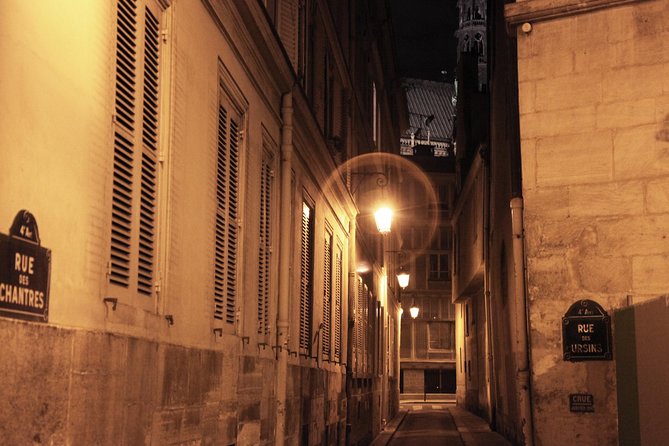
The night setting helps, even when the content is not frightening. Streets are quieter, the monuments look different, and the subject matter feels more natural after sunset. Still, the route includes ordinary city walking. There can be long stretches when the guide is moving the group from one point to another.
Guide quality makes a real difference
The best version of this tour depends on the person holding the lantern, figuratively speaking. Some guides are warm, clear, funny, and good at linking one event to the next. Sophia, Daniel, Sylvia, Thelma, and Ami are among the guides singled out for clear explanations, friendly interaction, or strong storytelling.
Other accounts describe a faster, flatter presentation. One guide was pleasant but seemed eager to finish. Another spoke mostly to a few people, leaving the rest to listen passively. That variation is worth considering because the route itself is fixed, while the energy and accuracy of the presentation may change.
There has also been criticism of historical errors, especially around Catherine de’ Medici, Henri IV, the Templars, and the St. Bartholomew’s Day Massacre. If you teach French history or already know the period well, you may notice oversimplifications or disputed claims.
I would not choose this walk as my main history lesson on sixteenth-century France. I would use it as an accessible introduction, then check important details in a museum, book, or reputable historical source.
Is $18.10 good value?
At $18.10 per person, this is an inexpensive way to fill an evening in central Paris. You get a local guide, about two hours of walking, and a group limited to 20. There is no hotel pickup, but the start and finish are both central and close to public transportation.
The value is best if you want an easy introduction to Parisian history without committing to a museum visit. The route covers several major locations, and you can continue sightseeing afterward. For the price of a modest meal or drink in Paris, you get a structured walk and a set of stories you might not encounter by wandering alone.
The value is weaker if you already know Paris well or want a tightly connected route with constant action. One detailed assessment found long gaps between points of interest and suggested that the stops could be arranged more logically. You may spend part of the evening simply walking while waiting for the next story.
Free cancellation is available if you cancel at least 24 hours before the start time. A minimum group size is required, and if that is not reached, you are offered another date or a full refund.
Who should book this evening walk?
I would recommend it most to first-time visitors, casual history fans, and anyone looking for a different way to spend an open evening. You do not need prior knowledge of French history, and the central route gives you useful orientation around Île de la Cité, the Louvre area, and Hôtel de Ville.
It also suits people who enjoy serious subjects presented in a social walking-tour format. You will hear about executions, poisoners, massacres, imprisonment, and political violence, but the guide may balance the material with humor and local stories.
I would hesitate if you are a specialist in medieval or early modern France. I would also hesitate if the words ghost tour mean a genuinely scary supernatural experience to you. You may enjoy the atmosphere, but the content is more often historical than haunted.
My call: book it for dark history, not guaranteed scares
Book this tour if you want a cheap, central evening walk through Paris’s most unsettling stories. The Conciergerie, St-Germain l’Auxerrois, Palais de Justice, Square du Vert-Galant, and Hôtel de Ville give the route plenty of historical weight, while the night setting adds mood.
Skip it if you want a polished theatrical ghost experience or highly exact academic history. Go in expecting murder, religious conflict, royal drama, executions, and legends, with the level of suspense shaped by your guide. Wear good shoes, keep your expectations realistic, and you are likely to get solid value for a modest price.
FAQ
Where does the Paris by Night Walking Tour begin?
The tour begins at the equestrian statue of Henri IV, 15 Place du Pont Neuf, 75001 Paris, near Pont Neuf bridge.
Where does the tour end?
The walk ends near Hotel La Ville at 70 Rue de Rivoli, 75004 Paris.
How long does the tour last?
The tour lasts approximately two hours.
What language is the tour offered in?
The tour is offered in English.
How many people can join the group?
The group has a maximum of 20 people.
Is hotel pickup included?
No. Hotel pickup and drop-off are not included.
What places are included on the route?
The route includes or passes Square du Vert-Galant, Eglise St-Germain l’Auxerrois, Île de la Cité, the Conciergerie area, Palais de Justice de Paris, and Place de l’Hôtel de Ville.
Is the tour suitable for most people?
Yes. Most people can participate, but you should be prepared for about two hours of walking. One account estimates roughly 10,000 steps.
Can I cancel for a full refund?
Yes, if you cancel at least 24 hours before the experience start time. Cancellations made less than 24 hours before the start are not refunded.
Just added around Paris
- Paris: The Da Vinci Code Walking Tour with a Local Guide★ 4.3 · 5 reviews
- Paris: Flea Market Insider’s Tour in Extra-Small Group★ 4.6 · 73 reviews
- Paris: Private Fashion Tour (Chanel, Dior, Sex & the City)★ 5.0 · 3 reviews
- Paris: Floral Earrings workshop★ 5.0 · 3 reviews
- PARIS: Family e-bike longtail renting★ 5.0 · 3 reviews
- Paris: Fashion History Walking Tour in the Heart of Paris★ 4.9 · 22 reviews
- Paris: Famous Monuments Cycling Tour★ 4.7 · 20 reviews
- Paris: private city tour with seine river cruise★ 4.8 · 28 reviews
Paris Walking Tours, compared.
Paris Top Sights Half Day Walking Tour with a Fun Guide
Read our review →
Montmartre Hidden Gems and Scenic Highlights Walking Tour
Read our review →
Montmartre Hill French Gourmet Food and Wine Tasting Walking Tour
Read our review →
Paris Île de la Cité and Notre-Dame Walking Tour With Crypt
Read our review →
Montmartre Cheese, Wine & Pastry Guided Walking Tour
Read our review →
Paris in a Day: Louvre or Orsay, Eiffel Tower, City Walk & Cruise
Read our review →
Montmartre Highlights Walking Tour with a Local Guide
Read our review →
Browse the lists this tour appears in