
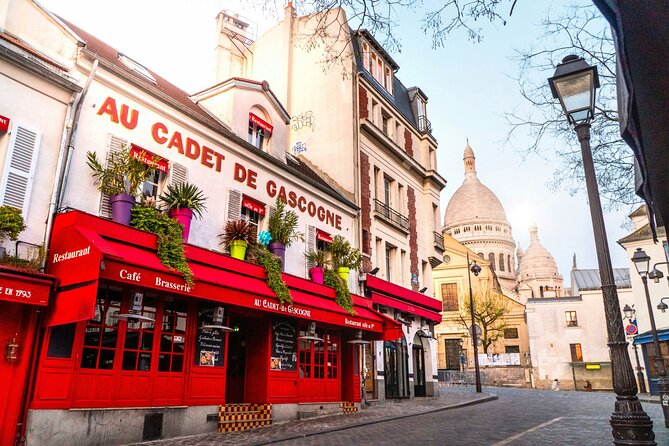
Reviewed · MONTMARTRE AND SACRé-CœUR TOURS
Paris – Montmartre Small Group Walking Tour with a True Local
Montmartre is best understood on foot, and this small-group walk puts its strongest asset front and center: Corentin grew up in the neighborhood. He links the famous sights with stories about artists, writers, films, cabarets, and local characters, while adding side streets and lesser-known corners that are easy to miss on your own.
I like the six-person maximum, which makes it easier to hear on busy streets and ask detailed questions. I also like the route’s range, from the Moulin Rouge and Café des Deux Moulins to the old artists’ quarters, a city vineyard, Sacré-Cœur, and Place du Tertre. The main drawback is the hill, stairs, and uneven walking, so this is not a good match for anyone with limited mobility or a low tolerance for uphill walking.
Key points at a glance
- A true local guide: Corentin was born and raised in Montmartre and shares neighborhood stories alongside standard landmarks.
- A six-person limit: The small group leaves room for questions and makes it easier to follow the guide through busy streets.
- An artist-focused route: Van Gogh, Renoir, Picasso, Marcel Aymé, and the many painters tied to Montmartre all have a place here.
- A downhill-to-uphill story: You begin near Place Blanche and finish at Sacré-Cœur, with the neighborhood’s climb built into the route.
- A family-friendly pace: The walk takes about 1 hour 45 minutes, and families with children as young as 10 have found the storytelling engaging.
- A notable service risk: One reported missed meeting caused a serious problem, although the guide accepted responsibility and issued a full refund.
Why a local-led walk suits Montmartre

Montmartre can feel simple on a map: start at the Moulin Rouge, climb toward Sacré-Cœur, then finish at Place du Tertre. In practice, the neighborhood is a maze of sloping streets, stairways, crowded viewpoints, movie locations, old cabarets, and small traces of its artistic past.
That is where a local guide can earn the $80 price. Corentin is not just pointing out buildings. He connects locations to people and stories, then makes room for questions. The strongest praise for this tour focuses on his storytelling, patience, humor, and ability to show places not normally included on a standard route.
The maximum group size is six. That matters in Montmartre, where traffic noise and crowds can make a large walking tour hard to follow. You are more likely to hear the explanation at each stop, and you can ask about Parisian history, artists, films, or the neighborhood itself without waiting for a long line of people to finish.
The tour is conducted in a comfortable, moderate rhythm, with short pauses for photos and views. It is still an active walk. You should expect uphill sections and city pavement rather than a flat promenade.
More Montmartre and Sacré-Cœur Tours:
- Montmartre Hidden Gems and Scenic Highlights Walking Tour
★ 5.0 · 2,684 reviews - Montmartre Hill French Gourmet Food and Wine Tasting Walking Tour
★ 5.0 · 2,588 reviews - Paris: Montmartre Cheese, Wine & Pastry Guided Walking Tour
★ 4.8 · 2,255 reviews
Starting at the Moulin Rouge and Place Blanche
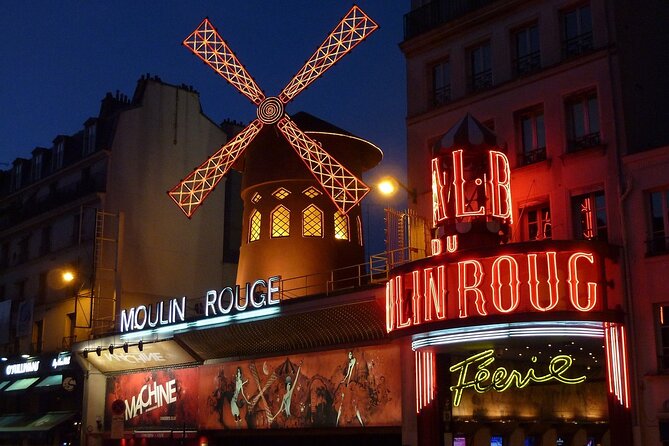
The meeting point is outside Five Guys at 3 Place Blanche, close to the Moulin Rouge. It is a practical location near public transportation, though a fast-food restaurant is not exactly a romantic introduction to Montmartre. Look for the guide carefully and allow enough time to arrive before the scheduled start.
The Moulin Rouge is the right opening stop because it introduces Montmartre’s long connection with nightlife, performance, and the Belle Époque. You spend about 10 minutes here learning how the red windmill became one of Paris’s best-known cabaret symbols.
Admission to the Moulin Rouge is not included, and the tour does not take you inside. That is worth understanding before you book. This is an exterior-focused walking tour, with no admission to buildings along the route.
You then pass the Café des Deux Moulins, known as the workplace of Amélie Poulain in the film Amélie. The café is a quick pass-by rather than a scheduled meal or seated visit. If the movie is important to you, this is a pleasant film connection, but you should not expect time for a full café stop.
Van Gogh, Renoir, and Montmartre’s artist years
The apartment connected with Vincent van Gogh and his brother Théo offers a chance to discuss Vincent’s Paris years. This period helped shape his artistic direction, and the guide uses the location to explain how Montmartre affected his work.
The stop lasts about 10 minutes and is free, but the tour does not include access to the apartment. You will be learning from the street and from Corentin’s explanation. That format is common throughout the walk: the value comes from context, not from entering historic interiors.
At Le Moulin de la Galette, the focus shifts to Renoir and Le Bal du Moulin de la Galette. The place also has a darker past, which gives the stop more weight than a simple painting reference. You get a look at how an actual Montmartre setting became part of the story of Parisian art.
The route then reaches Le Bateau-Lavoir, a major address in the development of modern art. Picasso lived and worked here, along with other artists in the early 20th century. Again, the site is seen from outside, but the stop helps explain why Montmartre attracted people who were changing painting and sculpture.
This sequence is one of the tour’s strongest stretches. Instead of treating famous artists as isolated names, it places them in the same streets, buildings, studios, and cafés. You get a clearer sense of Montmartre as a working neighborhood where artists lived cheaply, met one another, and built reputations.
The donkey artist and other local stories
One of the most appealing features of this walk is its use of unusual anecdotes. A particularly memorable story concerns an artist and a donkey, a small tale that shows how Montmartre’s art scene was not limited to the names found in major museums.
This kind of story gives the walk personality. You are not only hearing dates and biographies. You are also hearing the odd, funny, and human details that make a neighborhood easier to remember.
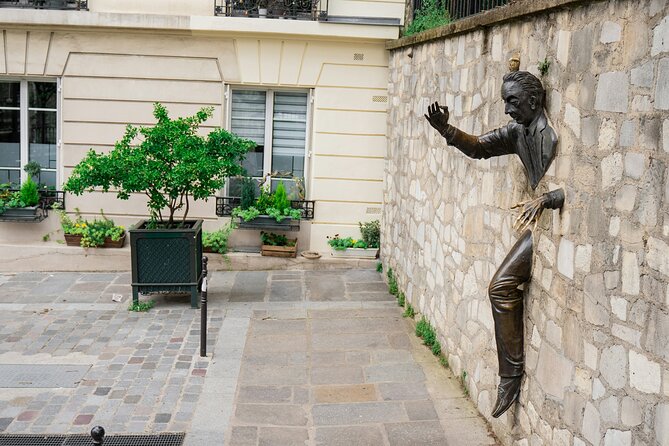
At the Passe-Muraille statue, the subject changes from painting to literature. The sculpture shows a man appearing to pass through a wall, based on Marcel Aymé’s character. It is a quick five-minute stop, but it adds another layer to Montmartre’s identity, where public art, books, and local folklore sit beside famous buildings.
The guide has also been praised for adding unscheduled side streets and extra spots when time and conditions allow. Those additions are part of the appeal of a small local-led walk, but they should be viewed as possible extras rather than guaranteed stops.
More walking tours in Paris:
- Paris Top Sights Half Day Walking Tour with a Fun Guide
★ 5.0 · 2,893 reviews - Paris Île de la Cité and Notre-Dame Walking Tour With Crypt
★ 5.0 · 2,272 reviews - Paris in a Day: Louvre or Orsay, Eiffel Tower, City Walk & Cruise
★ 5.0 · 1,956 reviews - Paris: Montmartre Highlights Walking Tour with a Local Guide
★ 4.9 · 1,668 reviews
A vineyard, an old cabaret, and the climb upward
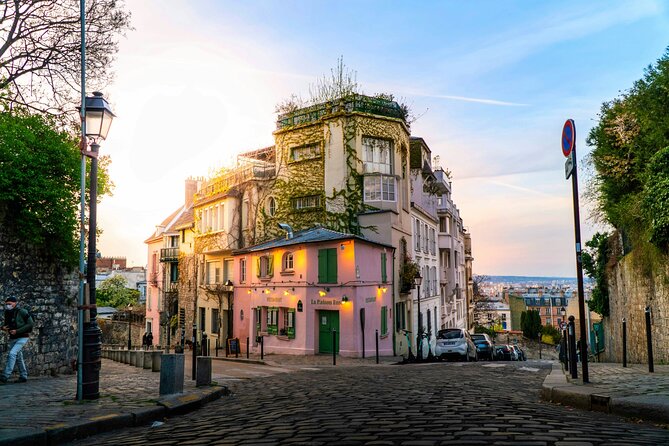
The Vigne du Clos Montmartre is one of the neighborhood’s surprising features. A vineyard in central Paris sounds unlikely, yet this small historic planting remains tied to Montmartre’s wine traditions. The scheduled stop is brief, about five minutes, but it gives you a useful break from the better-known art and movie landmarks.
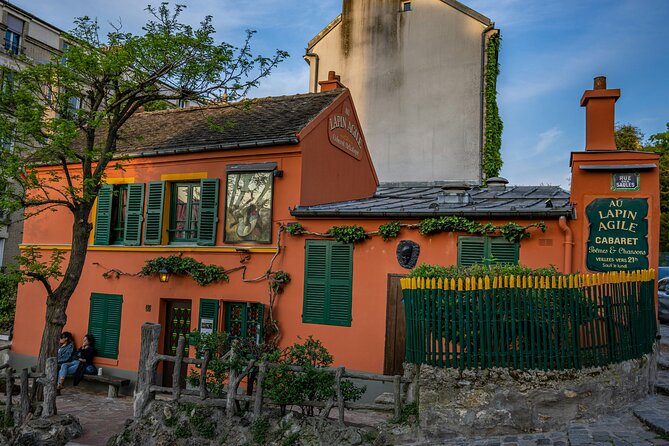
Au Lapin Agile is another short stop, lasting about five minutes. It is described as Montmartre’s oldest cabaret and has a long connection with artists and performers. The guide uses amusing stories to bring the place to life, rather than treating it as just another photograph from the sidewalk.
These two stops are easy to underestimate. Neither is a major attraction requiring a long visit, but together they show why Montmartre feels different from a conventional monument district. You move between art, farming, nightlife, literature, and neighborhood memory within a few blocks.
The route gradually takes you higher. That makes the final section more demanding than the opening around Place Blanche. Wear sensible shoes, bring water, and consider the weather. The tour description specifically advises against the walk for older people and those with reduced mobility, and that warning should be taken seriously.
Sacré-Cœur and the final view
The Basilique du Sacré-Cœur de Montmartre is the visual high point of the walk. You finish at 1 Parvis du Sacré-Cœur, with the broad Paris view from the hill providing a natural ending.
You admire the basilica from the outside and learn about its architecture and religious importance. The tour does not include access to buildings, so do not assume that you will enter the basilica as part of the scheduled experience.
The hilltop setting is also where the route’s physical effort pays off. The views give you a chance to pause, take photographs, and see how Montmartre sits above the rest of Paris. Depending on the crowd and weather, this can be one of the busiest parts of the walk, so the small group remains useful.
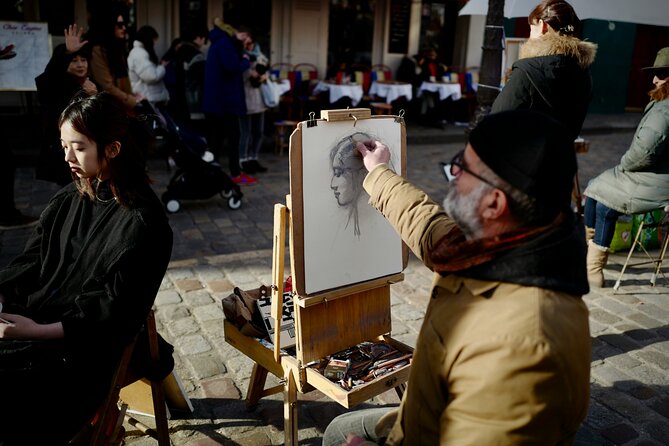
The route ends at Place du Tertre, about five minutes after the basilica stop. This square is known for its artists and for the portrait painters who work around the edges. It is picturesque, but it can also be crowded and commercial. Think of it as a lively finish and a good place to continue exploring, not as a quiet final stop.
What the $80 price really buys
At $80, this is not the cheapest way to walk through Montmartre. You can follow a map through many of the same streets for free, and most stops are viewed from public areas without admission.
The price makes more sense if you value interpretation and conversation. You are paying for a native guide, a group capped at six, a route that links artists and local stories, and the chance to ask questions as you go. Several parts of the walk would be easy to overlook without someone explaining why they matter.
The value is strongest for a first visit. If you already know Montmartre well, or have read extensively about its artists, you may find some stops familiar. Even then, Corentin’s personal connection and possible side streets could add something that a guidebook cannot.
I would also compare this price with the cost of a larger group tour. A cheaper tour may cover the same major sights, but a bigger crowd can make it harder to hear, ask questions, or follow the guide through busy streets. For a couple, family, or small party that wants a more personal pace, the difference may be reasonable.
The tour has free cancellation up to 24 hours before the start time. Changes or cancellations within 24 hours are not refundable. The activity also requires a minimum number of participants, so a cancellation by the provider for that reason would bring an alternative date or a full refund.
The service issue you should know about
The experience has a listed rating of 4.7, with 92 percent recommended, and the strongest praise centers on Corentin’s warmth, English and Spanish skills, storytelling, and patience with questions. Families with children, including children aged 10, have found the walk engaging, and the pace has been described as neither too short nor too tiring.
There is one serious caution. A participant reported waiting in hot weather after the guide failed to appear because of a scheduling error. Corentin accepted responsibility and said a full refund was issued. That does not erase the inconvenience, especially when your Paris schedule is tight, but the direct response is important context.
I would confirm the meeting time and location shortly before setting out, especially because the tour is short enough that a missed start can cost a large part of your day. Bring your booking confirmation on your phone, since the ticket is mobile.
Who should book this Montmartre walk?
This tour suits you if you want Montmartre explained through people and stories rather than a checklist of monuments. It is especially useful for:
- First-time visitors who want an orientation to the neighborhood
- Couples seeking a small, conversational walk
- Families with older children and teenagers
- Art lovers interested in Van Gogh, Renoir, Picasso, and Montmartre’s wider creative life
- Film fans who want to see the Café des Deux Moulins
- Visitors who prefer local anecdotes to a formal lecture
You should think twice if you need step-free access, dislike hills, or want to visit the interiors of the Moulin Rouge, artists’ buildings, or Sacré-Cœur. You should also choose a different experience if your main goal is a long museum visit or a cabaret performance.
Should you book it?
I would book this walk if you want a human introduction to Montmartre and value a guide who can answer questions rather than recite a script. The six-person limit, native connection, artist-focused route, and local anecdotes give it more character than a basic orientation walk.
The decision is less clear if you are watching every euro or have mobility concerns. At $80, the tour is buying access to Corentin’s time and interpretation, not paid entry to attractions. For a first visit, that can be a fair trade. Just arrive ready for hills, confirm the meeting details, and understand that the route ends outside the main sights rather than taking you inside them.
FAQ
How long does the Montmartre walking tour last?
The tour lasts approximately 1 hour and 45 minutes.
What is the price of the tour?
The listed price is $80.
How many people can join the tour?
The group is limited to a maximum of six travelers.
Who leads the tour?
The tour is led by Corentin, who was born and raised in Montmartre.
Where does the tour begin?
The meeting point is Five Guys, 3 Place Blanche, 75009 Paris, France.
Where does the tour finish?
The tour ends at 1 Parvis du Sacré-Cœur, 75018 Paris, France.
Does the price include entry to the Moulin Rouge?
No. Admission to the Moulin Rouge is not included.
Does the tour include entry to buildings?
No. Access to buildings is not included.
Is the tour suitable for people with reduced mobility?
The tour is not recommended for people with reduced mobility. A moderate level of physical fitness is advised, and the activity is also not recommended for older people.
Can I cancel for a full refund?
Yes. You can cancel at least 24 hours before the start time for a full refund. Cancellations or changes made less than 24 hours before the start time are not refunded.
Just added around Paris
- Private Paris Marche d’Aligre Walking Tour with Tastings★ 5.0 · 8 reviews
- Private Louvre Museum Tour for Kids & Families with Alberto or his team in Paris★ 5.0 · 41 reviews
- Private Highlights of Paris Tuk-Tuk Experience★ 5.0 · 26 reviews
- Paris Latin Quarter Walking Tour: History & Culture – Small Group★ 5.0 · 14 reviews
- Private Highlights of Paris Bike Tour★ 4.5 · 15 reviews
- Paris Musee d’Orsay PRIVATE TOUR with a Local Private Guide★ 5.0 · 41 reviews
- Private Half Day Historic Tour★ 5.0 · 58 reviews
- Pere Lachaise Cemetery Paris – Exclusive Guided Walking Tour★ 5.0 · 72 reviews
Montmartre and Sacré-Cœur Tours, compared.

Montmartre Hidden Gems and Scenic Highlights Walking Tour
Read our review →
Montmartre Hill French Gourmet Food and Wine Tasting Walking Tour
Read our review →
Montmartre Cheese, Wine & Pastry Guided Walking Tour
Read our review →
Montmartre Highlights Walking Tour with a Local Guide
Read our review →
Sacré-Coeur and Montmartre Tour with Expert Guide
Read our review →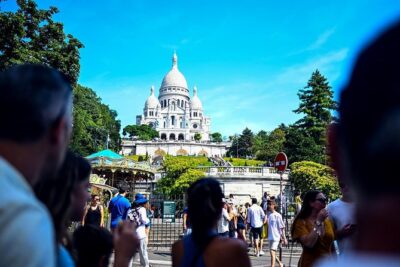
Private Montmartre Food Tour with Wine, Cheese & Pastries
Read our review →
Paris Montmartre Food Tour – A Full French Meal by Do Eat Better
Read our review →
Hidden Montmartre: Paris’ Secret Streets Walking Tour
Read our review →Browse the lists this tour appears in