
Reviewed · LE MARAIS TOURS
Le Marais District & Jewish Quarter – Exclusive Guided Walking Tour
Le Marais is one of Paris’s best neighborhoods for walking because its grand mansions, royal squares, Jewish bakeries, modern boutiques, and wartime memories all sit close together. This tour gives that mix a clear shape, moving from Saint-Paul Saint-Louis to Place des Vosges, then through the Pletzl and onward to Hôtel de Ville.
I like the small-group format, which makes it easier to hear a guide such as Eden, Hugo, François, or Alasdair and ask questions. I also like the range of stories, from Jesuit architecture and noble townhouses to French Jewish life, the Resistance, and the school principal remembered in Jardin des Rosiers.
The main consideration is focus: you will see Jewish-quarter landmarks but will not enter a synagogue, and one short tour cannot cover every part of modern Jewish life or the Marais’s museums. The 2.5-hour walk also calls for comfortable shoes and sensible planning in rainy weather.
Key points to know before booking
- Royal Paris in a compact walk: See Saint-Paul Saint-Louis, Hôtel de Sully, Place des Vosges, and former aristocratic mansions.
- Jewish-quarter focus: Walk Rue des Rosiers and the Pletzl, with context on Jewish communities in the Marais from the 18th and 19th centuries.
- Small-group or private choice: The experience can be booked as a private tour, with a lower-priced semi-private option also available.
- Strong guide element: Eden, Hugo, François, Alasdair, Agustina, and Adrian are among the guides named in booking feedback.
- Modern Paris at the finish: Centre Pompidou and Hôtel de Ville show how the area changed from royal suburb to central city district.
- No interior synagogue visits: Security restrictions mean the Jewish-quarter portion is an exterior walking tour.
Why Le Marais rewards a guided walk
Le Marais can look easy to explore on your own. Its streets are pleasant, its shops are lively, and Place des Vosges is impossible to miss. Yet the neighborhood’s importance is not always visible at street level. A handsome doorway may belong to a former noble residence, while a quiet garden may recall a courageous act during World War II.
That is where a good guide earns the fee. The walk connects buildings and events that otherwise feel scattered. You are not simply moving from one photo stop to another. You are following the transformation of an area that once lay beyond central Paris, later became a royal address, then developed a major Jewish community, and now functions as one of the city’s most fashionable districts.
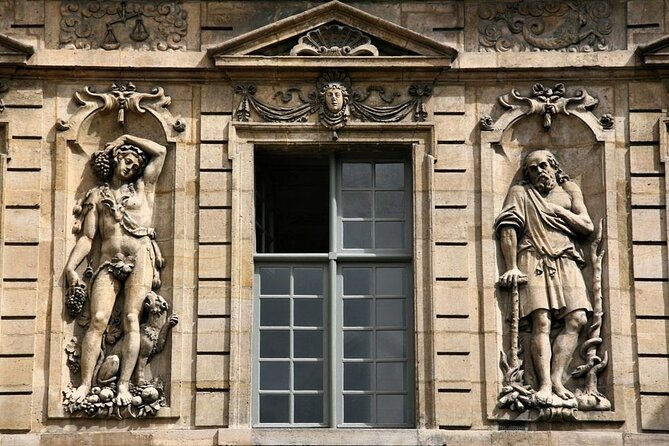
The route also offers a useful contrast in architecture. You see a 17th-century church, Renaissance and Baroque townhouses, a carefully planned royal square, narrow Jewish-quarter streets, and the colorful high-tech exterior of Centre Pompidou. That variety gives the walk more substance than a standard shopping stroll.
The experience lasts about two and a half hours. That is long enough for a proper introduction without taking up an entire day. The pace is described as manageable, and the route does not require a high level of athletic ability, but you will be on your feet for most of the time. Wear shoes that can handle old city streets.
More Le Marais Tours:
- Award-Winning Paris French Bakery Experience — Le Marais, 4th Arr
★ 4.5 · 1,186 reviews - Paris Le Marais Food Tour With 10+ Tastings, Cheese, Wine & More
★ 5.0 · 985 reviews - Paris Le Marais District Original Food and Wine Tasting Tour
★ 4.5 · 880 reviews
Starting at Saint-Paul Saint-Louis
The tour begins near Saint-Paul in the 4th arrondissement. The first major stop is the Church of Saint-Paul Saint-Louis, a 17th-century building commissioned by the Jesuits and shaped by the design of Rome’s Gesù church.
This opening is useful because it places the Marais in its royal and religious setting. Allow your guide time to point out the church’s role in the neighborhood rather than treating it as a quick exterior photograph. The stop is listed at about 10 minutes, so the visit is an introduction, not a full church tour.
The starting point is close to public transportation, but hotel pickup and drop-off are not included. Plan to reach Saint-Paul on your own, using the metro, taxi, or Uber. You should also supply a mobile phone number with country code so the guide can contact you if needed.
Hôtel de Sully and the royal Marais
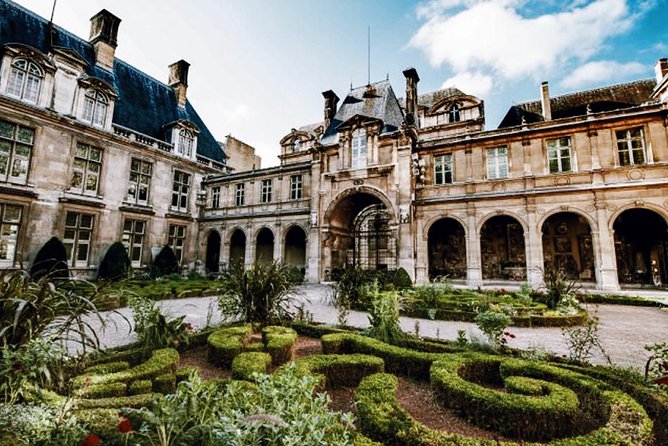
From the church, the route continues to the courtyard and garden of Hôtel de Sully. Built between 1624 and 1630, this townhouse reflects the period when the Marais attracted powerful residents and major construction projects.
The value here is architectural context. The building combines Renaissance design with Baroque touches, and its courtyard helps you understand the scale of the private mansions once built for the nobility. These are not ordinary Paris apartment blocks. They were urban estates, designed to display rank within the city.
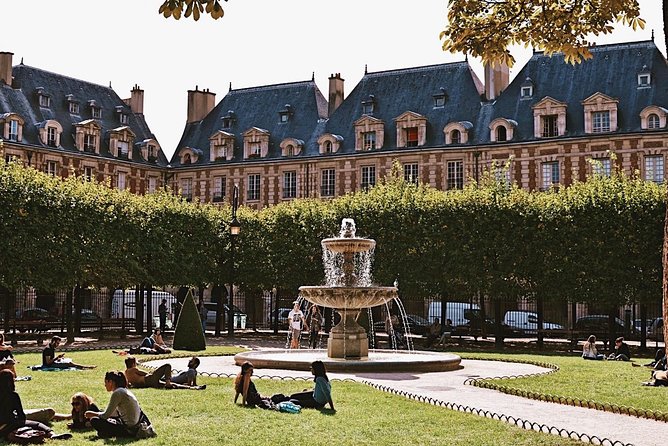
The tour then reaches Place des Vosges, one of Paris’s most carefully planned squares and the oldest planned square in the city. Its regular facades and arcaded ground floor give it a calm, almost stage-set quality. It is one of those Paris places where you should pause instead of rushing through for a picture.
A guide can explain why this square matters to the Marais as a whole. It is not just a pretty garden. It represents the district’s connection to royal planning and aristocratic life, before the area’s later chapters as a Jewish center, commercial quarter, and modern cultural hub.
The stop itself is brief, listed at roughly 10 minutes. If you want time to sit under the trees, browse the arcades, or take careful photographs, plan to return on your own after the tour.
Rue des Francs Bourgeois and the mansions behind the shops
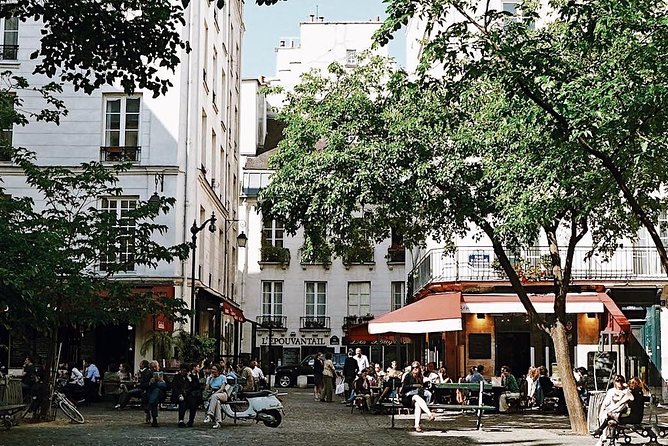
The walk continues along Rue des Francs Bourgeois, a busy shopping street lined with fashion stores and other boutiques. This is a good place to see the Marais as it exists today, but the guide’s job is to help you look past the retail fronts.
The street passes one former mansion after another. Some are now museums, including the Hôtel Carnavalet. The contrast is part of the fun: you can browse modern shops while standing among buildings connected to the city’s old elite.
The Musée Carnavalet, devoted to the history of Paris, is seen from the outside during this tour. Admission is not included, and the itinerary does not provide a museum visit. That is a limitation, but also a useful planning tip. If you enjoy urban history, consider setting aside a separate visit to the museum rather than expecting the walking tour to cover it.
The walk gives you a framework for that later visit. You will have already heard how the Marais changed, so the museum’s displays should make more sense. Just keep your expectations clear: this is an outdoor introduction, not a museum tour.
More Jewish heritage tours in Paris:
- Le Marais District & Jewish Quarter Guided Walking Tour 12ppl Max
★ 5.0 · 361 reviews - Le Marais/Paris – The Historic, Trendy, Jewish, LGBT district
★ 5.0 · 341 reviews - Paris: Le Marais & Montmartre Jewish History Walking Tour
★ 4.8 · 170 reviews - Jewish Marais – Yiddish world : Walking tour and pastries
★ 5.0 · 23 reviews
Rue des Rosiers and the Pletzl
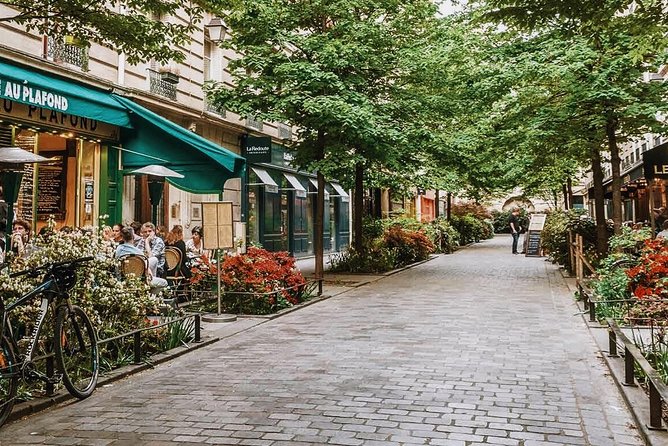
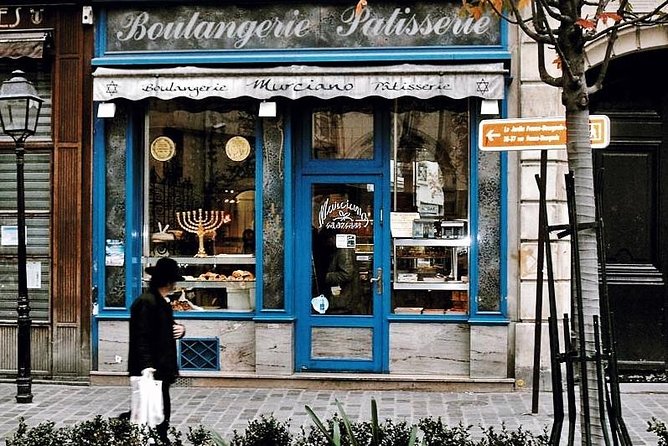
The Jewish-quarter portion begins around Rue des Rosiers, the narrow street at the center of the Marais’s historic Jewish neighborhood. This is where the tour shifts from noble architecture to community history.
The Pletzl is known for bakeries, boutiques, and food shops, but its importance goes beyond what you can buy today. The tour explains how Jewish communities helped put this part of the Marais on the map during the 18th and 19th centuries. You will hear about the area’s development and see the streets where Jewish life became a defining part of the neighborhood.
This section is especially useful if you have walked Rue des Rosiers before and felt you were seeing only the commercial surface. A guide can explain why certain streets matter and how the area’s identity developed over time. Several guides are also praised for connecting local history with wider French history, which helps the quarter feel like part of a larger story rather than an isolated attraction.
Still, you should know what the tour does not provide. No synagogue interiors are included, since access is restricted for security reasons. If your main goal is current religious life or an inside look at synagogues, this experience may leave you wanting more. It is stronger as a street-level history walk, combining architecture, community memory, and historical events.
One useful question to ask your guide is how much time can be given to present-day Jewish life. The standard route includes that subject, but the overall tour must also cover royal Paris, the Resistance, architecture, and modern landmarks.
Jardin des Rosiers and a wartime story
A short turn brings you to Jardin des Rosiers, a small garden tucked behind shops and townhouses. It is named for Joseph Migneret, a school principal who hid dozens of students in his home during World War II. He was eventually arrested and killed.
This stop adds moral weight to the Jewish-quarter section. The garden is modest, and you could easily pass it without knowing its story. With the guide’s explanation, it becomes a place of remembrance tied to an individual act of courage.
The stop also shows why a walking tour can be more useful than a simple neighborhood map. The most meaningful sites are not always the largest ones. A small garden or plaque can carry more human feeling than a grand facade, provided you know what you are looking at.
If World War II history is your main interest, tell the guide early. The tour includes the French Resistance and wartime experiences, but the time is shared with several centuries of architecture and local history. One short walk cannot give equal depth to every subject.
Centre Pompidou and the changing city
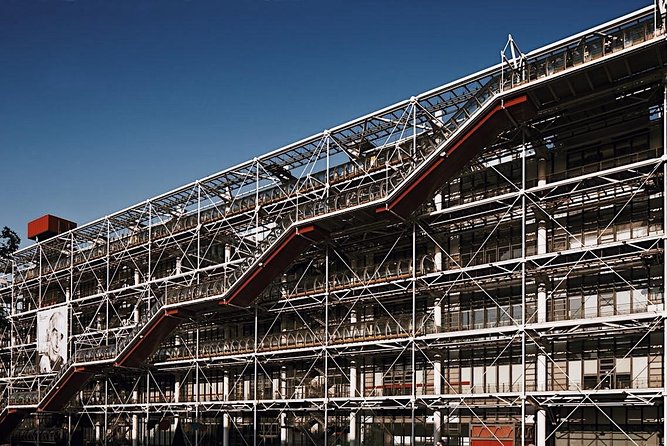
Near the end, the route heads to Centre Pompidou. Its exposed pipes and colorful exterior make it one of Paris’s most recognizable modern buildings, and its high-tech design sharply contrasts with the Marais’s old stone mansions.
The center was conceived as a multicultural place bringing art and literature together. You will see the exterior, but admission to the museum is not included. That arrangement works well for a first visit because the building itself is a major sight, even if you do not have time for its galleries.
I like this part of the route because it prevents the tour from treating Le Marais as a preserved medieval or royal quarter. The neighborhood is also modern, commercial, artistic, and constantly changing. Centre Pompidou makes that point without a long lecture.
If you want to visit the museum, arrange a separate ticket and extra time. The walking tour is not designed to pause for an interior cultural visit.
Hôtel de Ville and Saint-Gervais-Saint-Protais
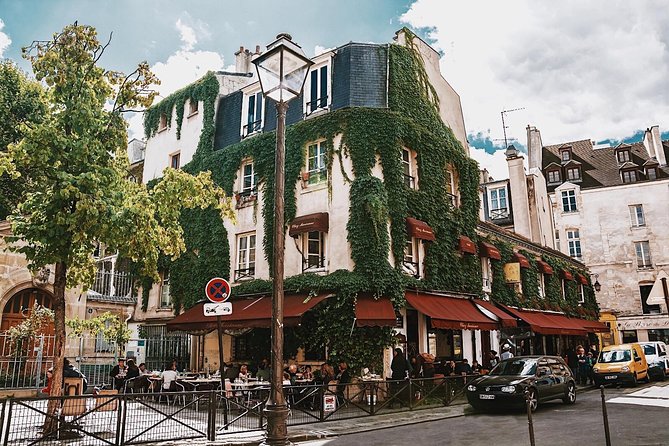
The official endpoint is Hôtel de Ville, Paris’s city hall and the seat of municipal government since 1357. Its location provides a natural close to the walk because it shows how the Marais moved from the edge of Paris into the center of civic life.
Nearby, you will see Église Saint-Gervais-Saint-Protais, regarded as an early example of French Baroque architecture in Paris. It served as a parish church until 1975 and is now associated with the Monastic Fraternities of Jerusalem.
The final stretch is visually varied. You finish with civic architecture, a historic church, and the streets of central Paris rather than at a single attraction with an admission gate. The end point is in Le Marais, so you can continue exploring, stop for food, or make your way to another neighborhood by public transportation.
Private, semi-private, and the $59.69 price
The advertised cost is $59.69 per person, but the exact value depends on the option you choose. A private booking gives your own group an exclusive guide. A semi-private choice costs less, but the guide is not reserved only for your party. Read the selected option carefully before paying, since the private inclusions do not apply to the save-money semi-private option.
For a private group, the price can make sense when you value questions, flexible conversation, and a more personal pace. It is also useful for families or friends who want the guide to adjust the balance between architecture, Jewish history, and wartime stories.
The value is weaker if you mainly want a quick orientation or prefer exploring silently. Much of the route is outdoors and free to enter, and you can see several landmarks independently. You are paying for the explanations, local framing, and time saved in figuring out what you are seeing.
The tour is often reserved well ahead, with bookings averaging about 40 days in advance. If your Paris dates are fixed, booking early is sensible, especially if you want a particular time or private format.
What guides add to the experience
The guide can make or break a walking tour, and the strongest pattern here is clear explanation combined with personality. Eden is described as organized, warm, and able to connect the neighborhood’s past with modern times. Hugo is noted for humor, clear English, strong preparation, and arriving early.
François is praised for making the walk interactive and for bringing together Jewish, Parisian, and even Scottish history. Alasdair is described as engaging even in the rain. Agustina is noted for tailoring the walk to the group, while Adrian is singled out for his command of the subject.
Guide assignments can vary, so you may not receive a particular person. You can still help shape the experience by asking questions and stating your priorities at the start. If you want more Jewish history, say so. If architecture interests you most, mention that too.
The guide also sends a message on the morning of at least some tours, and arriving early is wise. Do not assume the guide will wait while you finish breakfast or search for the meeting point.
Weather, bags, and practical comfort
The tour runs rain or shine. Bring an umbrella in wet weather, a hat in summer, and a bottle of water. Paris weather can change quickly, and there is no promise of long indoor shelter during the walk.
Large bags and suitcases are not allowed. This matters if you are arriving between hotels or heading directly to a train station. Leave luggage at your hotel or use an appropriate storage service before meeting the guide.
The route is near public transportation, but there is no hotel transfer. Moderate physical fitness is recommended. You do not need to be an athlete, yet you should be comfortable walking and standing for two and a half hours.
National celebrations can alter the route. In those cases, an alternative route is used to preserve the major sights, but there is no refund or discount for the change.
Free cancellation is available up to 24 hours before the start time. Changes or cancellations inside that window are not refunded, so keep that cutoff in mind when arranging a busy Paris schedule.
Who should book this Marais tour?
Book it if you want more than attractive streets and shops. It suits first-time visitors who need a clear introduction, repeat visitors who have walked the Marais without understanding its layers, and anyone interested in Jewish history, French architecture, royal Paris, or World War II memory.
It is also a good choice for people who prefer a human guide to an audio app. The route covers a lot, but it does so at a manageable length, and the small-group or private format gives you a better chance to ask questions.
Think twice if you want extensive synagogue access, a full museum visit, or a detailed study of present-day Jewish life. Those subjects receive attention, but the tour must also reach Place des Vosges, Centre Pompidou, Hôtel de Ville, and several architectural stops.
Should you book it?
I would book this tour if you want a well-shaped introduction to Le Marais and especially if its Jewish-quarter history matters to you. The strongest features are the mix of royal architecture and personal stories, the compact route, and guides who explain the area with clarity and humor.
Choose the private option if your group values flexibility. Choose semi-private if price matters more and you are comfortable sharing the guide. Bring good shoes, avoid carrying luggage, and arrive ready to spend most of the time outdoors. If you understand that synagogue and museum interiors are not included, this is a thoughtful and useful way to read one of Paris’s most layered neighborhoods.
FAQ
How long does the Le Marais walking tour last?
The tour lasts approximately 2 hours and 30 minutes.
Where does the tour start and end?
It starts at Saint-Paul in Paris’s 4th arrondissement and ends in Le Marais near Hôtel de Ville.
Is the tour private?
The standard private option is for your group only. A lower-priced semi-private option is also offered, and the private guide inclusions do not apply to that option.
Does the tour enter synagogues?
No. The tour does not include synagogue entry because access is restricted for security reasons.
Are museum admissions included?
No. Admission to the Musée Carnavalet and Centre Pompidou is not included. The route may show you these places from the outside.
What should I bring?
Wear comfortable shoes and bring water. An umbrella is recommended in rainy weather, and a hat is useful in summer. Large bags and suitcases are not permitted.
More walking tours in Paris
- Paris Top Sights Half Day Walking Tour with a Fun Guide
★ 5.0 · 2,893 reviews - Montmartre Hidden Gems and Scenic Highlights Walking Tour
★ 5.0 · 2,684 reviews - Montmartre Hill French Gourmet Food and Wine Tasting Walking Tour
★ 5.0 · 2,588 reviews - Paris Île de la Cité and Notre-Dame Walking Tour With Crypt
★ 5.0 · 2,272 reviews
Just added around Paris
- Paris: The Da Vinci Code Walking Tour with a Local Guide★ 4.3 · 5 reviews
- Paris: Flea Market Insider’s Tour in Extra-Small Group★ 4.6 · 73 reviews
- Paris: Private Fashion Tour (Chanel, Dior, Sex & the City)★ 5.0 · 3 reviews
- Paris: Floral Earrings workshop★ 5.0 · 3 reviews
- Paris: Fashion History Walking Tour in the Heart of Paris★ 4.9 · 22 reviews
- PARIS: Family e-bike longtail renting★ 5.0 · 3 reviews
- Paris: Famous Monuments Cycling Tour★ 4.7 · 20 reviews
- Paris: private city tour with seine river cruise★ 4.8 · 28 reviews
Le Marais Tours, compared.
Award-Winning Paris French Bakery Experience — Le Marais, 4th Arr
Read our review →
Paris Le Marais Food Tour With 10+ Tastings, Cheese, Wine & More
Read our review →
Paris Le Marais District Original Food and Wine Tasting Tour
Read our review →
Paris Bike Tour Hidden Secrets in the Latin Quarter & Le Marais neighborhoods
Read our review →
Food and Wine Tasting Walking Tour in Le Marais
Read our review →
Le Marais District & Jewish Quarter Guided Walking Tour 12ppl Max
Read our review →
Le Marais/Paris – The Historic, Trendy, Jewish, LGBT district
Read our review →
Paris Le Marais Food & Wine Tour with Eating Europe
Read our review →Browse the lists this tour appears in