
Reviewed · PARIS WORLD WAR BATTLEFIELD TOURS
Paris WW2 The German Occupation Small group or Private tour
Paris during World War II is not presented here as a neat row of monuments. It is a story hiding in plain sight: a hotel commandeered by the German Army, a fashionable square linked to Coco Chanel, bullet marks left by the Liberation, and an ordinary doorway tied to secret resistance work. Guide Chris Pollard connects these places to the people who shaped occupied France.
I like the small group size, capped at 10, and the way the tour can slow down when a question deserves a proper answer. I also like the use of photographs, books, and personal stories to explain why people collaborated, resisted, stayed silent, or simply tried to survive. The main consideration is that this is an intensive outdoor walk, not a quick two-hour highlights tour.
Key points to know before booking
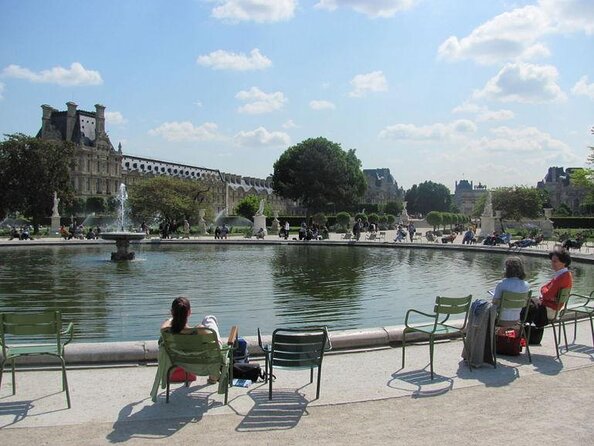
- Meet at Palais Royal, not Tuileries: The starting point is Place Colette, outside Palais Royal Metro exit 5, opposite the Comédie-Française.
- Expect three to three and a half hours: The route covers roughly two miles, with plenty of time spent listening and asking questions.
- The route finishes at Place de la Concorde: The general tour does not normally continue to the Shoah Memorial or the Marais.
- Chris Pollard leads a flexible, discussion-based tour: The exact stops can change depending on your interests and the questions asked.
- A minimum of four people is required: Small groups have a maximum of 10, while private tours allow a more personal plan.
- This suits serious history fans best: Bring water, wear layers, and prepare to spend much of the time outdoors.
Starting at Palais Royal, where occupied Paris comes into view
The tour begins at Place Colette, beside Palais Royal Metro exit 5 and opposite the Comédie-Française. This matters because the meeting point differs from some general descriptions you may see elsewhere. Go to Palais Royal, not Tuileries Metro.
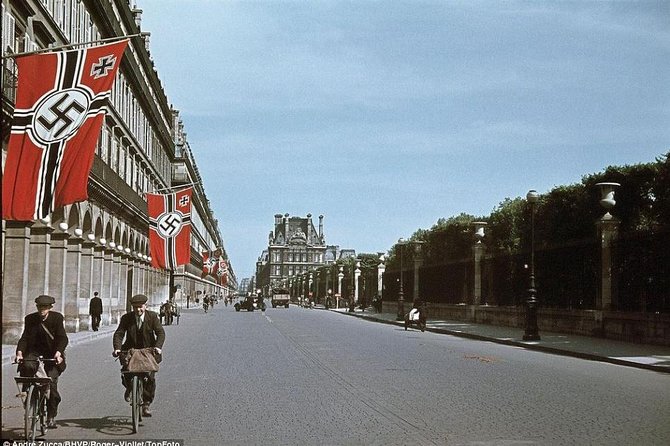
From here, Chris sets the scene for the German occupation and the years leading up to it. The opening is short, about 15 minutes, but it gives you the political and military background needed for the rest of the walk. Instead of treating World War II as a series of disconnected dates, he explains the pressures on France, Germany, and ordinary Parisians.
That approach shapes the entire experience. The buildings are important, but they are mainly the stage. The real subject is human behavior: how people responded to defeat, military rule, food shortages, political pressure, anti-Semitism, fear, and changing hopes about the war.
You will not receive a fixed speech delivered at exactly the same sites every time. Chris may spend longer at one place if you ask about the Resistance, the German command structure, Chanel, the French government, or Jewish persecution. That flexibility is useful, but it also means the tour is less tidy than a standard walking route.
More wartime history tours from Paris:
- Somme Battlefields Small-Group Day Trip with John Monash Centre from Paris
★ 4.5 · 270 reviews - Somme Battlefields from Paris with Australian memorial & Amiens Cathedral
★ 5.0 · 228 reviews - WWI Somme Battlefields Day Trip from Paris
★ 4.9 · 111 reviews
From the Louvre to Rue de Rivoli
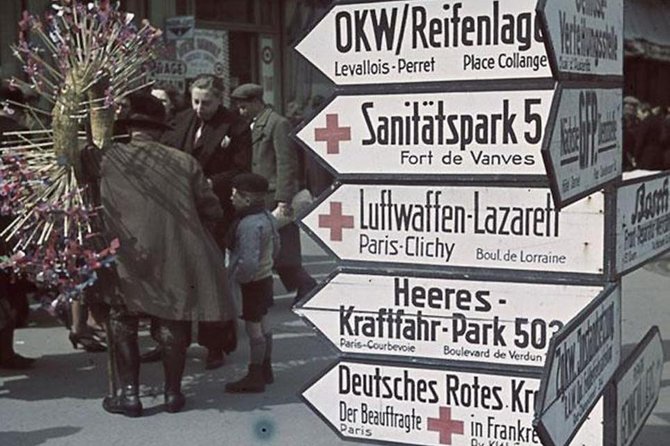
The area between the Louvre, Palais Royal, and Rue de Rivoli contains a surprising number of Occupation sites. You see the Louvre from outside, then move through streets where German offices, hotels, collaborationist organizations, and secret networks once operated.
One important stop is the former German Army headquarters at the Hôtel Meurice. The building is still part of elegant Paris, yet during the Occupation it served a military purpose. That contrast is central to the tour. Paris did not stop being fashionable or beautiful in 1940, but behind the grand façades the city was being controlled by a foreign army.
You also learn about the first secret Gestapo headquarters in Paris and the headquarters of the Parti Populaire Français, one of France’s largest collaborationist groups. These stops help separate several forces that are often lumped together under the single label of the French. The German military, German security services, French officials, political collaborators, resistance networks, and ordinary civilians did not share the same goals.
That distinction is one of the tour’s strongest features. Chris spends time explaining the competing French political factions and the difference between accommodation, collaboration, and active resistance. If you already know the broad outline of World War II, this is where the walk can add useful detail.
Place Vendôme, the Ritz, and the people behind the façades
Place Vendôme brings the story into the world of luxury hotels, high society, and military power. The Ritz became associated with Coco Chanel, who stayed there during the Occupation. The hotel was also a meeting place connected to anti-Nazi figures within the German military.
The point is not simply to attach a famous name to a famous building. Chris uses Chanel and the Ritz to show how complicated life in occupied Paris could become. Social access, personal relationships, ideology, survival, and self-interest could overlap in uncomfortable ways.
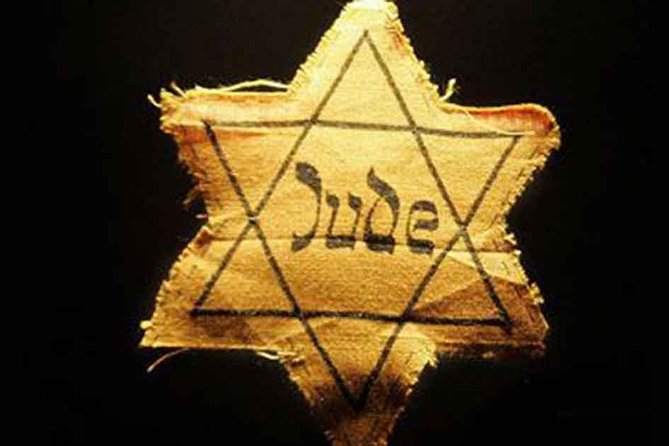
The same stop introduces the German military leadership in France and the spread of anti-Semitic policy. The final solution was not an isolated event that suddenly appeared without warning. The tour traces the political and social conditions that led to its implementation in France, while also making clear that the general route cannot give the Holocaust the same attention as a dedicated tour.
That limit is worth noting. You will discuss the treatment of Jewish people in Paris and occupied France, the growth of anti-Semitism, and Jewish participation in the Resistance. But if the Shoah is your main reason for booking, ask about a private Holocaust-focused tour. A single general Occupation walk has too many other subjects to cover this topic with the care and time it deserves.
Secret networks on Rue Rouget de Lisle
Rue Rouget de Lisle is one of the quieter but more meaningful stops. It is linked to the early organic French Resistance, which began to take shape in October 1940. This is not the sort of site you would necessarily notice on a normal Paris walk, and that is part of its value.
The tour also covers the Société Maurice Duclos, associated with the first Allied spy network in France and its radio work. The emphasis here is on how resistance began before it looked like the organized movement many people picture today.
Chris explains that the Resistance was not one united organization from the start. It developed through separate groups, individuals, political beliefs, military aims, and personal risks. Some people gathered information. Others printed newspapers, carried messages, helped people escape, or prepared for armed action later in the war.
This part of the walk works best if you are willing to ask questions. A short stop can introduce a name or a network, but Chris often adds the background that makes the choice meaningful. That can make the tour run longer than expected, especially for a group eager to follow a particular thread.
More private tours in Paris:
- Paris: Private Photoshoot at the Eiffel Tower
★ 4.7 · 2,636 reviews - Top Private Cruises in Paris with French Champagne and surprises
★ 5.0 · 1,553 reviews - Private Paris Airport Arrival Transfer – CDG & ORLY Airports
★ 4.5 · 1,119 reviews - Paris Private Arrival Transfer from Charles de Gaulle (CDG) or Orly (ORY)
★ 4.0 · 1,084 reviews
Jeu de Paume and the stolen art of Occupied Paris
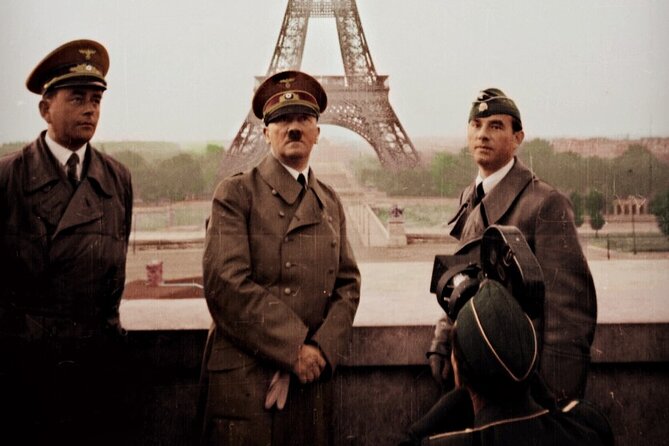
The Jeu de Paume Museum provides one of the tour’s most striking subjects. During the Occupation, the Nazis used the building to store, process, and organize art stolen from Jewish families and others across Europe before sending it to Germany.
You see the museum from outside, but the significance comes from the explanation. The building was not simply a storage room. It formed part of a larger system of confiscation and cultural theft. The discussion shows how looting operated alongside military occupation and racial persecution.
This stop is especially effective for anyone interested in art, museums, or the way governments use culture. It also broadens the tour beyond battles and uniforms. Occupation affected property, businesses, homes, careers, food, movement, identity, and family life.
Chris uses visual material to help bring such stories into focus. Photographs and other aids are useful here because the modern streets can look calm and unchanged. You need help seeing the wartime activity that is no longer visible.
Place de la Concorde and the marks of Liberation
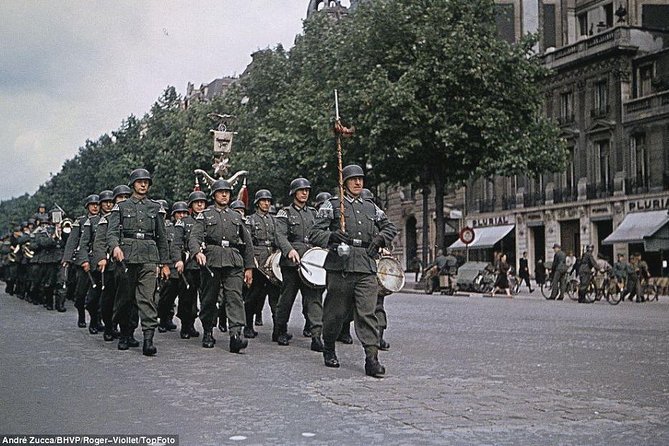
The route generally ends at Place de la Concorde after about 20 minutes around the square. This is the correct ending for the general tour. It does not normally continue to the Shoah Memorial or finish in the Marais unless you arrange a different private itinerary.
Place de la Concorde is one of France’s largest monumental squares. It began as Place Louis XV, was renamed during the Revolution, and became the site where Louis XVI and Marie Antoinette were executed. The World War II story adds another layer.
The square contains the former Naval Ministry and Hôtel de Crillon, both important German headquarters during the war. The Grand Palais, one of Paris’s largest freestanding buildings, was damaged during the Occupation and Liberation. Bullet holes and other scars remain as physical reminders of the fighting.
The Egyptian obelisk gives the square its familiar postcard appearance, but the tour asks you to look beyond the grand view. You learn how a place associated with ceremony and royal power became part of the military and political story of twentieth-century France.
This final section works well because it brings several themes together: German control, French administration, resistance, fighting in the streets, and the difficult process of national memory after liberation. You finish in a central area with easy access to the rest of Paris, rather than at a distant museum or memorial.
Why the flexible format matters
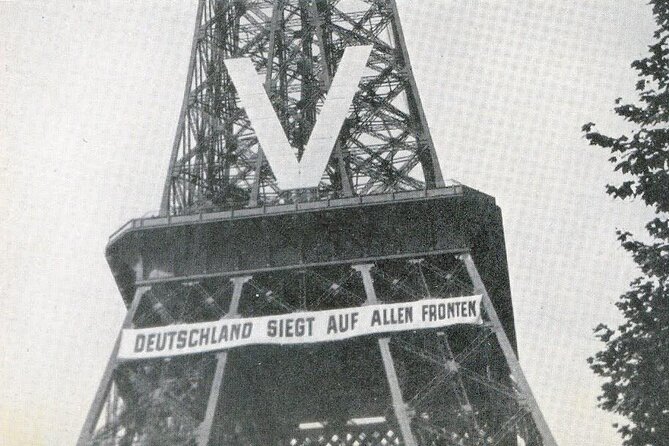
The advertised duration is roughly three to four hours, with the general route usually taking about three to three and a half hours. One private experience lasted about four hours and covered roughly two miles. The exact length depends on the group, the questions, and how much time you have.
This is a discussion-led walk. Chris asks about your interests and can shape a private tour around subjects such as the Resistance, the Liberation, the French government, the German Army, Chanel, or the Holocaust. On a group tour, the whole group needs to agree if you want to shorten the route or spend extra time on one subject.
That format is a strength if you want context rather than a checklist. It is less suitable if you want a tightly timed itinerary with a short explanation at every stop. You may walk past some places without stopping, or spend a long time at a site that looks unremarkable from the street.
The guide’s passion is clear, and most of the available feedback praises his preparation, warmth, visual material, and ability to connect people and places. One useful point for you is that Chris can provide reading and viewing suggestions after the tour, and he encourages you to share your interests before arrival.
Group size, walking, and comfort
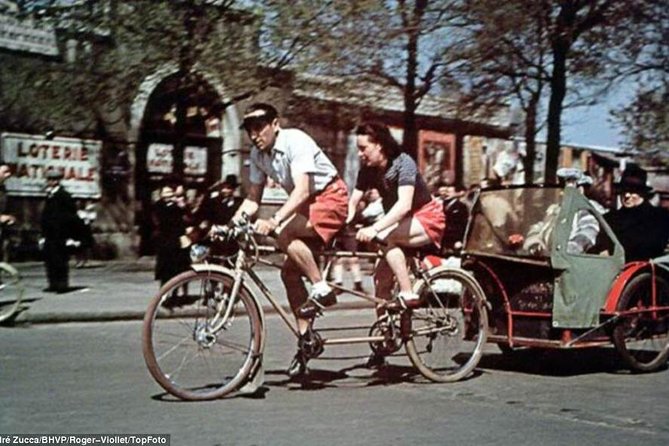
Small groups are limited to 10 people, with semi-private bookings allowing up to four separate groups. Private tours offer more control over the meeting point, starting time, and route.
The group size makes a real difference. You can speak directly with Chris, hear the answers, and ask follow-up questions without competing with a large crowd. It also makes it easier to adjust the pace, though the tour remains an outdoor walk with extended periods of standing.
Wear comfortable shoes and dress in layers. Bring water. Paris weather can change, and the route may feel cold or windy if you are not prepared. Chris can pause when needed and has adjusted routes or made sitting breaks possible, but you should not book this expecting a seated museum presentation.
The tour is described as suitable for most people, and service animals are allowed. Still, tell the guide about mobility concerns in advance. The route involves walking and standing for several hours, and the most satisfying experience comes when you have enough energy to listen and participate.
Is $108.84 good value?
At $108.84 per person, the price is higher than a mass-market Paris walking tour. The comparison is not quite fair, though. You are paying for a small group, a specialist subject, a flexible route, and a guide who can answer detailed questions rather than simply recite a standard script.
I think the price makes the most sense for two kinds of visitors. First, it suits people who already care about World War II and want a fuller understanding of occupied France. Second, it works for families or private groups who want the route shaped around their own questions.
If you only want a quick orientation to Paris, this is not the best use of your money or time. You will get more from a general city walk. But if you are planning to visit Normandy, the D-Day beaches, or other wartime sites, this tour can give you useful French political and social context before you go.
Small-group tours require at least four people to operate, and the maximum is 10. Book well ahead if possible, especially because bookings made less than two weeks before the date may depend on the minimum already being met. Free cancellation is available up to 24 hours before the start, but the operator may cancel if the minimum is not reached or if weather makes the outdoor tour unsuitable.
Who should book this Paris Occupation walk?
I would book it if you enjoy asking why, not just where. The tour is especially good for history students, World War II readers, serious museum visitors, and anyone interested in the Resistance, collaboration, political divisions, or the experience of ordinary people under occupation.
It can also work well for teenagers if they already have some interest in the subject. The guide’s use of anecdotes and photographs gives younger visitors more to hold on to than a list of dates.
I would choose a private tour if your main interest is the Holocaust, a particular Resistance network, the Liberation, or a family story. The general tour touches these subjects, but its broad scope limits the time available for any one of them.
Should you book it?
Book this experience if you want a serious, personal walking lesson in occupied Paris and are happy to spend three or more hours outdoors. Chris Pollard’s greatest strength is his ability to connect grand political events with hotels, streets, offices, artworks, and individual choices.
Skip it if you prefer a short, tightly scripted route or want the Holocaust Memorial and Marais Jewish Quarter included as standard stops. For that, arrange a private itinerary or choose a dedicated Holocaust-focused tour. For everyone else, this is a strong choice for seeing central Paris through the difficult, complicated years that shaped modern France.
FAQ
Where does the tour begin?
It begins at Place Colette, outside Palais Royal Metro exit 5, opposite the Comédie-Française Theatre.
Where does the general tour end?
The general tour normally ends around Place de la Concorde. It does not normally end at the Shoah Memorial or continue into the Marais.
How long does the tour take?
The tour generally lasts about three to three and a half hours, though the experience may run closer to four hours depending on questions, interests, and the chosen itinerary.
How many people can join?
Small-group tours have a maximum of 10 people. Semi-private bookings are limited to four separate groups, while fully private tours are also available.
Is the Holocaust the main subject?
No. The general tour discusses anti-Semitism, Jewish life under occupation, the conditions that led to the final solution in France, and Jewish involvement in the Resistance. A private Holocaust-focused tour is recommended if you want to spend most of the time on that subject.
What happens if the minimum number is not reached?
All tours require at least four people to run. If the minimum is not met, you may be offered another date or experience, or receive a full refund. Free cancellation is also available when you cancel at least 24 hours before the start time.
Just added around Paris
- Paris: The Da Vinci Code Walking Tour with a Local Guide★ 4.3 · 5 reviews
- Paris: Flea Market Insider’s Tour in Extra-Small Group★ 4.6 · 73 reviews
- Paris: Private Fashion Tour (Chanel, Dior, Sex & the City)★ 5.0 · 3 reviews
- Paris: Floral Earrings workshop★ 5.0 · 3 reviews
- Paris: Fashion History Walking Tour in the Heart of Paris★ 4.9 · 22 reviews
- PARIS: Family e-bike longtail renting★ 5.0 · 3 reviews
- Paris: Famous Monuments Cycling Tour★ 4.7 · 20 reviews
- Paris: private city tour with seine river cruise★ 4.8 · 28 reviews
Paris World War Battlefield Tours, compared.
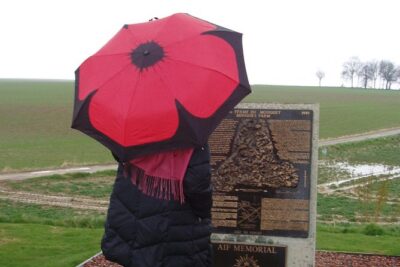
Somme Battlefields Small-Group Day Trip with John Monash Centre from Paris
Read our review →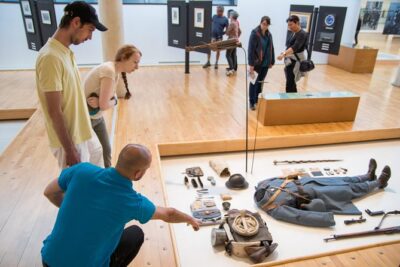
Somme Battlefields from Paris with Australian memorial & Amiens Cathedral
Read our review →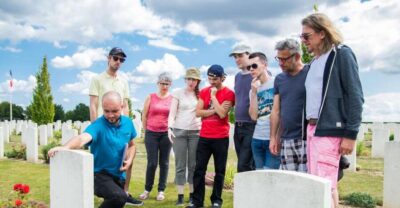
Browse the lists this tour appears in